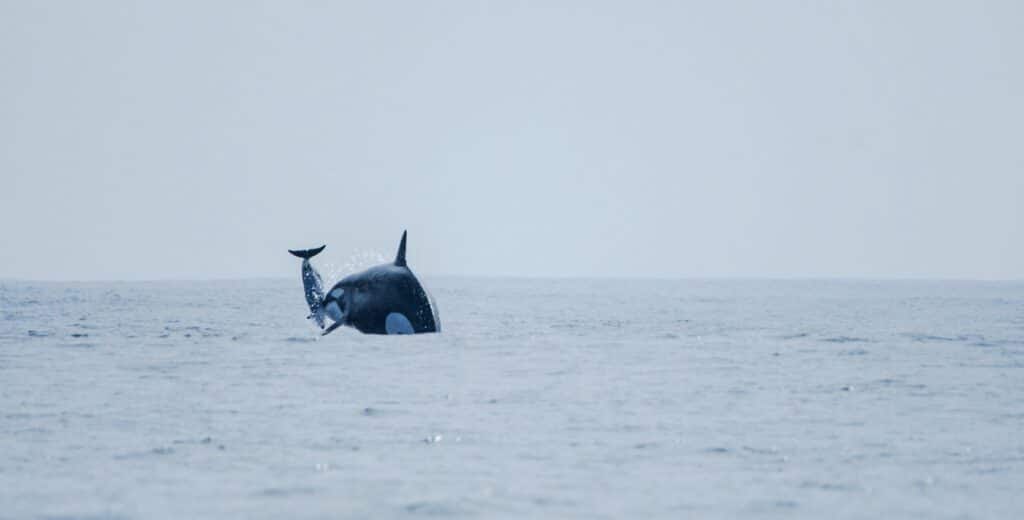
Off the coast of Chile, in waters teeming with krill and anchovy along the Humboldt Current system, lives a shy and little-known population of orcas.
Thanks to citizen science and years of dedicated monitoring, a team of scientists led by Ana García Cegarra from the University of Antofagasta is unraveling their secrets, starting with their dinner.
García Cegarra’s team, which had previously observed these orcas using fishing boats to help them capture sea lions, has now, for the first time, seen them successfully hunt bottlenose dolphins and share the food among the group.
This new evidence about their feeding habits could help scientists understand how southern hemisphere orca populations are linked, advancing conservation efforts.
“Studying the orcas in their natural environment is a major challenge, since they are top marine predators that travel long distances and live offshore, which makes observation difficult,” says García Cegarra, lead author of the study in Frontiers in Marine Science. “But understanding their role in the marine environment is crucial for the conservation of this little-known species in the Humboldt Current,” she adds.
We are what we eat
Orcas are apex predators with an impressively varied diet, but not all of them eat the same things. Populations can be assigned to different ecotypes based on their preferred foods, vocalizations, and genetics, so understanding what the Humboldt Current orcas eat is an important step toward understanding where they fit among the other orca populations around the world.
There are five different ecotypes recorded in the southern hemisphere: some, such as Type A and Type B1 orcas, focus on marine mammals, while other types prefer fish. Understanding where the Humboldt Current animals fit would help us understand how these populations relate to one another and conserve them for the future.
García Cegarra and her colleagues used a combination of their own surveys and citizen science data gathered during whale-watching trips and fishing boats to monitor the population and track their hunting choices.
Observers recorded the presence of orcas, the composition and location of groups, and took photographs and videos that the scientists could cross-check with catalogs of known individuals.
Combining these data with their own systematic surveys and drone imagery, the scientists built a map of the presence of orcas in the area and tracked the groups’ behavior and their prey choices.
This allowed researchers to capture evidence of bottlenose dolphins being hunted by the Menacho orca group — a species that no orca in the area had successfully hunted before. Dramatic footage shows the matriarch, Dakota, tossing a dusky dolphin into the air.
These sightings could indicate that these orcas may belong to ecotype Type A, which hunts mammals.
The prey and the small size of the calves would be consistent with this hypothesis, although the white eye patches are smaller than those typical of Type A orcas. They have also never been recorded in Patagonia with other Type A orcas.
“We would like to obtain skin biopsy samples to analyze their genetic data, since there is no genetic information for the orcas in this region of the southeastern Pacific,” says García Cegarra. “However, they are very elusive and intelligent, which makes it difficult to approach them on a boat to take biopsies,” she notes.
Sharing the spoils
The scientists’ observations of the bottlenose dolphin hunt also revealed that the Menacho group shared their food. Food sharing is documented in many orca populations, sometimes to help feed relatives, and other times because the group hunts cooperatively and everyone gets a share.
In this case, García Cegarra and colleagues suggest that the Menacho group was sharing the food with their relatives, similar to Type A orcas that hunt harbor seals by deliberate strandings: the female orcas were seen sharing the meat with group members, allowing the closest relatives to eat first.
García Cegarra stresses that much more information and systematic studies are needed to fully understand and protect this secretive population of orcas. “The fact that we have observed newborn calves is important because it indicates they are breeding, but we do not know their survival rate,” she says. “Thanks to citizen science, we can track the presence of orcas across thousands of kilometers of the Chilean north coast—but most orca sightings are opportunistic,” she concludes.