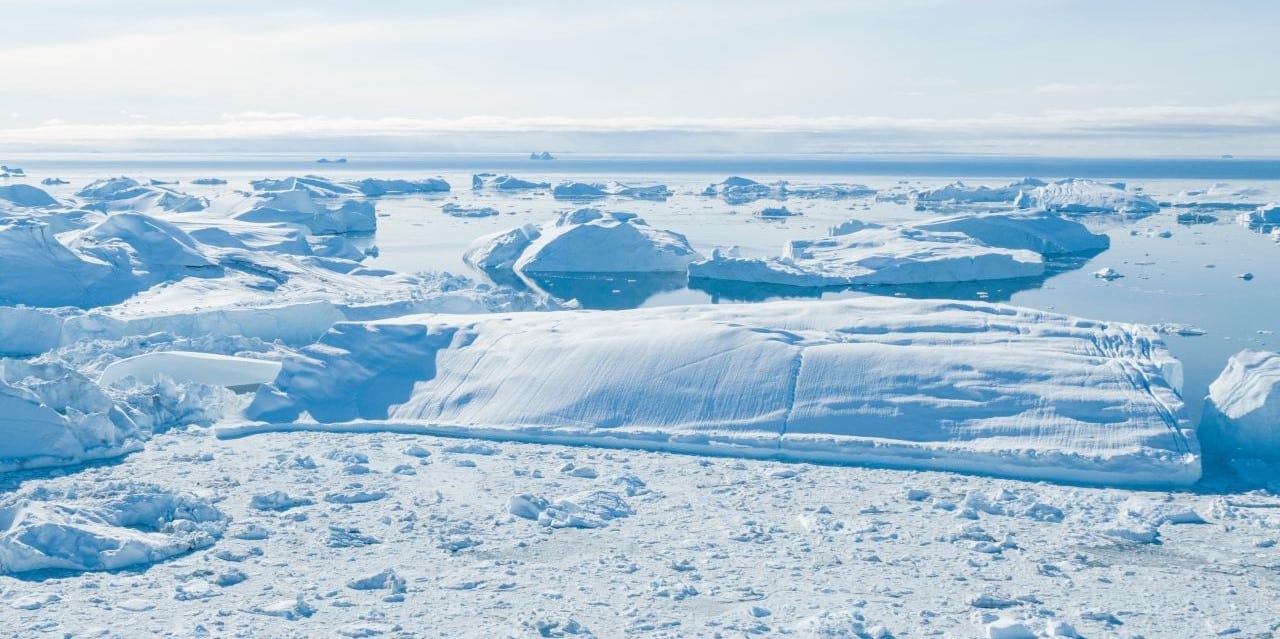
The force of gravity seems constant and predictable. However, it is not the same at all points on the planet. A new study reveals that its intensity is particularly low beneath the Antarctica — forming the strongest “gravitational hole” on Earth — and explains how this phenomenon developed over tens of millions of years.
The research, conducted by scientists from the University of Florida and the Paris Institute of Earth Physics, was published in the scientific journal Scientific Reports. The work reconstructs the evolution of this gravitational deficit and suggests that its intensification coincided with decisive changes in the Antarctic climate, including the onset of widespread glaciation.
An invisible phenomenon, but with real impact
Gravity variations result from density differences in rocks located at great depths. Although small in absolute terms, these differences have measurable effects, particularly in the oceans.
Where gravity is weaker, the sea surface tends to sit slightly lower relative to the Earth’s center, as water flows toward regions where gravitational attraction is stronger. In Antarctica, the mean sea level around it is lower than would be expected without this anomaly.
“If we can better understand how the interior of the Earth shapes gravity and sea levels, we will better understand factors that influence the growth and stability of the great ice sheets,” explains Alessandro Forte, Professor of Geophysics and co-author of the study.
A ‘CT scan’ of the Earth’s interior
To map the phenomenon, the researchers turned to global seismic records and advanced physical models that allowed them to reconstruct the three-dimensional structure of the Earth’s interior.
“Seismic waves work like light in a medical imaging exam. We don’t have X-rays to observe the Earth’s interior, but we have earthquakes, which illuminate what happens at depth,” explains Alessandro Forte.
Based on these data, the team was able to generate a global gravitational map that matches reference measurements obtained by specialized satellites.
A 70-million-year journey into the past
The next stage involved traveling back in time. Through computational simulations, the scientists reconstructed the slow movements of rocks in the Earth’s mantle up to about 70 million years ago, still in the time of the dinosaurs.
The results show that the “gravitational hole” began weaker. Between about 50 and 30 million years ago, however, it intensified—precisely during the period when profound changes occurred in the Antarctic climate, including the development of the vast ice sheets that today characterize the continent.
Climate and internal dynamics may be linked
The temporal coincidence raises a central question: could the evolution of the Earth’s interior have influenced the formation of the Antarctic ice masses?
The team now intends to test this hypothesis with new models that integrate gravity, sea-level variations, and changes in continental elevation.
The big question remains: to what extent is the planet’s climate tied to the processes occurring in its deepest layers?