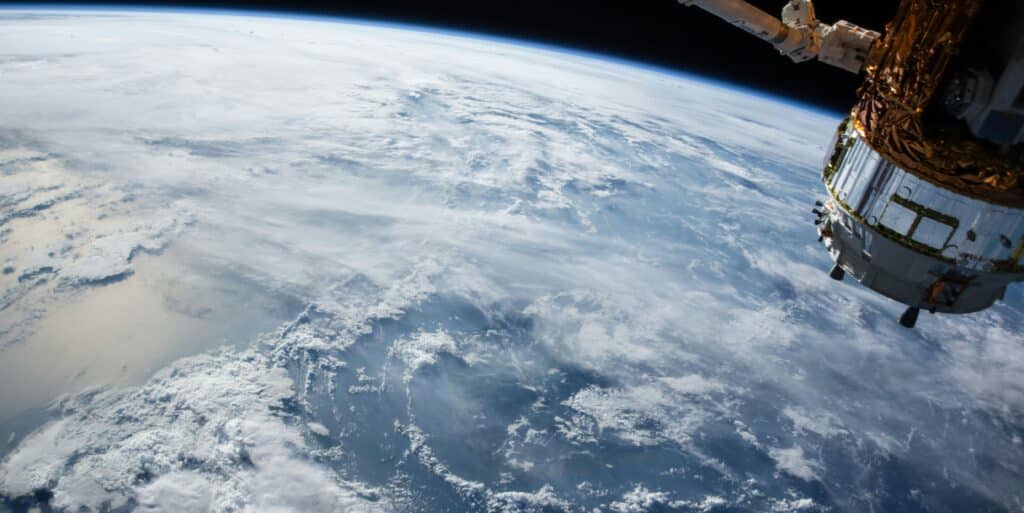
Data centers intended to feed artificial intelligence systems could, in the future, operate in orbit, using solar energy and networks of interconnected satellites. The proposal is being studied by researchers at Google, who believe that the reduction in launch costs could make this option economically viable by the middle of the next decade.
The idea involves placing in orbit several satellites equipped with processors for artificial intelligence, which would function together as a distributed data center. Communication between the satellites would be carried out via laser links, and energy would be obtained through solar panels.
One of the advantages pointed out is the possibility of exploiting the solar radiation available in space without the limitations associated with the atmosphere and the occupation of land on Earth. The researchers argue that this approach could also reduce water consumption associated with cooling data centers on Earth.
Economic viability, however, will depend on a significant reduction in the costs of placing equipment into orbit. The researchers estimate that, if these costs reach about 350 New Zealand dollars per kilogram, space data centers could become competitive by the mid-2030s.
The heat continues to be a problem
Although space offers abundant access to solar energy in certain orbits, it does not automatically solve one of the main problems of data centers: the heat produced by processors.
In space there is no atmosphere that allows cooling mechanisms based on convection or evaporation as on Earth. The heat will have to be dissipated through dedicated systems, such as heat pipes and radiators that release energy in the form of radiation.
Ulrich Speidel, a researcher at the School of Computer Science at the University of Auckland, notes that this need could require installing large radiator surfaces, increasing the mass of equipment that has to be launched.
Moreover, satellites in low Earth orbit spend part of their time on the night side of the planet, which means solar-powered systems require batteries and a significant area of panels to maintain operation during those periods.
More satellites, more risks
The multiplication of satellites in orbit also raises environmental and safety concerns. One of them is the increase in space debris and the risk of cascading collisions, known as the Kessler syndrome.
The growth in the number of satellites could also have consequences after the end of their useful life. Reentry of large quantities of equipment into the atmosphere could release aerosols and other materials, with possible effects on the atmosphere.
Researcher Tulasi Parashar, of Victoria University of Wellington, also points to the impacts of satellite constellations on astronomy. Reflection of sunlight and interference with radio frequencies can hinder astronomical observations, including activities such as asteroid detection.
Another challenge is communication with Earth. Even if satellites can process large amounts of information in orbit, part of the data will have to be sent to ground stations. For Ulrich Speidel, the limited capacity of the radio spectrum could become a major constraint.
The proposal arises in a context of rapid growth in demand for computational capacity for artificial intelligence, which is increasing the need for electricity and data center infrastructure. The use of solar-powered satellites could, in theory, reduce some of these pressures on the ground, but would first require solving a significant set of technological, economic, and environmental problems.