Regarded as one of the world’s rarest birds, the Mindoro bleeding-heart dove (Gallicolumba platenae) is an endemic species of Mindoro, an island in the Philippines, relatively common in the interior forests until the mid-20th century. Since then, scientifically verified records have become increasingly scarce until they eventually ceased to occur.
The last record confirmed by scientists dates from 2005. An individual had been caught in a trap aimed at other forest birds, and was later released back into the wild after having been photographed. A species already classified as “Critically Endangered” since 1994, concerns intensified that the Mindoro bleeding-heart dove might really have disappeared, even earning its entry on the List of Lost Birds.
A ground-dwelling columbid, which moves through the forest floor vegetation, and with a distinctive red patch on its chest, as if it were a bleeding wound (hence its common name “bleeding-heart”), many had prepared to abandon any expectation of ever seeing this bird in the wild. However, in August, the flame of hope was rekindled and now shines even brighter.
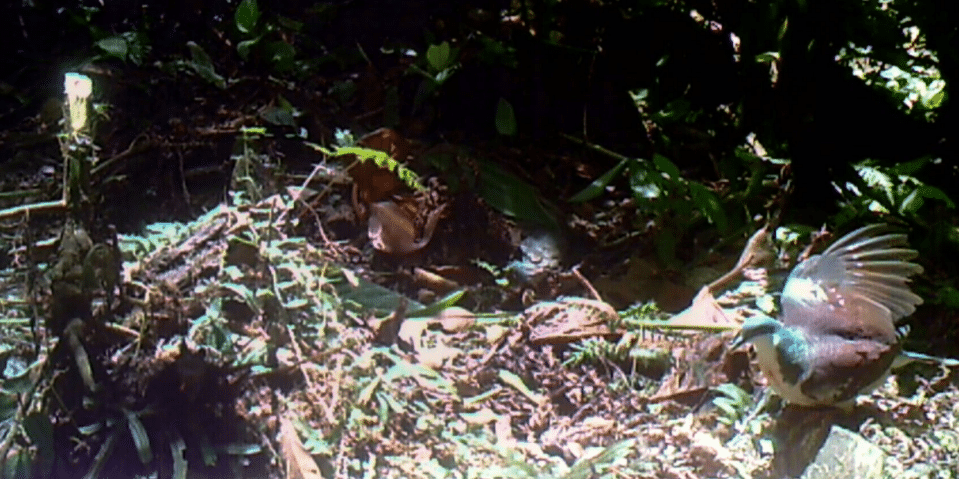
At the start of last month, camera traps placed by the Filipino organization Center for Conservation Innovations (CCIPH) in Mindoro’s forests captured images researchers had not expected: a Mindoro bleeding-heart dove passing in front of the cameras, calmly, ignoring the fact that many in the conservation community believed it to be lost forever. It was only after they collected the equipment that the researchers realized what they had captured.
“For an extremely rare and reclusive species, a single image can carry enormous weight,” CCIPH says in a statement. In other words, that the bird is still surviving, even in highly degraded habitats.
Researchers say that the fact that the dove has been captured again on film is not the only important aspect, but also the place where the image was obtained. The Mindoro bleeding-heart dove has always been described as a lowland species, typically found around 400 meters above sea level, and at the limit, up to 800 meters. The newly captured images were recorded above 900 meters, because the scientists, after years of studying the ecological conditions of the bird’s natural habitats and the changes they have undergone over the decades, predicted that the ideal sites for the species were above 900 meters. There they placed the camera traps and there they obtained the confirmation that the best habitats are now at higher elevations, where they re-encountered the dove.
While they acknowledge that a photo cannot scientifically confirm a shift in the species’ distribution, experts understand that it suggests that at least some of the Mindoro bleeding-heart doves survivors now live in forest refuges in Mindoro’s highlands.
The expansion of agriculture, settlements, mining, timber extraction, and roads has destroyed and fragmented much of Mindoro’s lowland forests. Therefore, CCIPH researchers say that a single photographic record of a single dove is not necessarily a sign of hope. What it means is that the species persisted longer than previously thought. Therefore, they warn that, now that it is confirmed the species has not yet disappeared entirely, there is an urgent need to invest in protecting and restoring its habitats to prevent that from happening. In allusion to the patch on the dove’s chest, the organization says that “that heart still beats.”
Whether it will continue to beat for another 20 or 100 years, CCIPH cautions, will depend on how we view this unexpected image: merely as an extraordinarily remarkable record, or as something that will significantly alter the species’ future course.