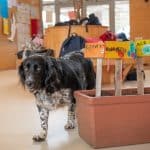
Urtigão the donkey is not yet a year old, but he has already traveled from the Azores to Porto to take the lead role in the 16th edition of the Festa do Outono, on the 26th and 27th of this month, at the Serralves Foundation.
He came from Graciosa Island in the Azores, and is the new four-legged resident of the Serralves Foundation Park in Porto, where he arrived to join the other native breeds.
Small, young, and described as “very friendly,” the donkey from Graciosa has been at Serralves for a short time, but has already won over the educational community.
In the press conference presenting the Festa do Outono, Mariana Roldão, Deputy Director of the Serralves Park, underscored that the animal’s presence goes far beyond the novelty of having a new resident in the park.
“It is a way of giving him visibility, of showing the importance they have in a very unique ecosystem,” explains the official, referring to the native breeds and the need to preserve threatened species.
Urtigão is part of the breed that will be featured in the 16th Festa do Outono, an initiative that aims to bring visitors closer to biodiversity and draw attention to species that, many times, go unnoticed.
The new inhabitant arrived to join a small animal community that Serralves has been building and preserving.
There are currently 12 individuals of different native breeds, including birds, cows and bordaleira sheep from Entre Douro and Minho.
Urtigão has a trait that quickly made him special: “the ability to establish relationships with those who visit him.”
“He is a very empathetic living being,” describes Mariana Roldão, who highlights the “affable” way the donkey from Graciosa relates to the educational community.
For the official, it is precisely this closeness that can transform Urtigão into a starting point to speak about conservation.
Looking at Urtigão, she noted, visitors can discover not only a donkey, but also a breed, a origin, and the need to protect endangered species.
“It also draws us to learn some values that we tend to forget, of caring, of protecting,” she says.
The name, Urtigão, came with the animal and ended up winning over the Serralves team.
A few months away from turning one year old, the Azorean donkey will now have a new role: to be a kind of ambassador for native breeds during the Festa do Outono.
The plan is to create an emotional bond between visitors and biodiversity: “If they tell me that one day they will come back to see Urtigão again, I will be happy and I think our objective will be achieved,” stated Mariana Roldão.
And so, Urtigão, although not yet one year old, already has a clearly defined mission: to win over visitors and help them discover that among trees, gardens and works of art, there are also species that need to be known so as not to disappear.
The 16th Festa do Outono, on the 26th and 27th of September, in Serralves, Porto, will bring the Graciosa Donkey together with performances, music, cinema, educational activities, workshops and a market, in a free program that aims to bring families closer to nature and raise awareness for biodiversity preservation.