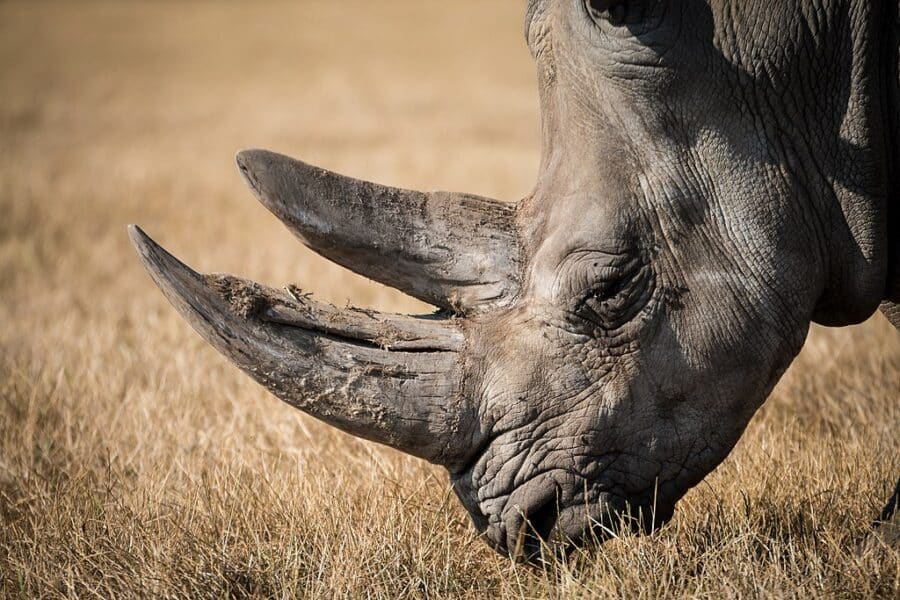
The Zinave National Park has become the first in Mozambique to host viable populations of white rhinoceroses and black rhinoceroses, 40 years after their disappearance, a milestone pointed out by conservation authorities as a sign of the fauna’s recovery.
According to information from the organization Peace Parks Foundation, which has supported Mozambique’s National Administration of Conservation Areas (ANAC) in this process, the two species “are already reproducing in the park,” located in Inhambane Province, in the south of the country, “after decades of rhinos being absent from Mozambican territory.”
Zinave currently hosts 39 white rhinoceroses and 22 black rhinoceroses, the latter considered critically endangered, notes Peace Parks Foundation, recalling that nine female white rhinoceroses were translocated this week to that park, from South Africa.
“Together, they form the first viable founding populations of both species established in a Mozambican national park, with both species already breeding and giving birth after the introduction,” it adds.
This development is presented as the culmination of a decade of ecological restoration work and strengthened protection of the conserved area, previously affected by war and poaching in Mozambique.
“At about ten years ago, Zinave was known as a silent park, due to the drastic reduction of wildlife caused by years of armed conflict,” the nature conservation foundation recalls.
The ongoing project also included the creation of a “high-security sanctuary for rhinos,” the strengthening of the operational capacity of rangers, surveillance systems, and anti-poaching measures in the park.
“Today, Zinave is Mozambique’s first conservation area with the ‘Big Five’ [lion, buffalo, leopard, elephant and rhinoceros] and one of the most significant stories of ecosystem recovery in Africa,” underlines Peace Parks Foundation in the note, which states that since 2015, 2,431 animals of 16 different species have been reintroduced locally, “allowing the ecological balance to be restored and creating conditions for the return of the rhinoceroses.”
The entities involved argue that the park’s recovery demonstrates the results of prolonged cooperation among the Government, conservation organizations, the private sector, and local communities.
“This is much more than simply relocating animals. It is about restoring the space so that life can return and rebuilding one of Africa’s emerging conservation landscapes,” the foundation emphasizes.
The Zinave National Park is part of the Great Limpopo Transfrontier Conservation Area, linking Mozambique, South Africa and Zimbabwe, and is the only one in Mozambique that has the “Big Five.” There you can also find, among other animals, crocodiles, giraffes, warthogs, bushbucks, hippos, impalas, cudus, elands, oribis, chacos, pivas, wild cattle and zebras.
The park also contains more than 200 tree species and 200 grass species, and covers 408,000 hectares, having been redeveloped after Mozambique’s civil war, which lasted 16 years.
Mozambique has 12 national parks and protected areas, and is home to 5,500 species of flora and 4,271 species of terrestrial wildlife.