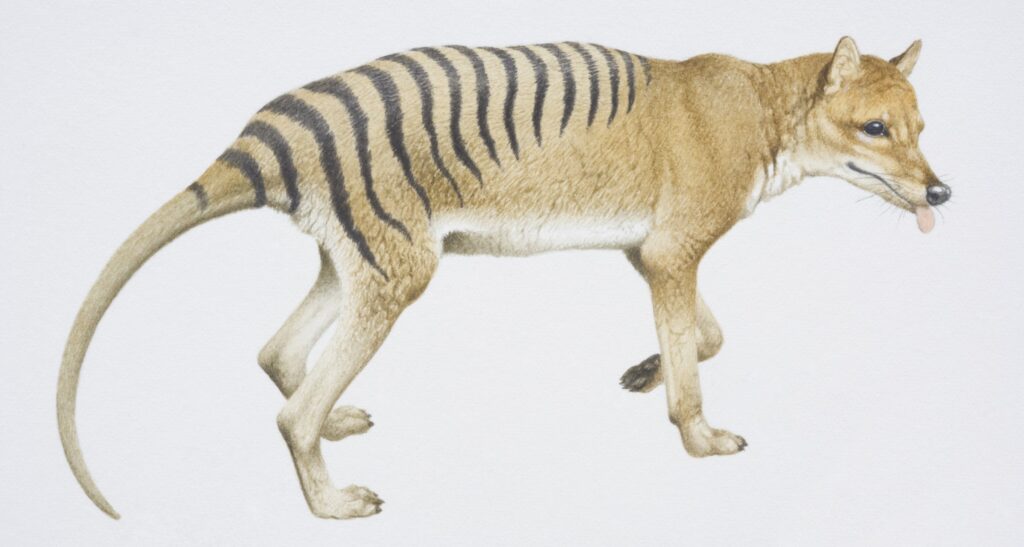
The Tasmanian wolf, or thylacine, employed a hunting strategy more similar to that of a fox, jackal, or coyote than to that of a tiger or wolf, according to an international study led by the University of the Sunshine Coast in Australia.
The investigation, published in the scientific journal BMC Ecology and Evolution, analyzed the biomechanics of 48 predator mammal species, including both extant species and others that are extinct. Among the animals studied was the Tasmanian wolf (Thylacinus cynocephalus), a carnivorous marsupial that bore the appearance of a dog with a striped coat and fed on animals such as wallabies, opossums, and rodents. The species became globally extinct in the 1930s, in Tasmania.
“We used archival images and modern biomechanical analyses to analyze how posture, movement and locomotion influenced the hunting styles of the animals,” explains Christofer Clemente, associate professor at the University of the Sunshine Coast.
The team grouped the animals into five groups, ranging from predators that pursue prey in groups to species that seize them or attack suddenly.
“It was fascinating to discover that the Tasmanian wolf was more likely an opportunistic, surprise-attack predator, similar to a fox, jackal or coyote, rather than a predator that gripped its prey, like a tiger or a wolf,” adds the researcher.
To reach these conclusions, the researchers used a methodology that allowed them to track the movements of the animals over time and space.
“What made this technique so powerful was the fact that we could track the movement of animals in four dimensions, across space and time,” explains Joshua Gaschk, the researcher and lead author of the study.
According to the researcher, the approach allowed a detailed analysis of the movements of different body parts during locomotion.
“We were able to follow how the forelimbs, hind limbs, the spine, and the head of an individual change shape and posture during natural locomotion,” states the researchers.
The researchers then used these data to compare carnivorous species from different regions of the world and to understand whether locomotion patterns were related to hunting strategies.
The results showed that hunting ecology was reflected in the way predators moved, especially during faster and more demanding movements associated with acceleration, maneuvers and prey capture.
“The study showed that hunting ecology was reflected in how predators moved, particularly during the faster and higher-performance movements associated with acceleration, maneuvers and prey capture,” says Clemente.
Slower gait patterns were more related to the animals’ evolutionary history, though they also retained information about hunting behavior.
In the case of the Tasmanian wolf, the observed movements were consistently associated with opportunistic fast-attack predators, which use brief bursts of movement to seize capture opportunities — rather than with predators highly specialized in pursuit or those that grab their prey,” concludes Clemente.
“The movement of the Tasmanian wolf during walking was more consistently associated with opportunistic surprise-attacking predators — predators that use brief bursts of movement and take advantage of available prey — than with predators highly specialized in pursuit or those that grab their prey,” concludes Clemente.
For the researchers, the methodology used to reconstruct the behavior of extinct species could also have applications in conservation.
The study was conducted by researchers from the University of the Sunshine Coast, Yale University, and the University of Tasmania, and published in the scientific journal BMC Ecology and Evolution.