On the first day of October 2024, the police were called to the locality of El Zabal, in the city of La Línea de la Concepción, in southern Spain. They were responding to a complaint that a person had been bitten by a monkey.
Upon arrival, the Civil Guard’s Nature Protection Service (SEPRONA) collected the animal. It was a cotton-top tamarin (Oedipomidas Oedipus), wandering alone through the streets.
A week later, the small primate was collected by the European animal rescue organization AAP and taken to its Spanish rehabilitation center. There, experts confirmed that she was a young female, about one to two years old, and they named her Tam.
She was extremely thin. On a scale from one to nine, with five being optimal, Tam’s body condition was level three.
The health status was also reflected in her coat, dull and in poor condition, signs indicative of poor nutrition and that the animal was not receiving proper care. In addition, AAP teams noticed that Tam had deformities in the bones of her arms, which veterinarians attributed to metabolic bone disease caused by vitamin D deficiency (associated with an inadequate diet) and a lack of exposure to sunlight.
AAP explains to the ‘Green Savers’ that Tam, upon arrival at the Spanish recovery center, showed signs of anxiety and some fear, but also curiosity about the new space and about what was happening around her. As protocol, Tam remained in quarantine for 12 weeks, during which she received the necessary treatments, including for a bacterial infection that was detected, and a tamarin-specific diet to help her gain weight and improve her overall physical condition.
Tam stayed more than a year at the Spanish facilities of AAP before traveling to Portugal to join another tamarin, Belo, and begin a new chapter of her life.
A rare species
Tam belongs to a species classified as “critically endangered” on the International Union for Conservation of Nature (IUCN) Red List. The cotton-top tamarins are native to Colombia, found only in the forests of the northwest of that Latin American country. It is estimated that there are no more than six thousand of these animals in the wild, making them among the most endangered primates in the world.
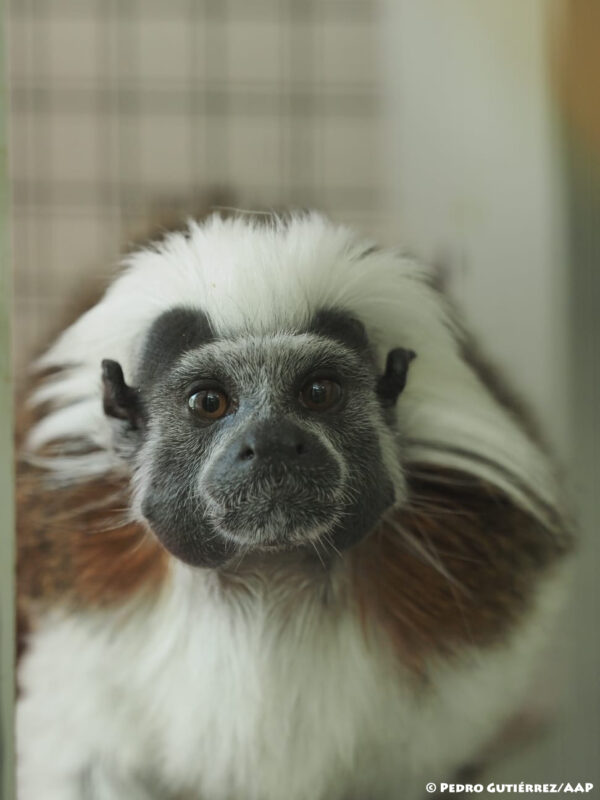
Among the main threats are the ongoing and intense destruction of the forests where this monkey lives and the capture for the exotic pet market.
According to the latest information, it was not possible to determine Tam’s origin, so her story before being found wandering alone through the streets of La Línea de la Concepción remains a mystery, probably with tragic undertones. However, all indications suggest that Tam was yet another victim of illegal trade for the exotic pet market.
Belo returns to have company
Another character in this story is Belo, a male golden-handed tamarin (Saguinus midas). Belo was rescued in November 2018 in Belgium, when he was about six months old. He had been confiscated by Belgian authorities along with two others: Manani, a common tamarin (Callithrix jacchus), and Goiani, a white-faced tamarin (Callithrix geoffroyi).
According to information shared by AAP with the ‘Green Savers,’ the animals were seized from a person who had bought them in Poland, and who was not aware that their possession was illegal in Belgium. The three tamarins were very young, still dependent on milk, and were kept in a hamster cage as pets.
After confiscation, the three were taken to AAP facilities in Almere, Netherlands, headquarters of the organization and also its rescue center in that country. All weighed below the ideal for their species and age. In addition, Belo had difficulty moving and his limbs seemed stiff.
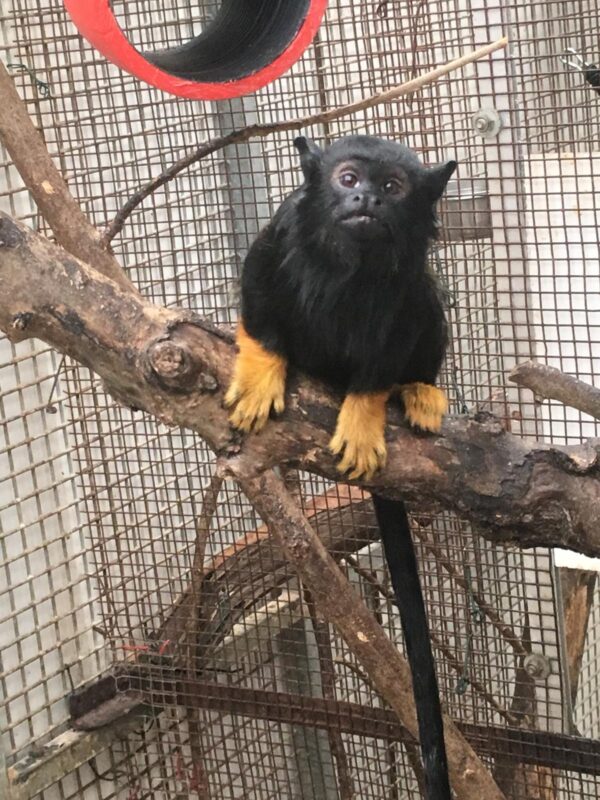
Tests revealed that the three tamarins battled bacterial infections and showed vitamin D deficiency.
After a month of care, Belo regained his mobility and became more active, and, at the end of the 12-week quarantine, all the primates had reached ideal weight.
Around a year after the rescue, Belo and Goiani were transferred to Krazy World, a zoo in Algoz, in the Algarve municipality of Silves.
Recently, Goiani died, leaving Belo alone, so AAP and Krazy World decided to bring Tam to keep Belo company, and the two now live together in Portugal, each with their own traumatic history, but, according to those who work with them most closely, with great resilience and a will to live.
Golden-handed tamarins are native to Brazil and the Guyanas, and are classified as “least concern” on the IUCN Red List.
A new beginning in Portugal
After troubled and tragic starts in life, Tam and Belo are now taking the first steps in a new stage of their lives.
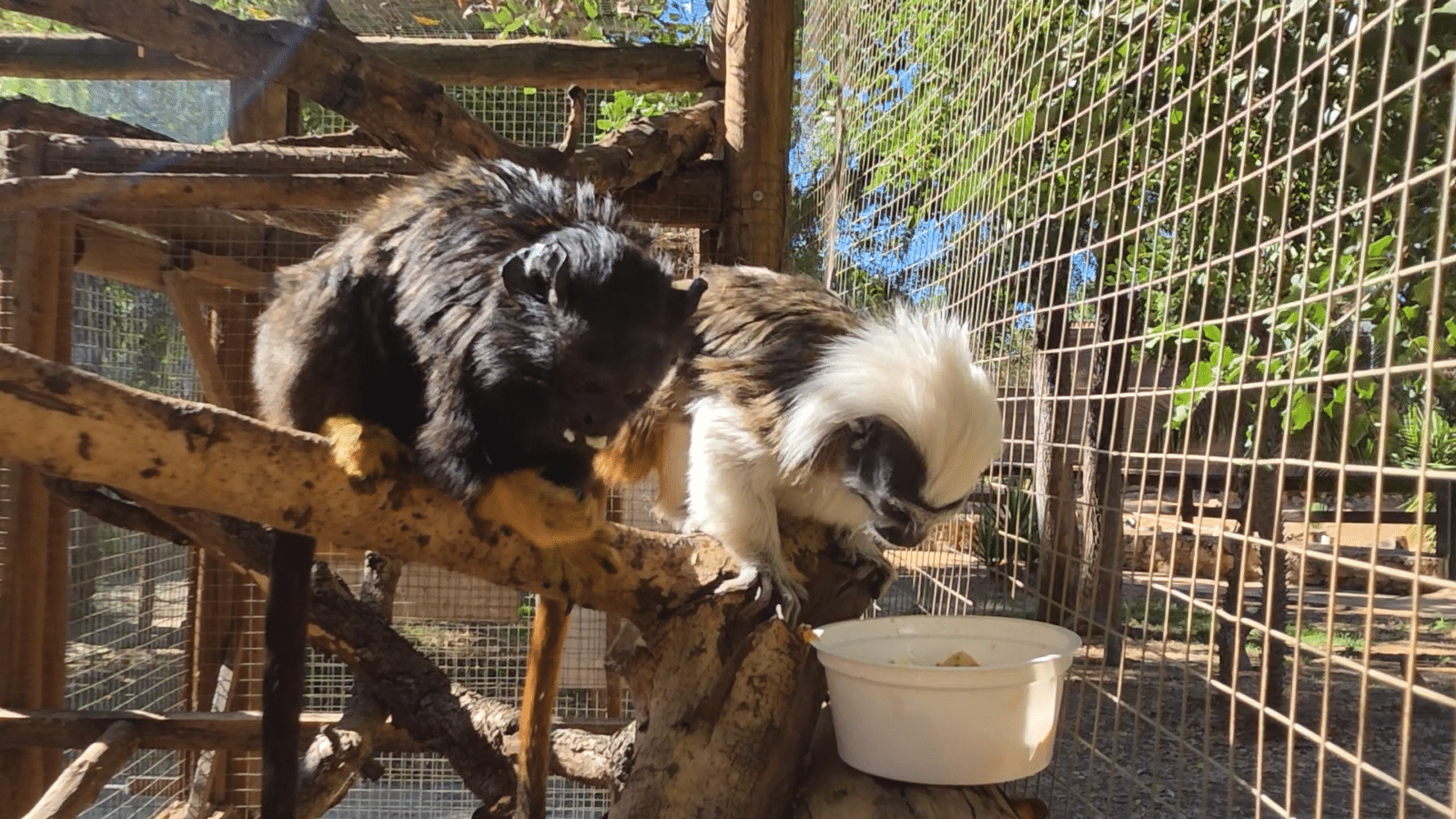
Tam arrived at Krazy World this summer, where she was integrated into the same enclosure where Belo resided. Although they are of different species, they are highly social animals that have evolved to live in groups, so the institutions and their specialists prioritized providing them with the companionship they so need.
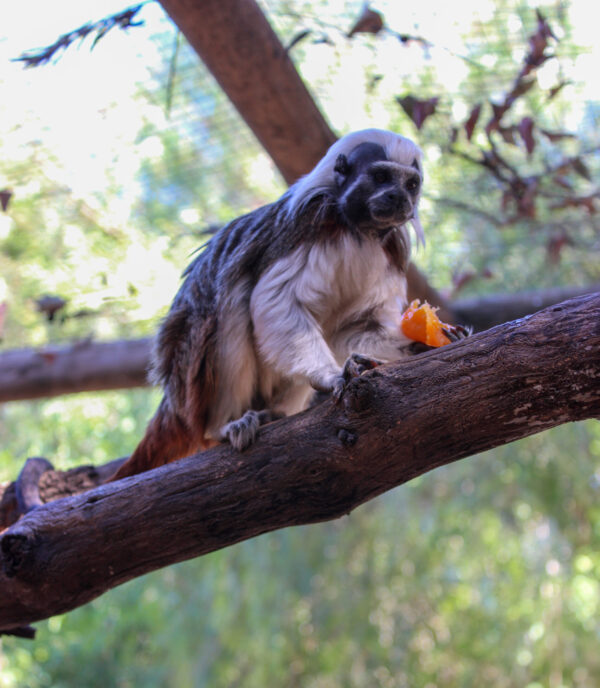
According to AAP, before Tam’s transfer to Portugal, the technical teams showed the cotton-top tamarin videos of golden-handed tamarins to the female to help her get accustomed to the vocalizations of what would become her new companion. This technique aimed to facilitate the integration of the two primates into the new Portuguese facilities.
AAP explains that the choice of Krazy World to receive these primates was due to it being a zoo essentially oriented toward the reception of rescued animals.
“Many zoos are not yet prepared to receive rescued animals, since, even after recovery, they arrive with several traumas, which can hinder their care,” explains a source from AAP.
The majority of the animals under Krazy World’s care came from seizures or rescue centers.
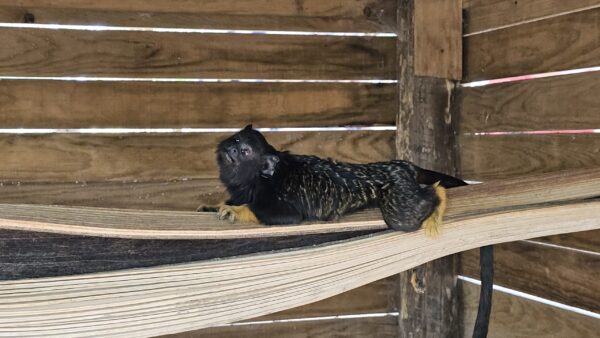
According to Tiago Nabiço, head of the animal area at the zoo, the integration of Tam, after a 30-day quarantine, with Belo was “successful,” allowing the formation of what he describes as a “stable social group.”
“This coexistence provides them with natural social interactions considered essential for their physical and behavioral balance,” explains the official, which made it possible for the two tamarins to move past a period of isolation and resume lives, though very different, as close as possible to what they would have in the wild.
For Tiago Nabiço, this is “a second chance at life” and an example of recovery of animals victims of trafficking, irresponsible ownership of exotic animals, or abandonment.
Tam and Belo now share the same enclosure at Krazy World zoo in the Algarve, where they keep each other company, as socialization is an important dimension of tamarin life. Source: Krazy World.
Tam received a contraceptive implant, because although she and Belo belong to different species, their genetic and evolutionary proximity does not entirely exclude the remote possibility of reproduction. But the head of the animal area at Krazy World assures that “in this case, reproduction is not at all the goal,” but, rather, to allow both tamarins to simply live their lives in peace.
The scourge of trafficking
Illegal trade, especially for the exotic pet market, is considered one of the major threats to numerous species around the world, and primates are among the groups most strongly affected.
Europe is considered one of the most important regions in the global wildlife trade, as a destination, transit point, or origin. For AAP, “European law does not adequately protect wild animal species from legal or illegal trade.”
And this is largely due to what the organization describes as “a heterogeneous set of regulations” that, although covering certain dimensions of the trade, suffer from fragmentation and consequent inefficiency. Therefore, AAP advocates the existence of a “single, comprehensive regulatory framework” common to all member states and the creation of a Positive List for the entire European Union.
This list, explains the organization, should clearly define which animals may be kept as pets, excluding, by default, all others not listed. “This list should be based on verifiable scientific criteria with the welfare of the animals at the center of decision-making processes,” declares AAP.
The internet and online social networks have amplified wildlife trafficking and made efforts to combat it much more complicated. Therefore, the demand side, as well as the supply side, is a crucial dimension of the problem and should, therefore, be the target of measures, such as targeted demand-reduction strategies.
“It is not right at all to have a wild animal as a pet, and we need this to become the dominant narrative in our communities,” emphasizes AAP.
Tiago Nabiço highlights the role that zoological institutions, such as Krazy World, can play in the fight against wildlife trafficking, notably in raising public awareness of the risks of illegal or irresponsible possession of exotic species, as well as in the reception, recovery, rehabilitation, and integration of rescued animals.
“Tamarins are not companion animals and their social, nutritional, and behavioral needs are extremely specific, and are hardly satisfied in a domestic environment,” warns the official.
“When they can no longer be kept by their owners, they can end up abandoned or seized by authorities and require specialized centers,” he says, highlighting that “the Tam and Belo case is presented precisely as an example of the importance of cooperation between specialized institutions.”