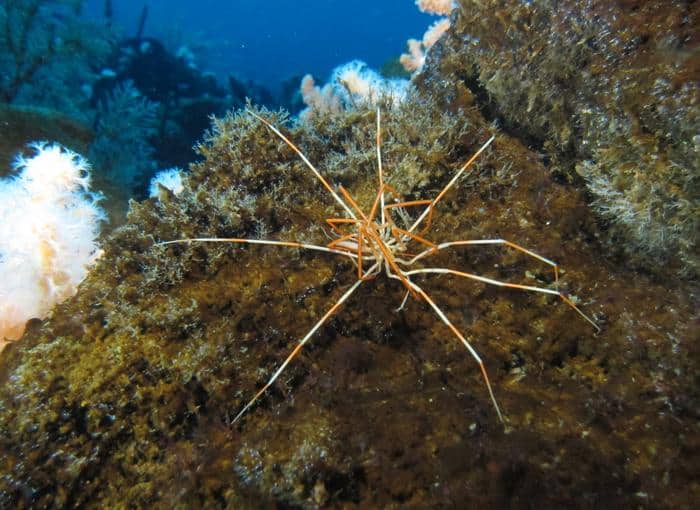
Sea spiders are crustaceans that, as the name suggests, resemble spiders, with long legs extending from their segmented bodies, and they inhabit marine waters around the world.
However, little was known about how these animals reproduce and care for their offspring, until a trio of researchers from the University of Hawaii at Mānoa decided to embark on an expedition to Antarctica to study the life cycle of a giant sea spider, Colossendeis megalonyx.
Photo: S. Rupp
Although most sea spiders, also known as pycnogonids, measure no more than the width of a fingernail, the legs of this Antarctic species can reach more than 30 centimeters in length, something scientists call a striking example of what is known as ‘polar gigantism’, a scientific principle arguing that in polar regions animals tend to be larger than their relatives in warmer areas.
Even though it is known that in the world of sea spiders the males are the ones who care for the offspring, carrying them on their backs, literally from one side to the other as they develop, little is known about how C. megalonyx cares for its young, despite the species having been described in 1881.
The mystery began to be unraveled when, in October 2021, Amy Moran and two PhD students, Aaron Toh and Graham Lobert, dove under the ice in Antarctica and came upon a group of sea spiders that appeared to be mating. They collected some specimens and placed them in observation tanks, and the results, published in the journal Ecology, reveal a facet of the life of these marine invertebrates that was hitherto unknown.

Photo: R. Robbins
Although the males of C. megalonyx care for their offspring, they do so in a simpler manner than the males of other sea spider species, and this may help illuminate, according to Moran, the evolution of behaviors that give rise to male parental care that is much more intimate and continuous.
A few weeks after the male left the eggs on the rocks, the researchers noticed that they had become virtually invisible, hidden by a layer of algae, probably a protective measure against predators.
“We could barely see the eggs even though we knew they were there,” says Lobert in a statement. “It’s probably why researchers have never seen this before.”