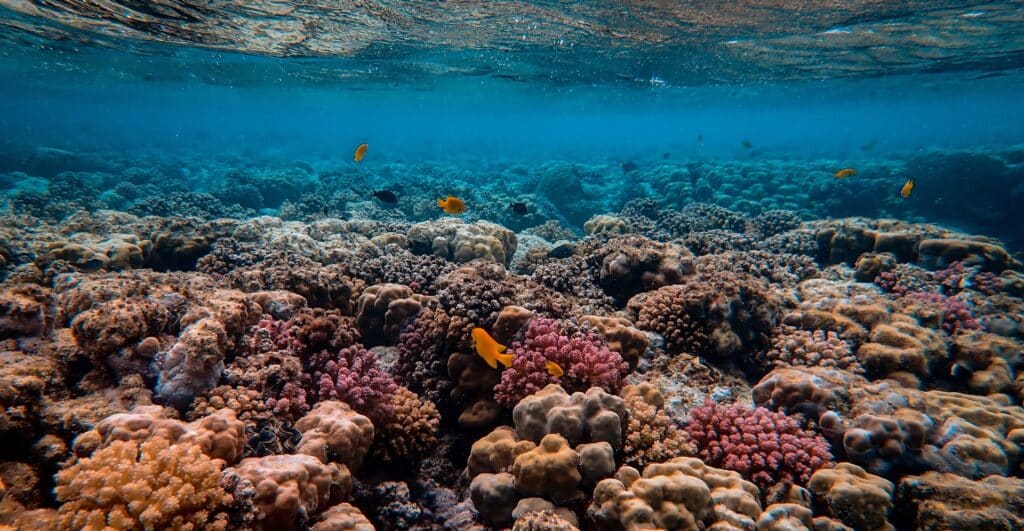
Traditional sunscreens, the so-called ‘traditional’ ones, can negatively affect marine life because of the chemicals they contain to block ultraviolet radiation. These components, such as oxybenzone and octinoxate, are released from the skin of bathers when in contact with water and enter ecosystems, with the potential to cause serious damage.
Earlier studies have already shown that these chemicals affect coral development and lead to bleaching, leaving them vulnerable to potentially fatal infections. In 2022, in an article published in Science, it revealed that contact with oxybenzone causes the cells of corals, and also those of anemones, to produce toxins that weaken and ultimately kill these animals.
This finding led to the ban on sunscreens containing oxybenzone in some tourist locations, such as marine parks in Mexico. So, what is the alternative for bathers to protect their health and the ecosystems where they enjoy their summer holidays? The answer may lie in pollen.
A group of scientists led by Nanyang Technological University in Singapore says they have created a pollen-based sunscreen made from camellia flower pollen that absorbs and blocks ultraviolet radiation as effectively as products currently available on commercial shelves.
In laboratory experiments, the researchers found that conventional sunscreens caused coral bleaching in as little as two days, and death in six. By contrast, the pollen-based sunscreen did not affect the corals, which remained alive and healthy.
Moreover, the team states, in an article published in the journal Advanced Functional Materials, that the sunscreen they created even helps to reduce the surface temperature of the skin.
According to Nam-Joon Cho, the study’s first author, pollen grains are ‘naturally resistant’ to ultraviolet radiation, since their outer exine capsule must protect the genetic content inside from adverse environmental conditions, including sunlight, ensuring that the grain remains intact.
‘We wanted to develop a natural, affordable, and effective sunscreen that would not cause allergies in humans and would be friendly to the environment,’ he notes.
According to its creators, this sunscreen takes the form of a gel that, when applied, is thinner than a human hair and is transparent, and that could be a major aid in the conservation efforts of marine ecosystems, to which every year thousands of tons of conventional sunscreen reach, harming not only the corals but the entire life network that forms around them.