

In 2025, the most repaired smartphone in iServices stores, across the five European markets where the company operates, was the iPhone 11. It was released in September 2019. It was followed by the iPhone X, from 2017. More than half of iPhone repairs concerned models from 2019 or earlier.
That data takes on another reading when cross-referenced with the environmental information published by Apple for that model. The iPhone 11 product report estimates a life-cycle carbon footprint of about 72 kg of CO₂ equivalent (64 GB version), of which 79% corresponds to production. To estimate the use phase, the company assumes three years of use by the first owner. An iPhone 11 repaired in 2025 would have already been in use for at least six years.
It is not a measurement of iServices’ own footprint, nor of any specific device. It is something else, perhaps more interesting: the gap between the lifespan assumed in the calculations and the lifespan that many consumers actually attribute to their devices.
The footprint that has already been paid for
A smartphone begins to weigh on the environment long before its first call. Extraction of raw materials, manufacturing of chips, screens and electronic boards, transport across continents. According to the European Environmental Bureau (EEB), production, distribution and end-of-life account for about 72% of a smartphone’s climate impact; charging and use account for the rest.
What is this footprint worth in kilograms of CO₂? It depends on who measures and how. A review of studies cited by the European Environment Agency (Manhart et al., 2016) found values between 16 and 110 kg of CO₂ equivalent per device, depending on the model and assumptions. The range is not a flaw of science: it is an honest portrait of products, supply chains, and very different methodologies.
What the studies have in common is the conclusion. If most of the impact happens in the factory, each additional year of use dilutes that environmental investment. And the average replacement cycle is short: less than two years, according to an analysis by the European Commission’s Joint Research Centre published in the Journal of Cleaner Production (Cordella et al., 2021).
What is the value of one more year?
There are Europe-wide estimates that help to give a sense of scale.
The EEB calculated that extending the life of all smartphones in the European Union by just one year would save about 2.1 million tonnes of CO₂ per year until 2030, equivalent to removing more than a million cars from the road.
The European Commission estimates that the premature disposal of goods that could still be repaired generates, every year in the EU, 261 million tonnes of CO₂ equivalent, consumes 30 million tonnes of resources and produces 35 million tonnes of waste.
A Fraunhofer UMSICHT study, published in 2025, concluded that reusing a smartphone can reduce about 37% of greenhouse gas emissions compared with a single lifecycle scenario.
They are numbers from different years, scopes, and methodologies. They do not add up, nor are they transferable to a particular repair. But they all point in the same direction.
The less comfortable side: not every repair saves
It would be easy to stop here. But the circular economy also has a fine print, and it is worth reading.
Repairing and refurbishing have their own impacts: parts, transport, energy, packaging. And the environmental benefit only exists if the repair truly replaces the purchase of a new device. A study published in Frontiers in Energy Research (Makov and Font Vivanco, 2018) analyzed the so-called rebound effect in smartphone reuse: the money saved often ends up spent on other goods and services, which also have a footprint. On average, about 29% of the expected environmental benefits are lost this way, ranging from 27% to 46% depending on the model. In some scenarios, the effect even fully offsets the gain.
That is why this article does not attribute a fixed number of emissions or water savings to each repair. Without a verifiable life cycle analysis, that number would be more marketing than science. Since September 27, 2026, European rules against generic environmental claims apply across the EU. More than an obligation, they are a good filter.
Why mobile phones reach stores
In most cases, it is not because they are obsolete. In the Joint Research Centre analysis, the battery emerged as the most reported problem by consumers (42%, in a survey by the Spanish consumer organization OCU), and screen damage as the most frequent cause of repair requests. About three-quarters of screen damage resulted from drops onto corners or edges. The authors conclude that repair can pay off even three to five years after purchase.
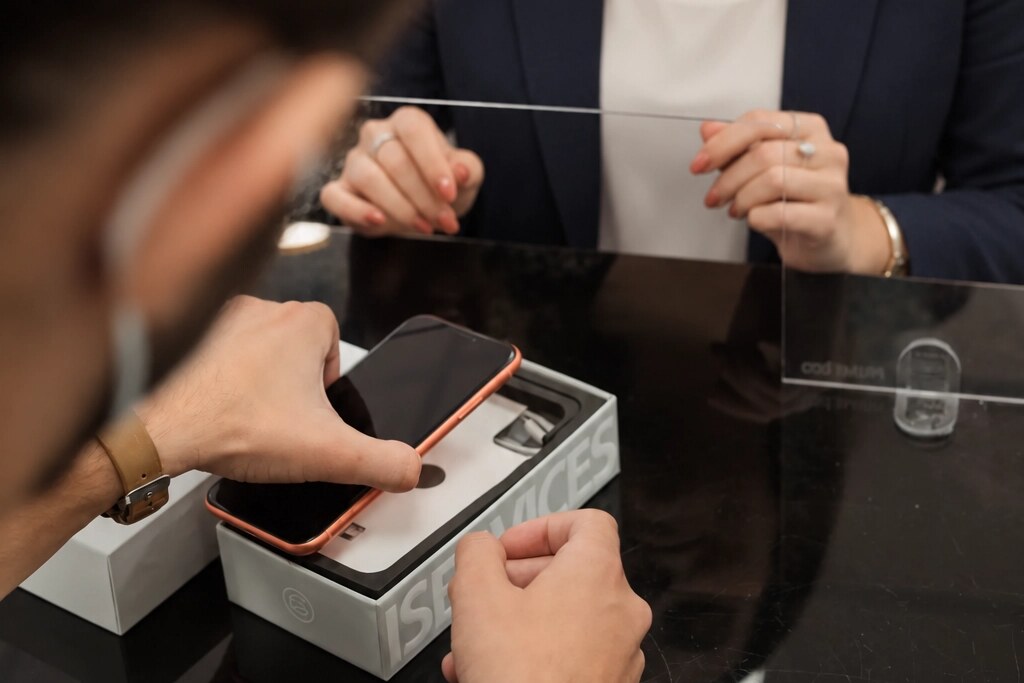
It is also what you see at the counter. Nine out of ten repairs carried out by iServices in 2025 were for smartphones, and Samsung accounted for about 25% of the interventions, ahead of the other Android brands. In the same year, the company performed more than 215,000 technical services and processed about 150,000 refurbished devices, including smartphones, computers, tablets and other devices.
Consumers rarely explain repair with environmental arguments. They explain it with arithmetic: when the cost of repair is proportional to the value of the device, continuing to use it makes sense. Sustainability here is a consequence of a sound economic decision, not the other way around.
Recycling remains indispensable. And it is far from enough
None of this exempts recycling. According to the Global E-Waste Monitor 2024 (ITU and UNITAR), the world generated 62 million tonnes of electronic waste in 2022 and only 22.3% had documented collection and recycling. Generation is rising five times faster than documented recycling; by 2030 it could reach 82 million tonnes, with the documented rate falling to 20%. E-waste recycling covers today at most 1% of the demand for rare earths.
Europe collects more than the global average, but remains far from the target. Each European generates 17.6 kg of electronic waste per year, of which 7.5 kg has documented collection and recycling (Global E-waste Monitor 2024). According to Eurostat, in 2023 the EU collected 11.6 kg per inhabitant, a collection rate of 37.5%, when the European target is 65%.
In short: better recycling is urgent. But recycling later, after a device has completed its entire useful life, is even better.
Fast Tech: the problem that fits in a drawer
In 2026, the WEEE Forum dedicates International E-Waste Day, celebrated tomorrow, October 14, to the so-called Fast Tech: earbuds, cables, USB adapters, LED lights, small fans, disposable vapes. Cheap, impulse-purchased products that are replaced without thinking. In the United Kingdom alone, a Material Focus study (2023) estimated that more than 500 million of these small devices were purchased in one year, about 16 per second.
The problem is not only the volume. Many contain lithium batteries that, discarded with regular trash, cause fires: 36% of waste-treatment operators surveyed by the WEEE Forum reported a battery-related fire in the last year, and in France these fires doubled between 2019 and 2023.
Two simple choices help. First, before buying another cable or charger, check if there isn’t already one in the drawer; since December 28, 2024, new mobile phones sold in the EU are required to use USB-C, which makes chargers far more interchangeable. Second, when a small device stops working, drop it off at an electrical and electronic waste collection point, never in mixed municipal waste.
The rules are also changing
Since June 20, 2025, smartphones and tablets placed on the EU market must meet new eco-design requirements: batteries that maintain at least 80% capacity after 800 charge cycles, availability of replacement parts for seven years after the model’s end of sale, and a reparability rating visible on the energy label. The European Union’s Right to Repair Directive (EU) 2024/1799 goes further and strengthens consumers’ rights against manufacturers; the deadline for Member States to transpose it was July 31, 2026. Durability thus ceases to depend solely on the goodwill of the buyer and becomes also a responsibility of those who design and sell.
Three questions before replacing
Is the device still meeting what I need? If the problem is the battery or the screen, the answer may be yes.
Is the cost of repair proportional to the value of the device? A diagnosis helps to decide with information, not on impulse.
If I replace, what happens to the old one? It can be sold, taken back, refurbished, or, as a last resort, recycled. A drawer is not an option.
In a truly circular economy, the goal is not merely to recycle better what we stop using. It is to delay, with good sense, the moment when a useful device becomes waste.
Content in partnership with iServices.




