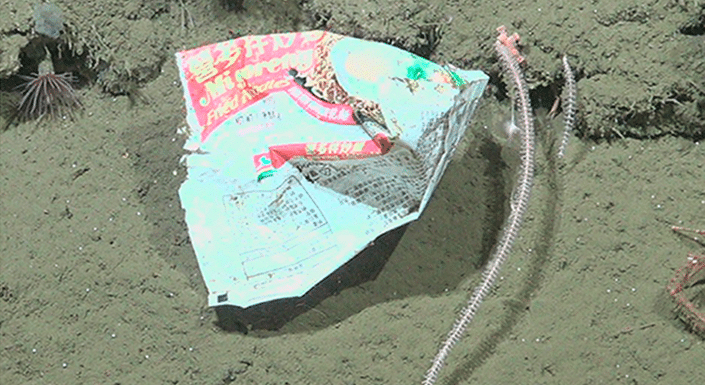
Researchers found human-made litter in more than half of the 17 missions conducted on the seafloor of the Mar del Plata canyon, off the coast of Argentina, including packaging, fishing gear, and a boot.
Even at about 3,000 meters depth, in an ocean floor that had never been filmed by scientists, there are signs of human presence. An international team found plastic and other human-made debris in the Mar del Plata submarine canyon, in the southwestern Atlantic, off Argentina.
The study, published in the scientific journal PLOS One, stems from 17 dives conducted in 2025 using a remotely operated vehicle. In total, the researchers analyzed about 240 hours of seabed imagery and identified 29 human-made objects in ten of the dives.
Most were plastic, but rubber objects were also found. Among the debris were fishing gear, plastic bags, food packaging, and even a boot.
Some objects were partially buried in sediments, while others were wedged between rocks or still in motion.
The canyon may be concentrating the litter
The researchers found more debris inside the canyon than in the surrounding areas, suggesting that its morphology and the ocean currents may be helping to transport and concentrate these materials on the seafloor.
The Mar del Plata canyon is one of the major features of the ocean floor in the region, yet it remains little studied. The 2025 expedition was the first to capture images of the canyon’s seafloor.
In addition to the debris, the researchers documented about 40 species that could be new to science, strengthening knowledge about an area that remains virtually unexplored.
Animals also interact with the trash
The images allowed observing different forms of interaction between animals and the debris.
Mobile organisms, such as crustaceans, approached the objects in what appeared to be transient ways. Stationary organisms, including starfish and corals, were observed clinging to some of the debris.
In some cases, these animals were partially on or inside plastic packaging and fishing gear.
The researchers warn, however, that the presence of organisms on an object does not mean that the debris is functioning as an adequate habitat.
The colonization of plastic or a fishing line by marine organisms can give the impression that the material has become part of the ecosystem, but that does not allow us to conclude that its presence is beneficial to those animals or to the community where they are found.
Not even the deepest depths are isolated
The discovery comes amid growing evidence that human waste is reaching very deep zones of the ocean.
A few months before this expedition, a team had identified a plastic bag in the Mariana Trench, the deepest known part of the oceans.
The seafloor naturally receives organic matter from the upper layers, which constitutes an important food source for ecosystems living far from sunlight. The new data, however, show that this transport to the depths is not limited to organic matter.
Plastics, fishing gear, and other waste can also sink, be carried by currents, and end up deposited in environments that for a long time were considered too remote to suffer significant human influence.
The study of the Mar del Plata canyon thus shows that distance from the surface does not prevent waste from reaching deep-sea ecosystems—and that the very dynamics of the seafloor can contribute to concentrating them.