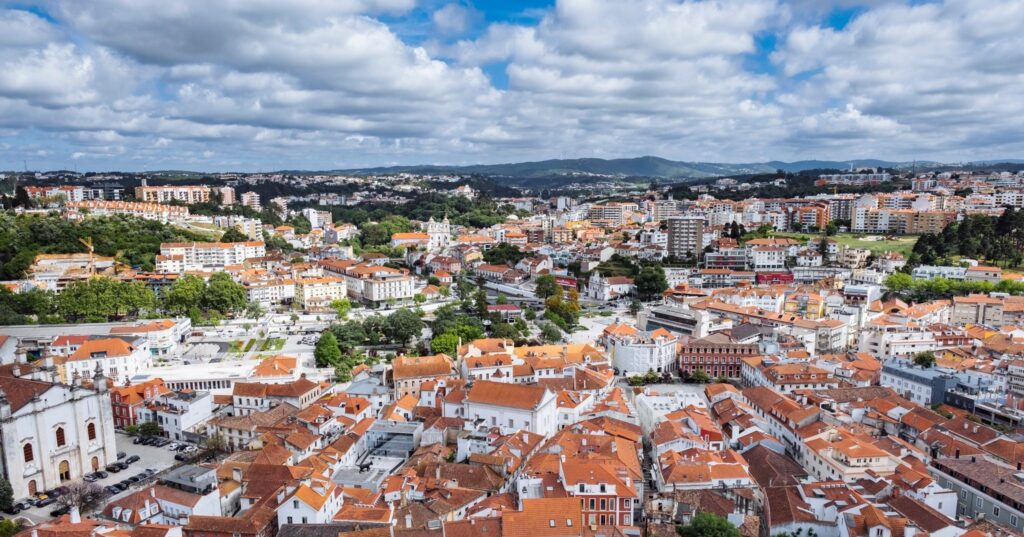
The Sustainable Urban Mobility Plan (PMUS) for Leiria, still under development, aims to bring the city’s parishes closer together and ensure the quality of life for those living in the municipality, the mayor said today.
Comprised of eight axes and 74 actions, some already implemented, others in the design, study, or initiation phase, Leiria’s PMUS is, however, still in the presentation phase, open to consultation, clarification of doubts, and acceptance of proposals.
The vote in a meeting of the City Council and Municipal Assembly is scheduled for September, so that, from then on, all initiatives can be put into practice by 2035, announced today by the municipality.
“It is a strategic plan, not only from the mobility standpoint but from the quality of life in Leiria,” summarized the president of the Leiria City Council, at the PMUS Leiria presentation to the media.
Gonçalo Lopes said that “if high-speed rail will bring Leiria closer to Lisbon and Porto, this plan will bring the parishes of the city closer together,” and argued that the plan should reflect “a vision for the entire municipality.”
The mayor admitted that it is “a very sensitive issue,” recalling “the strong opposition” that a similar plan generated about a decade ago.
“It is one of the most difficult discussions to have from a political standpoint, because it is a topic where everyone has an opinion – especially those who drive. The discourse and the discussion cannot be about cars; it has to be Leiria,” he stressed.
Changing mobility is, “often, contrary to people’s expectations,” and, for this reason, the Leiria City Council wants “broad communication, participation and clarification.”
“If the actions we plan to propose do not have this effort to involve people in the decisions, those who today say they want the street closed will, tomorrow, say they want it open,” he exemplified.
Politically, Gonçalo Lopes guaranteed that he would “force the opposition parties to be very clear about what they want,” in order to achieve “the broadest possible political support.”
“This plan cannot be based on populism. It is not only those who govern who must take responsibility. Let this plan not be a political weapon by the parties that do not govern the City Council, who in the council meeting defend one thing and on the street, beside the merchants, defend the opposite.”
Leiria’s PMUS gains importance in light of population growth.
“After all, we are not 130,000; we are 145,000, as was confirmed a few weeks ago,” he recalled, referring to INE’s 2025 data released in June.
“An extra 15,000 people takes a toll. Even so, the city can still absorb them here within the city, except during peak hours, when a change is already evident,” he acknowledged.
“There has been a demographic explosion. We are used to having a quality of life that has changed,” he noted.
Therefore, it is necessary to act, because “mobility intersects not only with public transport, but with the environment, housing and, above all, urban growth.”
The PMUS that Leiria is preparing “is no longer just a matter of public transport or pedestrianising; it is a matter of quality of life,” bringing the municipality closer to the standards defined by the European Union.
“The question is whether Portugal, and in particular Leiria, is ready to enter this discussion, or if we will continue debating how many parking spaces are right at the door or where the loading and unloading zone is and the encroachment on sidewalks and the fines, because ‘I only stopped to go to the pharmacy’,” he criticized.
Leiria’s PMUS has a public presentation session on August 4, at 21:30, in the auditorium of the Leiria Municipal Stadium. It will be available for consultation between August 5 and August 15. An electronic address for suggestions and contributions has been created at [email protected].
“We would really like to see responsible participation, citizenship, civic engagement. Do not think only in the short term. Look at Leiria ten years from now—and not only today,” urged the president of the Leiria City Council.