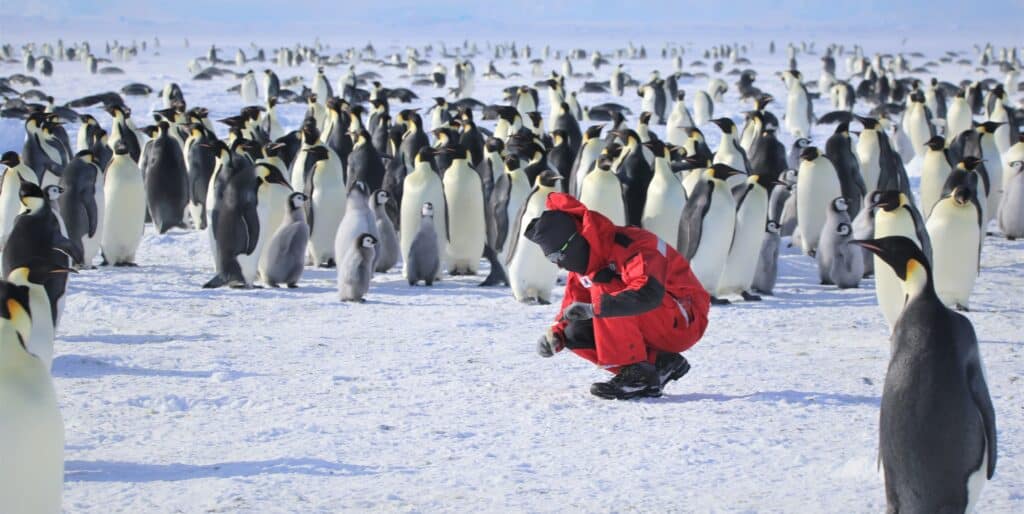
An enormous iceberg that ran aground off Coulman Island, in Antarctica, may have compromised the reproductive success of an emperor penguin colony by hindering the birds’ access to feeding areas, according to an international study.
The number of emperor penguin chicks (Aptenodytes forsteri) at the Coulman Island colony in Antarctica decreased by about 69% in 2025 compared with the previous year, a reduction that researchers associate with the presence of a large iceberg stranded near the colony.
The study, published in the scientific journal Communications Earth & Environment, concludes that the iceberg would have significantly increased the distance that the adults needed to travel to reach the feeding areas, compromising the colony’s reproductive success.
The investigation was based on two aerial surveys conducted in November and December 2025, during which scientists counted 6,658 live chicks. This figure represents a reduction of approximately 69% compared with the number recorded in 2024 and with the average observed between 2017 and 2024.
During fieldwork, the team identified a large iceberg stranded three to five kilometres north of the colony. Satellite image analysis revealed that the ice block, about 13.9 kilometres long and four kilometres wide, detached in March 2025, approached the island in July, and ran aground on 28 July, precisely during the egg-hatching period.
By combining the iceberg’s position with a three-dimensional model of its structure, the researchers estimate that the ice barrier increased the distance needed for the penguins to reach the feeding areas from about 9.3 kilometres in 2024 to approximately 14.9 kilometres in 2025.
According to the authors, this increase in distance would have forced the adults to spend more time and energy on travel, reducing how often they could return to the colony to feed the chicks during a critical stage of their development.
The researchers note that emperor penguins rely on a combination of stable sea ice and regular access to open waters to find food throughout the breeding season, which runs from June to January. While the overall conditions of sea ice are recognized as a determinant factor for the species’ reproductive success, the study suggests that localized events, such as the grounding of large icebergs, can also have a significant impact.
The authors emphasize, however, that the conclusions pertain to a single breeding season and result from an observational study, and therefore do not establish a direct cause-and-effect relationship. Still, they argue that future work on emperor penguin ecology should consider the impact of these events, alongside long-term changes observed in Antarctic sea ice.