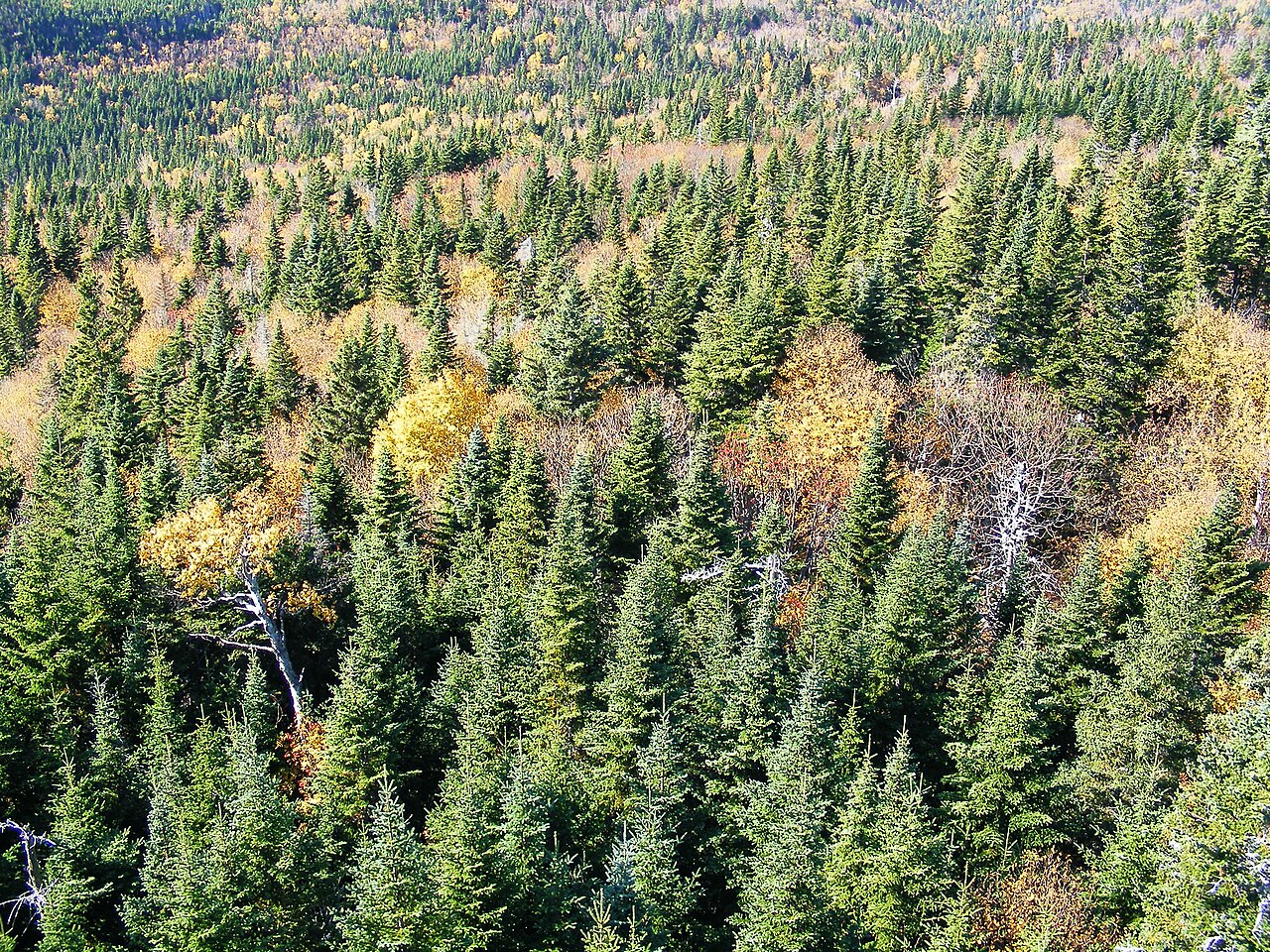
Tree planting is one of the most popular measures to mitigate climate change, aiming to increase the capture and storage of carbon from the atmosphere. However, this may not always be the best approach.
An analysis published by the United Nations University Institute for Water, Environment and Health (UNU-INWEH) points out that dense plantings of evergreen needleleaf trees, such as spruces (conifers in the Pinaceae family), in Canada’s boreal forests absorb so much solar radiation during winter that surface warming can negate 6% to 20% of the climate benefit attributed to them.
Researchers say that Canada’s climate mitigation strategies are producing inflated decarbonization estimates because they do not account for the heat absorbed by these perennial forests. Furthermore, they note that public investment in this type of plantings is not the most appropriate choice, given that they do not provide the benefits that are often assumed.
Thus, the team calls on Canada to reassess its afforestation efforts based on the effect they have on temperature rather than simply the tonnes of carbon sequestered.
“Climate leadership is no longer about planting more trees,” says Kaveh Madani, director of UNU-INWEH and coauthor of the analysis. “It is about being able to demonstrate, decades from now, that the forest we planted continues to cool the soil where it stands,” he explains.
In snow-covered landscapes, such as those that characterize northern Canada, the color of the land surface matters as much as what grows on it, the researchers argue. Snow-covered ground with no vegetation reflects most of the sunlight that hits it. By contrast, a darker surface, such as the canopy of a spruce forest, absorbs it.
Thus, a forest of evergreen trees makes the surface darker for almost the entire year, warming it even as the trees remove carbon from the air.
The authors of this work say that most of the models currently used to estimate carbon storage in forests do not account for this surface warming, which, they warn, leads to inflated perceptions of the “true climate value of reforestation.”
This work focused on the Taiga Plains in northern Canada, a country where tree planting is a central part of climate mitigation efforts. But the researchers say public money may be invested in forests whose climate benefits may be far lower than previously thought.
“A forest may pass a carbon audit, and yet leave the surface hotter than before. That is the part no one is measuring,” says Pooneh Maghoul, coauthor of the analysis.
Experts suggest that instead of dense plantations of a single evergreen species, which heat the surface more and also raise the risk of fire, plantations with 25% to 40% deciduous trees, such as poplars, planted at moderate densities of 600 to 1,400 per hectare, store substantial amounts of carbon and reflect more sunlight, contributing more to cooling. Moreover, in the event of a fire, they burn with less intensity due to the lower density of the forest.
“The question is not how many trees we plant. It is what we plant, at what density and whether the site will still be able to retain water thirty years from now,” emphasizes Pooneh Maghoul, coauthor.