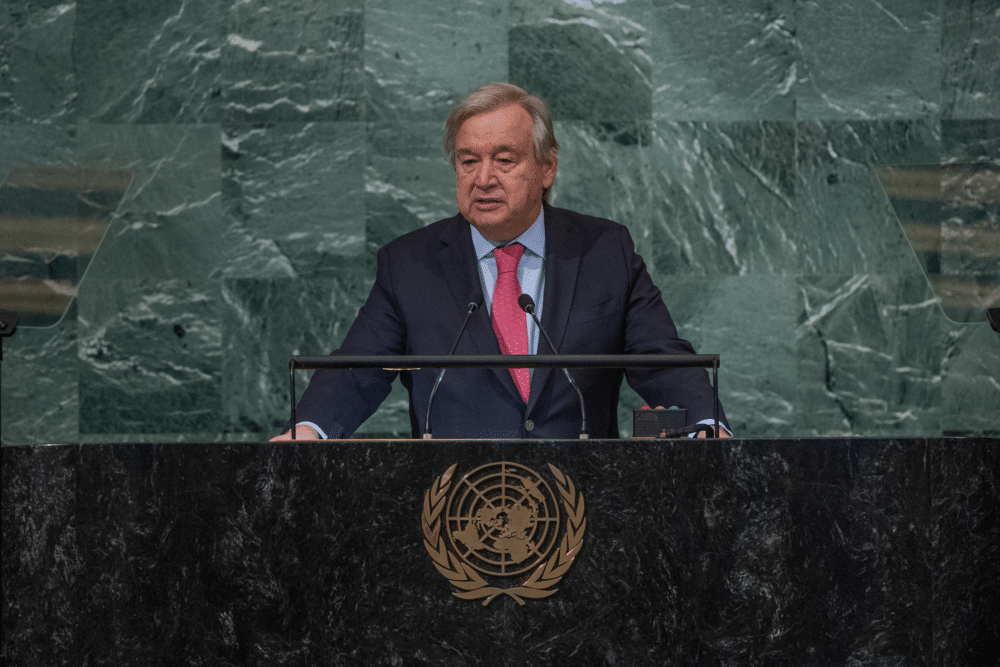
The UN Secretary-General, António Guterres, today pointed to the worsening inequalities and the climate crisis as strong obstacles to development, arguing for reforms and a collective international response capable of meeting these challenges.
Guterres considered that inequalities should not be treated merely as an economic problem, but as a question of power, linked to access to opportunities, resources and participation in decision-making.
At the opening of the annual debate of the United Nations General Assembly (UNGA), which began today in New York, Guterres stressed that humanity has never had so much wealth, knowledge and technological capacity, but that, for millions of people, progress remains out of reach.
According to the Secretary-General, while some populations benefit from prosperity and globalization, others face exclusion and fear that technological advances may threaten their livelihoods.
The former Portuguese prime minister also warned that billions of people continue to be deprived of basic needs.
He highlighted in particular the inequalities of the international financial system, arguing that no country should be deprived of a sustainable future by being on the less favored side.
In this context, he advocated reform of the international financial architecture, including faster, more effective and fair debt relief, multilateral development banks with greater financing capacity and a use of Special Drawing Rights for the benefit of the countries that need them most.
Guterres also highlighted gender inequality as “the most universal” of forms of inequality, warning that women and girls continue to face discrimination, violence, exclusion and abuse.
According to the Secretary-General, women’s rights are retreating in several parts of the world, while their voices are silenced, their bodies are used as battlegrounds and their freedoms are traded as bargaining chips.
Guterres linked gender equality to more stable societies and to more effective institutions, highlighting, in this context, the United Nations’ progress.
“I have the pride to inform you today that the United Nations has achieved gender parity for the first time in history at all levels of senior leadership, across all headquarters and among professional staff,” he announced.
“Equality is not a dream. It is a decision,” he added, arguing that this change should also encompass Governments, parliaments, businesses, peace processes and the General Assembly itself.
On another front, Guterres presented the climate crisis as “the deepest intergenerational power imbalance of all,” arguing that one generation is consuming the future of the next.
The Secretary-General, who has made the climate crisis one of the priorities of his mandate, warned that the impacts of climate change are arriving sooner, with greater intensity and reaching wider areas than many had anticipated.
Guterres argued that renewables are currently the cheapest source of new electricity in much of the world and constitute the most viable path to ensure energy security and independence and sustainable growth.
In this sense, he urged Governments to adopt national transition plans to phase out fossil fuels, aligned with the goal of limiting warming to 1.5 degrees, with clear timelines and protections for workers and affected communities.
He also criticized the influence of the fossil fuels industry, arguing that polluters should pay more for the damage caused and urged Governments, cities, civil society and citizens to continue to demand accountability.