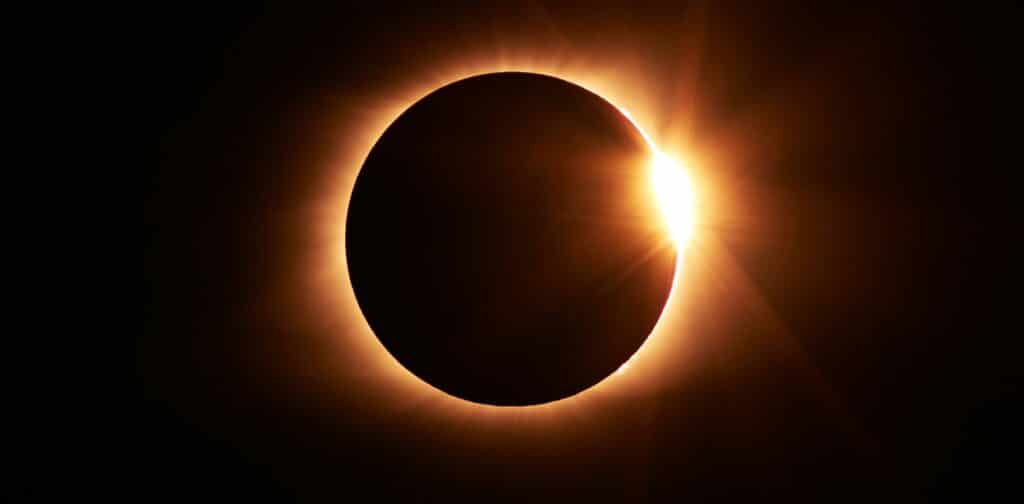
Europe will witness, on August 13, the first total solar eclipse in almost three decades. The phenomenon will be visible across different regions of the continent and can be followed live through a broadcast promoted by the Royal Observatory Greenwich, allowing millions of people to observe one of the most impressive astronomical events.
A solar eclipse occurs when the Moon positions itself between the Earth and the Sun, partially or wholly blocking sunlight and casting its shadow on the Earth. In the case of a total eclipse, the Moon completely covers the solar disc for a few moments.
Although the path of totality crosses only certain areas of Europe, in cities such as London the eclipse will be visible in a partial view, with more than 90% obscuration of the Sun.
The Royal Observatory Greenwich will broadcast the phenomenon live, following the evolution of the eclipse and explaining its different phases.
Experts remind us that direct observation of a solar eclipse requires specific precautions. Looking at the Sun without adequate protection can cause permanent eye injuries, so certified solar viewing glasses or indirect viewing methods should be used.
The August 13 eclipse will be the first total solar eclipse visible from Europe in almost 30 years, becoming one of the most-awaited astronomical events of the decade for astronomers and skywatchers.