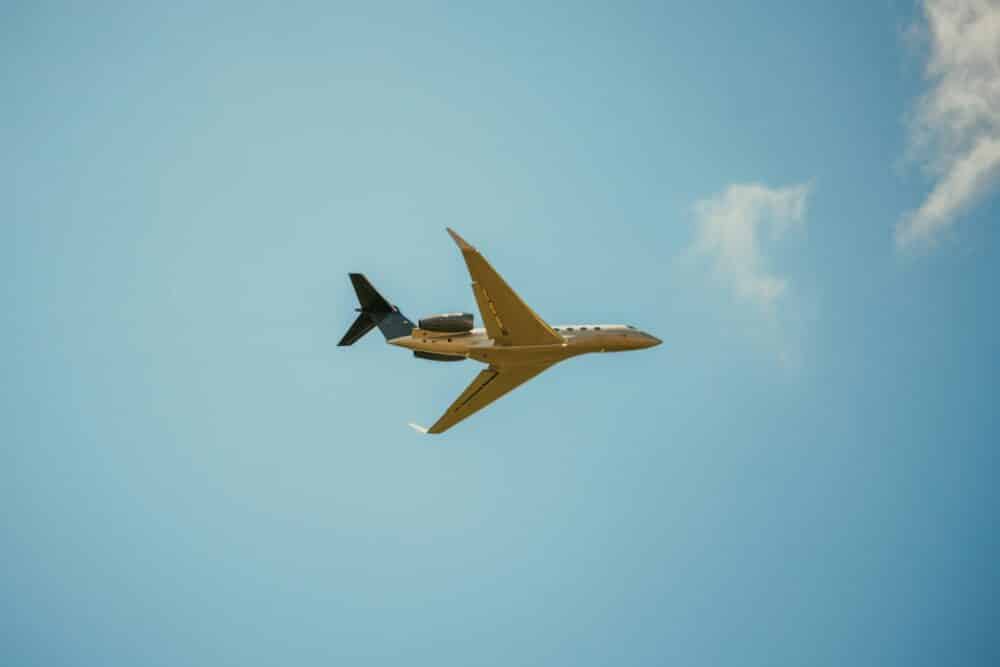
More than a hundred private planes landed in the first week of COP31 in Antalya, where the climate summit is taking place, emitting more carbon dioxide than 10,000 people during the same period.
“There are a lot of rich people coming to this summit, there are multimillionaires and there are many fossil fuel lobbyists,” said Mariana Paoli, a specialist from the international organization Oxfam, to the Spanish agency EFE.
“They form, in fact, one of the largest delegations,” explained the specialist from the non-governmental organization (NGO) founded in the United Kingdom in 1942, and with international headquarters in Kenya.
The NGO created the portal polluterjets.com, which records the arrival of all private jets to Antalya, on the southern coast of Turkey, during the two weeks of the summit.
The origin and flight data provide an estimate of the volume of carbon dioxide emitted on those routes.
A small plane coming from Germany, Switzerland, or Spain emits approximately 10 tonnes of carbon in two hours of flight, the equivalent of the emission by an average citizen of the planet over two years of life.
“This is the hypocrisy of multimillionaires: arriving by private plane, something that drives the carbon disaster and that hinders the summit’s purpose, rather than helping it,” Paoli said.
The registry includes all aircraft that landed in Antalya, with no way to determine whether the passengers are actually heading to COP31, whether the destination is luxury hotels along the coast, or even whether it is a medical flight.
However, given that the average in 2025 is nine private planes per week, it is reasonable to assume that the vast majority of the 128 flights landed during the first week of COP31 belong to participants in the summit.
On Tuesday, the day of the arrival of most heads of government, there were 31 landings, falling to 28 the next day, while on Thursday the figure dropped to 19 and on Friday to 14.
The carbon emitted by those 128 counted flights reaches one thousand tonnes, the equivalent of the contribution of 10,000 people during this period, wrote EFE in a piece signed by journalist Ilya U. Topper.
According to Oxfam, this value already represents double the 66 flights recorded over the 17 days of COP30 in Belem (Brazil), last year, which emitted a total of 678 tonnes of CO2.
Paoli admitted that for an international summit like COP it is necessary to travel by plane, but noted that the difference between taking a regular commercial flight and a private jet is abyssal.
“This is one of the few spaces where we have egalitarian representation between the North and the Global South, one of the few places where we can really push climate justice and accountability goals: those who pollute the most should pay for it,” she argued.
“We are not only talking about rich countries, but also rich individuals, who are behind many of the disasters we are experiencing,” she insisted.
The activist proposed as a solution to impose a special tax on private airplanes.
“Imposing a tax on private jets would be an important way to make polluters pay. And there is no need to wait for an international agreement for this: any government can start doing it at its national level,” she stated.
The measure should be integrated into a broader system of wealth taxation, aimed especially at the major oil companies.
The profits of the major oil companies exceeded $100 billion (about €90.7 billion at current exchange rates) only in the third quarter of this year, added EFE.
The 31st United Nations Conference on Climate Change (COP31) began on Monday and runs until November 20, with the mission of accelerating emissions reductions and financing the adaptation of developing countries.