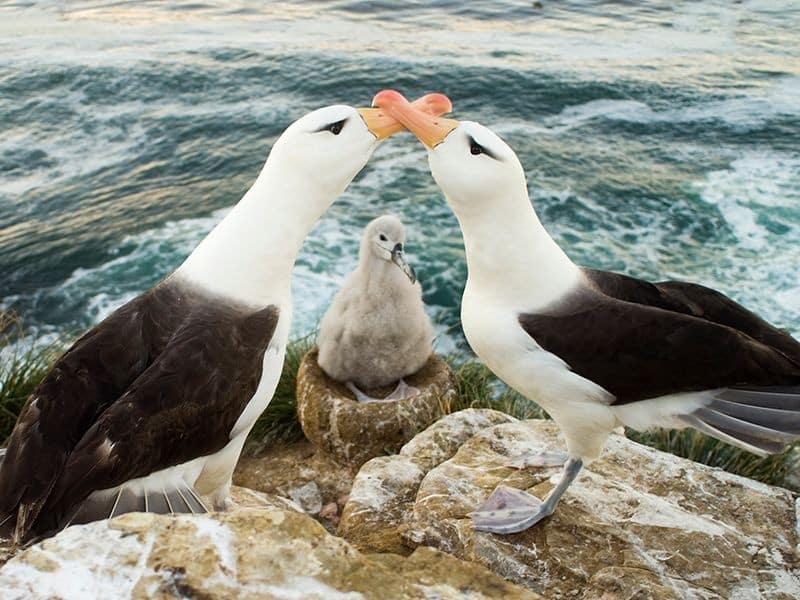
A study by the Royal Society suggests that climate change and warming ocean waters are driving an increase in the number of pair separations among this species. Under normal conditions, only one to three percent of black-browed albatrosses — birds that inhabit coastal waters and live for about 50 to 60 years on average — separate from the partners they initially choose.
In recent years, the unusual warming of sea temperatures has coincided with an increase in birds that separate: eight percent of albatross pairs are now “divorcing.” The study notes how warmer waters reduce the availability of fish, the staple prey of the albatrosses, making the environment more hostile. Scientists believe these circumstances lead to fewer chicks surviving and to higher stress hormones in the albatrosses, making it harder to maintain stable relationships. “If we do nothing, they will go extinct,” Graeme Elliott, a scientist who has studied albatrosses in New Zealand for three decades, told The Guardian.
Albatrosses are large birds belonging to the family Diomedeidae, order Procellariiformes. They are marine birds, extremely well adapted to life on the open sea, being found on land only during the breeding season. The family currently has about 20 known species distributed across four genera: Diomedea, Thalassarche, Phoebetria, and Phoebastria. They are monogamous birds and nest on oceanic islands, with the nesting period varying by species, forming large colonies. The pair lays eggs in large nests on the ground and incubates them for a period ranging from one to three weeks. They feed mainly on fish, crustaceans, and cephalopods (octopuses and squids).