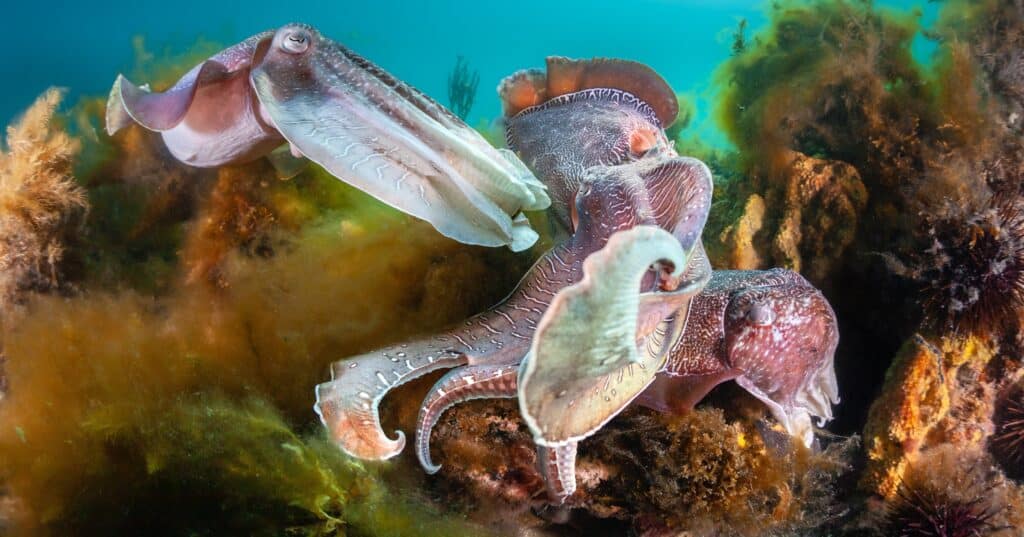
A photograph capturing two Australian giant cuttlefish competing for the attention of a female, during the breeding season in Upper Spencer Gulf, in South Australia, was distinguished in the 2026 edition of the photography contest from the journals BMC Ecology and Evolution and BMC Zoology.
The image, authored by Victor Huertas, a researcher at James Cook University, won the Relationships in Nature category and shows two male Australian giant cuttlefish (Ascarosepion apama) engaged in a dispute during the species’ annual breeding aggregation.
The photograph records the behavior of tens of thousands of cuttlefish that use skin pigmentation to compete for the right to mate. For David Ferrier, senior editorial board member of BMC Ecology and Evolution, the image highlights “both the intimacy and the intensity of a complex and highly competitive mating display.”
The annual contest aims to celebrate Earth’s biodiversity and highlight the work of researchers who study and contribute to protecting the natural world. This year, the jury selected a winning image and a runner-up in the overall competition, in addition to winners and runners-up in three categories: Relationships in Nature, Protecting Our Planet and Research in Action.
A Window to the Wetlands
The overall winner was a photograph of an orange-tailed damselfly (Ceriagrion cerinorubellum) peering through a hole in a leaf, captured by Sritam Kumar Sethy, a student at Berhampur University, in the Indian state of Odisha.
Titled Window to the Wetlands, the photograph was taken in a freshwater wetland and aims to reveal a universe of biodiversity often little observed. “It offers a glimpse into the world, often overlooked, of freshwater biodiversity,” explains the author.
Dragonflies play an important role as predators in wetland ecosystems and are recognized as indicators of ecosystem health. Because they depend on aquatic and terrestrial habitats, they are particularly sensitive to pollution, habitat loss, and climate change.
“It is hard not to smile at this image, so well composed and vibrant, in which the damselfly appears to reveal an extraordinary sense of personality and presence,” comments David Ferrier.
Jennifer Harman, editor of BMC Ecology and Evolution and of BMC Zoology, considers that the photograph “highlights the importance of wetlands, which support an extraordinary diversity of species, but are among the most threatened habitats and are disappearing faster than anywhere else in the world.”
Science Under the Moonlight
The runner-up in the overall competition shows two students working during a dark, rainy night near Portland, Oregon, United States. The team was installing a radio transmitter on a northern red-legged frog (Rana aurora), in a photograph captured by Ryan Wagner of Washington State University.
The photograph highlights the use of technology by researchers to understand animal movements and how they use habitats, knowledge that can contribute to creating safer environments for endangered species.
In the Research in Action category, the first place went to Intertidal Education, by Liam Brennan, of the University of New Brunswick, in Canada. The image shows university students investigating the local fish population in shallow coastal waters, under Moonlight.
According to Edward Narayan, senior editorial board member of BMC Zoology, giving students opportunities to develop research projects can “transform classroom science into action to support essential ecological and environmental monitoring work.”
Images That Show Conservation in Action
In the Protecting Our Planet category, the winner was Allen Tian, a researcher at Queen’s University, in Canada, with an aerial drone-captured image of the Long Sault Parkway at the western end of the Saint Lawrence River shipping channel.
The photograph, taken during biodiversity research, shows the environmental effects caused by dam construction in the past and the ecological recovery that can result from conservation efforts. To monitor the health of the ecosystem, the researcher used environmental DNA samples and drone surveys, avoiding disturbing the existing fauna.
The runner-up in this category was Abhijeet Bayani, of MES Abasaheb Garware College, in India, with a photograph that depicts community conservation efforts on the country’s western coast. The image shows a hatchling olive ridley turtle (Lepidochelys olivacea) being guided to the sea by local inhabitants who protected the nest.
Among the images that received a special mention from the jury are photographs of Florida manatees drinking freshwater in Everglades National Park, a researcher sheltered in a Himalayan cave while searching for signs of the presence of an endangered Himalayan brown bear, and a researcher atop a tree, in Australia’s Northern Territory, studying microbial communities on bark.
The set of winning images thus seeks to show different dimensions of the relationship between species, researchers, and ecosystems, from reproductive and predation behaviors to scientific monitoring and conservation efforts.