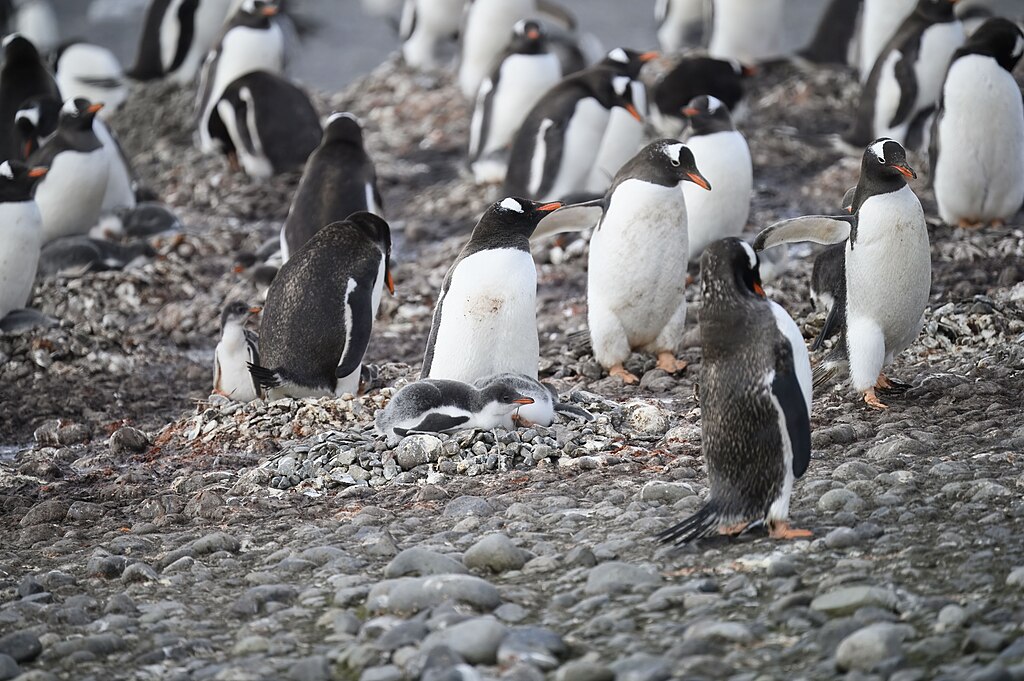
Three species of penguins that live in Antarctica are bringing forward their breeding season by more than a week. Scientists speak of a ‘record shift’ and that it is probably an adaptation to the effects of climate change.
Between 2011 and 2012 and again between 2021 and 2022, a group of researchers led by the University of Oxford studied 37 distinct colonies of gentoo penguins (Pygoscelis papua), Adélie penguins (P. adeliae) and Chinstrap penguins (P. antarcticus). The aim was to identify changes in the timing of reproduction of these animals.
Based on images collected by cameras placed on the Antarctic Peninsula and on several subantarctic islands in the Atlantic, to ensure that the results are relevant to the species as a whole and not limited to just a single colony, the team reveals that all three species advanced their breeding seasons during the study decade.
In a paper published in the journal Journal of Animal Ecology, the scientists show that gentoo penguins were the species where the change was most noticeable, with an average advancement of 13 days per decade. In some colonies this advancement reaches 24 days.
This is, according to the study’s authors, the fastest change in the reproductive behaviour ever recorded in a bird, and possibly also in any vertebrate species.
As for the Adélie and Chinstrap penguins, the advancement averages around 10 days between 2011-2012 and 2021-2022.
Ignacio Juarez Martínez, the first author of the article, explains that the results obtained suggest that, in the context of advancing climate change, the three penguin species studied will not all be affected in the same way.
“The increasingly marked subpolar conditions of the Antarctic Peninsula are likely to favour generalists such as the gentoo penguins,” he notes, to the detriment of specialists that have more limited diets, such as the Chinstrap and Adélie penguins.
“Penguins play a crucial role in Antarctic food chains and losing penguin diversity increases the risk of a broad ecosystem collapse.”

The polar regions are warming faster than anywhere else on the planet. Data collected by thermometers built into the cameras reveal a worrying reality.
The sites where the Antarctic penguin colonies are located are warming at an average rate of 0.3 degrees Celsius per year, four times higher than the regional average, which stands at 0.07 degrees per year. Therefore, the researchers say that the places where penguin colonies on the Earth’s southern pole are located are among the habitats warming the fastest on the planet.
Although they lean toward this idea, the scientists admit that it is not yet possible to confirm whether the advancement of the breeding season is truly an adaptation of penguins to an increasingly warm Antarctica or whether this change may be influenced by other factors.
Anyway, they say that advancing reproduction can cause a mismatch with other important factors and ecological cycles, such as food availability. If penguins started to reproduce, which involves large energy expenditures, before the sea contains abundant food, such as krill, reproduction may be a death sentence for many of these animals, with serious impacts on the survival of colonies and, ultimately, of the species themselves.
Moreover, with lower food availability, the development and even the survival of the chicks may be at risk. Although the three species are classified as “Least Concern” in terms of conservation according to the IUCN Red List, this scenario could reverse—and quickly—if the environmental and ecological changes in Antarctica prove highly detrimental to these birds.
Even if it is indeed a climate adaptation, doubts persist about the limits of these penguins’ ability to adapt to—and mold—the environment around them as it changes rapidly.
As these aquatic birds are considered indicators of climate change, “the results of this study have implications for species around the world,” says Fiona Jones, co-author of the article.
“It is necessary to continue monitoring to understand whether this record advance in the breeding seasons of these penguin species is impacting their reproductive success,” she adds.