Alqueva is one of the three pilot sites of a European project that is testing a new approach to the operation and maintenance of photovoltaic plants, using artificial intelligence (AI) and robotics. The results of three years of work on the TALOS project, funded by the Horizon Europe program, will be presented this Thursday, September 24, in Lisbon, according to a press release.
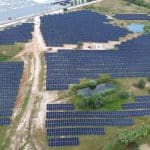
According to the same source, at the 5 MW floating photovoltaic plant installed on the Alqueva reservoir, near Portel, the main challenge is access to the panels. The presence of dirt and bird droppings requires interventions that are conditioned by weather conditions and wave action.
To address these limitations, the project uses a cleaning robot that moves along rails installed on the floating platform itself. The equipment uses a spraying system to clean the panels and charges its batteries wirelessly when it returns to the docking area.
Inspection is carried out by a drone carried to the installation by an unmanned vessel. In this way, the system avoids having a crewed vessel perform this operation and also reduces the flight time the drone would spend on the route between the shore and the plant.
Alqueva is one of the three scenarios in which TALOS tested a platform designed to make the maintenance of solar plants more autonomous. The system monitors production, weather conditions and data collected on site, identifies performance losses and determines which interventions can compensate for the cost of operation.
The proposals are presented to the plant manager, who retains final decision. They may approve an intervention, alter it or postpone it, including based on weather conditions. Only after human validation are the autonomous equipment mobilized.
The platform operates through a six-step cycle: monitor, detect, recommend, validate, execute and report. A digital model of the installation, or digital twin, allows comparing the expected performance with actual data and identifying possible production losses at the level of the panels, strings and inverters.
The system also calculates dirt accumulation on the modules, allowing to determine when a cleaning operation may be necessary, rather than following only a fixed maintenance calendar.
Beyond Alqueva, TALOS was tested in two other installations with distinct characteristics. In Villacastín and Cruz del Hierro, in Spain, the project worked on a set of hybrid solar and wind installations with a total capacity of 56 MW, including 28 MW of photovoltaic. In this case, the challenge was to coordinate different inspection, cleaning and vegetation-cutting machines in the same space.
In Randwijk, the Netherlands, the technology was tested on a 50 kW agrivoltaic installation integrated into a pear orchard. A drone and a ground robot work among the trees, with the second device performing inspection tasks and counting fruits to support agricultural production forecasts.
Among the equipment used by the project are drones equipped with conventional and thermal cameras, ground vehicles for cleaning and vegetation trimming, and large-scale cleaning robots.
According to the goals set by TALOS, the tested solutions could reduce human exposure to risks by up to 90%, shorten maintenance windows by more than 70%, and lower operating and maintenance costs by about 5%. The project also points to an improvement of around 10% in the efficiency of resources used in operations and to a reduction of up to 10% in lost production. In the two locations where the panels are washed, water use could decrease by about 35%.
The project also included an open initiative that integrated 12 European small and medium-sized enterprises and startups into the consortium. Applications were received from more than 30 countries and around 30 solutions were added to the technologies initially planned, including beyond-line-of-sight inspection drones, night electroluminescence surveys, and augmented reality systems to connect technicians on the ground to remote supervisors.
For the consortium, the three years of testing show that the main obstacles to wider-scale use of this type of systems are now also regulatory in nature. Among the issues identified are differences between national rules applying to the same technologies and the undefined responsibility for autonomous systems operating in energy infrastructures.
The project also points to the absence of a common European-wide definition for agrivoltaic and floating photovoltaic facilities, which could create difficulties in licensing processes and support mechanisms.
TALOS will present at the closing event, taking place at the EDP headquarters in Lisbon, a set of recommendations in five areas: European framework for autonomous systems in the energy sector; financial instruments and market development; skills transition, data governance, and social acceptance; environmental and ecological standards; and common technical and data standards in the single market.
TALOS — roboTics and Artificial intelligence Living labs improving Operations in PV Scenarios — ran from October 2023 to September 2026 and brings together energy companies, research centers, technology companies and universities from seven European countries.