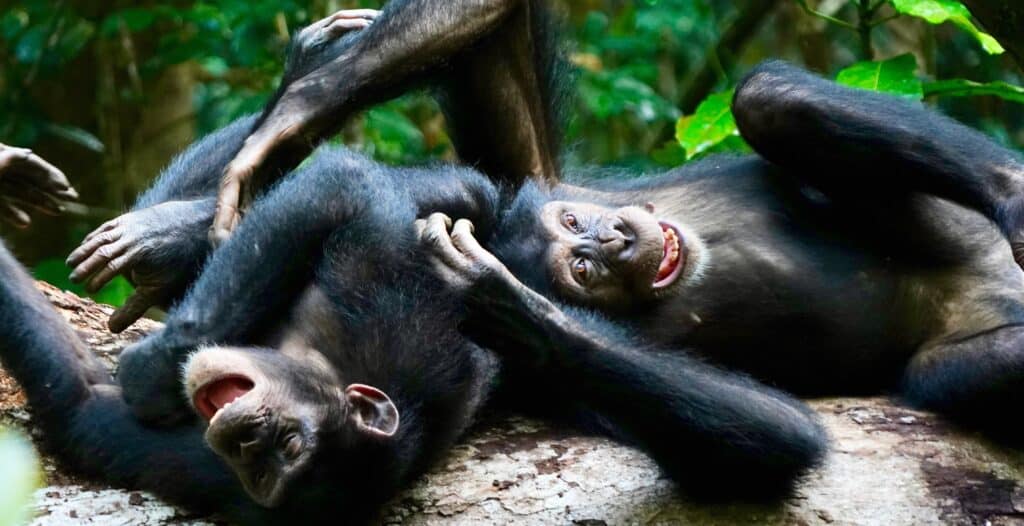
Compared with children, adults do not play as much, but social play in adulthood is considered a universal human characteristic. Playful activities play a role in building tolerance, cohesion, bonding, and cooperation. However, a new study published in Cell Press Current Biology shows that some chimpanzees, like humans, continue to play frequently throughout their lives and, in particular, before engaging in acts that require cooperative effort.
“We show that adult chimpanzee social play can promote a range of cooperative behaviors, from dyadic interactions to complex and risky activities that require coordination among several individuals,” says Liran Samuni of the German Primate Center in Göttingen, Germany, and of the Taï Chimpanzee Project in Côte d’Ivoire. “We identified a strong link between this positive social behavior, known to elicit feelings of joy, and some of the most complex forms of cooperation observed in non-human species.”
Samuni and his colleagues have been studying three cohesive groups of chimpanzees living in Taï Forest, Ivory Coast. Although no previous studies had been conducted on play in wild adult chimpanzees, they noted that the adult males and females in these groups regularly play together. Their play often involves physical actions such as wrestling, biting, slaps, pulls, and chases. The positive nature of these interactions is highlighted by “play faces” and panting vocalizations, which the researchers compare to human smiles and laughter.
“Although adult–adult social play was not a daily occurrence, it consistently arose under specific conditions,” says Samuni.
To better understand how play operates within chimpanzee society, they studied the play of 57 adult chimpanzees. The researchers found that adult chimpanzees were more likely to participate in social play before taking part in group activities, such as monkey hunting or defending territory against hostile outsiders. The chimpanzees who played together were more likely to cooperate in these activities, which indicates that play may signal cooperative motivation and reinforce collective cooperation.
When chimpanzees played with only one other individual, it was common for nearby social partners to be involved, illustrating the strong link between play, familiarity, and trust. Play also occurred more frequently during times of greater social tension, such as during competition for mates or after recent disputes, which suggests to the researchers that play may be a way to relieve tension and resolve conflicts.
The results obtained from the chimpanzees studied may or may not reflect play in other chimpanzee populations. Samuni explains that this is due to chimpanzees being behaviorally diverse and flexible, with different populations displaying unique strategies and behaviors.
The prevalence of adult play in this particularly cohesive population may reinforce the notion that “societies characterized by cohesion and tolerance also exhibit higher frequencies of adult play,” says Samuni.
In future work, they would like to learn more about how Taï Forest chimpanzee play compares with that of other chimpanzee groups. They are also curious to know whether the chimpanzees consciously decide to play as an intentional strategy to promote involvement, or whether the positive effects of play naturally promote cooperation without the chimpanzees intending to do so.