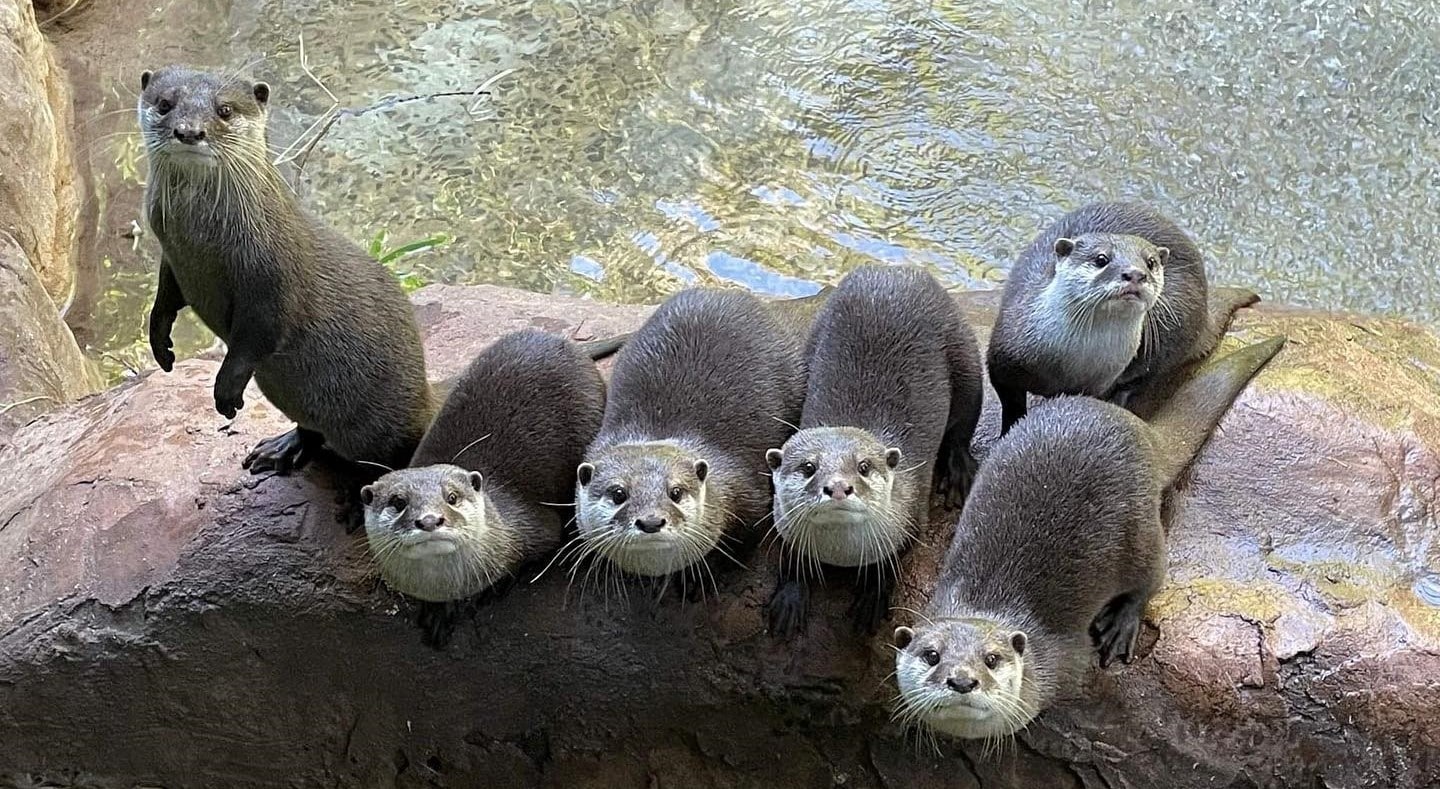
A new investigation by the University of Adelaide, in Australia, is challenging the idea that human presence necessarily has a negative impact on zoo animals. A study conducted with six Oriental small-clawed otters at the Adelaide Zoo concluded that the animals were generally more active and remained more visible when people were nearby.
The investigation, published in the Journal of Zoological and Botanical Gardens, followed the behaviour and vocalizations of the six otters over six months. In total, the researchers conducted 146 observation sessions, each lasting one hour, recording the animals’ activity levels, the occurrence of vocalizations – including squeaks, chirps, screams and barks – and the presence of visitors or zoo staff.
Paige Klingner, a PhD student at the School of Animal and Veterinary Sciences of the University of Adelaide and one of the study’s principal authors, explains that the results challenge some generalized ideas about the effect of visitors on animals.
“Our study did not find any evidence that visitors were associated with stress-related behaviours in these otters,” she states.
“Instead, we found that the otters were generally more active and more visible when people were present. This raises the possibility that visitors could have a positive or enriching effect on their welfare, although more research is needed before we can say this with confidence,” she adds.
The otters also showed a slightly higher probability of vocalizing when people were nearby. However, the study did not identify the specific types of sounds emitted. Previous investigations have shown that different vocalizations can be associated with situations as diverse as excitement, social interaction, or stress.
Co-author Bridget Cooper-Rogers explains that, at this stage, the team primarily assessed the occurrence of vocalizations and not what the different sounds might signify.
“The next step is to identify the different types of vocalizations to better understand whether certain sounds reflect positive experiences, anticipation, or stress,” she states.
The presence of zoo staff had little impact on the otters’ vocalizations when compared with the presence of visitors. This result contrasts with the possibility that these animals might respond differently to familiar keepers.
Oriental small-clawed otters are listed as vulnerable in the wild and rank among the most social and vocal species of the otter family. Zoos play a role in their conservation through breeding programs, education, and public awareness.
For Eduardo Fernandez, senior author of the study, the results contribute to a growing body of evidence showing that the relationship between zoo animals and visitors is more complex than previously thought.
“People often assume that visitors are a source of stress for zoo animals, but that is not necessarily the case,” he says.
Nevertheless, the researcher warns of an important limitation of the work: this is an observational study, so it is not possible to determine whether the presence of visitors made the otters more active or whether, conversely, more active animals attracted more people.
“Future studies need to analyze other factors, such as feeding times, weather conditions, and the different types of vocalizations, in order to better understand what is really driving these behaviours,” he concludes.