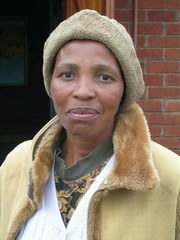
When Anoria Samka's brothers discovered she was HIV positive, they shunned
her. But now, when she tells her community that the drugs she takes can stem
the progress of the disease, no one ridicules her and no one turns her out. Instead,
they listen.
Addressing a hundred men, women and children at the Bodweni clinic in
rural South Africa, Samka says she was very weak before beginning
antiretroviral (ARV) treatment in February 2004. Her CD4 count - a measure
of the immune system's strength - was only 158. The audience nods
solemnly. Many are wearing T-shirts that say: 'HIV positive', and are already
aware that a CD4 level below 200 means a patient is at risk of serious
opportunistic infections and death.
After receiving ARV treatment for 10 months, Samka says, she is strong
and healthy again. "Today, my CD4 count is 421."
Applause and cheers of support erupt from the audience. Then a
woman stands up and spontaneously begins the first words of a song, and
soon dozens of people join in the traditional melody whose modern
lyrics call attention to the epidemic: "It is terrible because we are
dying of AIDS."
The gathering, part of the Bodweni clinic's campaign to promote voluntary
counselling and treatment, took place amid the green hills of South
Africa's Eastern Cape province, dozens of kilometres from the nearest
hospital. Here, in the remote town of Lusikisiki, Samka is one of hundreds
of people being treated for HIV, in what has been celebrated as
a new model for ARV delivery in resource-limited rural areas.
Launched in October 2003, the programme was designed by Medecins Sans
Frontieres (MSF), a humanitarian medical organisation, and implemented
in partnership with the local department of health. Unlike many ARV
distribution programmes, which tend to be centralised at hospitals, this
system delivers most of its services via a network of 11 clinics spread across
the countryside.
"The model was to deliver ARVs as close as possible to the home, not to
require patients travel to a hospital in a city," says Dr Hermann Reuter,
MSF's project coordinator at Lusikisiki.
So far, the Lusikisiki programme has exceeded enrolment expectations,
starting a total of 442 residents on ARV treatment in its first year of
operation, ahead of its original target of 300. While this is still shy
of the roughly 1,500 people that MSF estimates are in immediate need of
treatment in the area, the community-based approach could prove to be
a successful model for delivering ARVs in poor, underdeveloped communities
throughout sub-Saharan Africa.
As in much of the continent, the public health system in South Africa
is already debilitated by a significant shortage of resources and medical
staff. The Lusikisiki programme is no different: staff say the programme
could use an infusion of additional resources, including a car to transport
patients, and another 50 nurses.
The novelty of the Lusikisiki approach is that it depends on community
members to orchestrate the peer counselling and weekly support groups
that are the backbone of the programme. At the heart of the model are
dozens of volunteers, often HIV positive themselves, who have been
trained by their support group.
These volunteers publicly declare their HIV status and attempt to educate
community members about HIV prevention, testing, nutrition, and
treatment. Reuter believes they are a fundamental reason for the
programme's success: "The project is working because of the
non-professional staff."
While there is a risk of burnout, many volunteer community health workers
are motivated to act because they are living with HIV, and can see the
visible improvement of those on ARVs.
"This epidemic is so big, and so many families are affected, people see
that they are doing it for the community," Reuter said. "And the model that
we are implementing - it's not just a medical model; it's a model for human
rights, and ARVs as a part of human rights."
Dr Eric Goemaere, the head of MSF in South Africa, says the agency
began the programme in Lusikisiki to build on its experience of delivering
ARVs in Kayelitsha township near Cape Town. The Lusikisiki initiative was
an effort to transfer the successes of its programme in a resource-limited
urban environment to a resource-limited rural setting.
"We went to the most underdeveloped, most remote part of South Africa -
Lusikisiki," said Goemaere. "If it works in Lusikisiki, it can work anywhere
in South Africa."
Goemaere says the Lusikisiki programme, funded in part by the Nelson
Mandela Foundation, expanded "much faster" than MSF originally
anticipated and now services between 30 percent and 40 percent of all
publicly funded ARV cases in the entire Eastern Cape province.
"People are rushing for treatment," he says. "What Lusikisiki tells us is
that when service is available, even in the most remote area, people
are queuing for it."
Sarah Mahlangeni, the only professional nurse at the Bodweni clinic,
agrees: 23 of the clinic's 340 patients, known to be HIV positive,
are currently receiving treatment, and there has been a
significant change since the facility began dispensing ARVs in
February 2004. Scores of people are now voluntarily requesting to be
tested so they can begin treatment as soon as it becomes necessary.
A public demand for testing and treatment is notable in South Africa,
where stigma against HIV/AIDS often hampers efforts to educate and treat
the more than one in five adults estimated to have the virus. In many
communities people say they do not publicly declare their HIV-positive
status because they are afraid of being shunned by friends and family.
Nosipho Sivela, an ARV counsellor at the Bodweni clinic, says stigma
regarding HIV/AIDS has been largely eradicated in the surrounding rural area
because those on ARVs regularly stand up in front of others and explain how
their health has improved with treatment.
"It's because they trust the ARVs," Sivela says. "They believe that if
they know their status, they know how to live with their HIV. It makes them
confident because they know that they'll stay alive for a long time."
For Samka, who was abandoned by her brothers when they found out she was
HIV positive, the sense of belonging is the most important part of her
treatment. Four times a month she makes the 90-minute walk from her
village of Mxokozweni to receive her medication and attend a support group,
which she calls her "favourite thing" about being involved with the clinic.
"The support group taught me that now I can educate people about HIV
anywhere," she says. "Now, I'm a living example. When I talk, I can share
things that I've experienced."




 Print view
![[Photo Credit: IRIN]](images/ARV-logo.jpg)

 ???
???