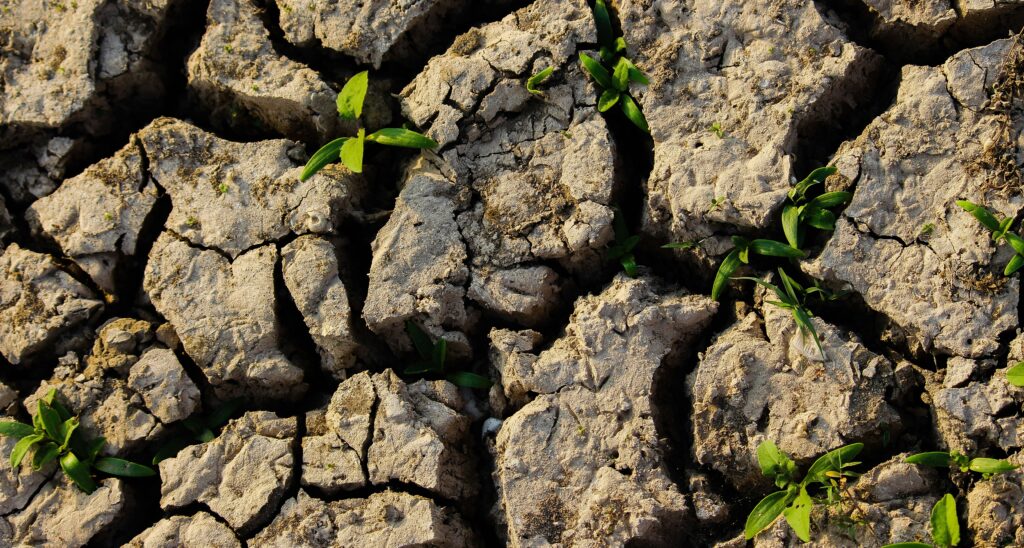
According to a new study, terrestrial water storage — in particular soil moisture — plummeted between 2000 and 2003. The conclusions — built on a thorough analysis of three independent data sets — reveal a global-scale change, previously unrecognized and potentially irreversible, in Earth’s water and establish it as a dominant factor in the rise of sea level at the start of the twenty-first century.
The frequency of severe droughts has risen markedly since the mid-19th century and is expected to worsen under future warming scenarios. Unlike rapid-onset natural disasters such as hurricanes or wildfires, droughts develop gradually, depleting terrestrial water storage (TWS)—including soil moisture, groundwater, and surface water bodies—and can persist for years.
Satellite gravity measurements have significantly increased the ability to monitor TWS variations at continental scales and have revealed a persistent loss of land water to the ocean. However, these observations have not been available long enough to assess whether the global depletion of TWS is linked to larger-scale climatic variations.
Given that the Earth’s polar motion (i.e., the wobble of the Earth) is influenced by mass redistribution in the terrestrial system, changes in polar motion (PM) and the accompanying sea level variations can serve as additional indicators of long-term TWS depletion, particularly in the period before satellite data availability.
Here, Ki-Weon Seo and colleagues combined satellite global soil moisture (SM) data, sea level measurements, and PM observations to estimate the terrestrial water storage from 1979 to 2016. They found a dramatic decline in soil moisture; between 2000 and 2002, soil moisture declined by about 1614 Gt. From 2003 to 2016, the soil moisture decline continued, with a further loss of 1009 Gt.
According to the authors, this decline is corroborated by independent observations of the mean global sea level rise (~4.4 millimeters) and of the terrestrial pole displacement (~45 centimeters). The results suggest that this decline is primarily driven by changes in precipitation patterns and by increased demand for water through evaporation due to rising temperatures.
Furthermore, the authors note that soil moisture had not recovered by 2021, with little likelihood of recovery under current climatic conditions.
“The conclusions of Seo et al. underscore the urgent need to improve the parameterization of land-surface models to better understand the complex geophysical issues,” writes Luis Samaniego in a related Perspective. “It is essential to develop next-generation models that incorporate anthropogenic influences, such as agriculture, large dams, and irrigation systems.”