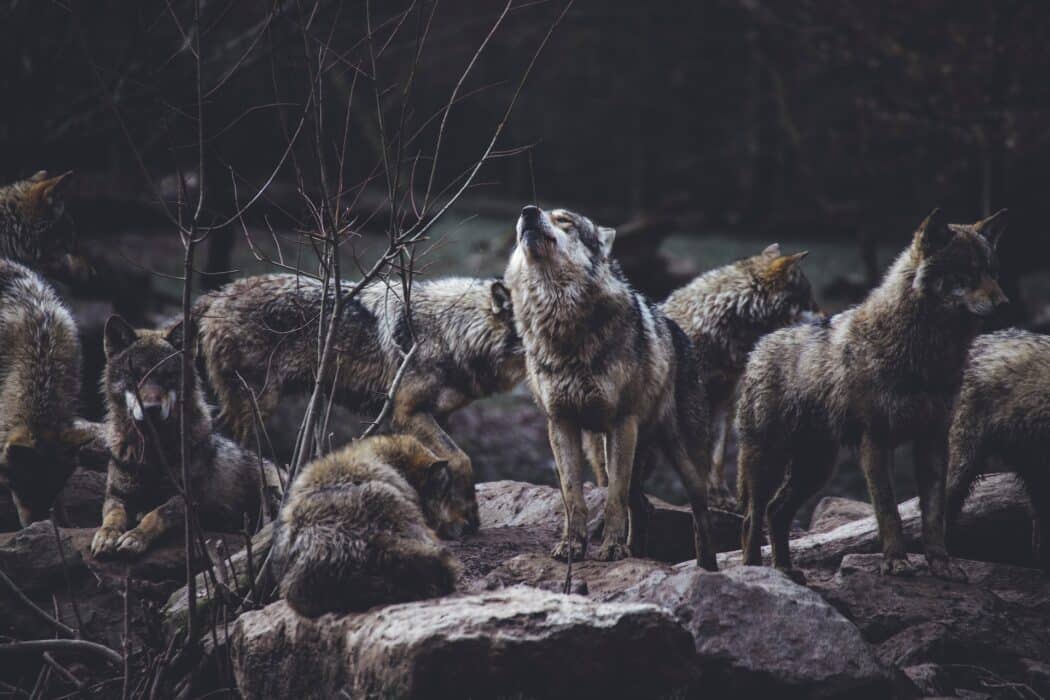
As urban spaces expand more and more into wildlife habitats, these animals must learn to cope with new stimuli, dangers, and opportunities.
Wolves are, perhaps, the most controversial wild animal today, and in Europe this is evident, with the reduction of the species’ protection status and with calls for stricter control, including the use of culling, of wolf populations.
A group of researchers led by the University of Veterinary Medicine Vienna (Austria) and the University of Sassari (Italy) sought to understand how wolves are adapting to a world around them that is changing rapidly.
The study, the results of which are presented in the journal ‘PNAS, focused on wolves living in central Italy. The team studied the behavior of 185 wild wolves, whose individual identities were known, at 44 different sites, some more urban and others more wild. The aim was to understand how the animals reacted to unfamiliar objects they had never seen and to the sounds of human voices.
The results, the authors say, provide unique and important perspectives on how wolves adapt their behavior to environments created by humans.
Fear of humans persists
One might think that the increasing proximity to spaces populated by humans would cause wolves to lose their fear of our species. Earlier studies had already shown that this is not true in Poland, and now this one confirms it in Italy.
When exposed to recordings of human voices, 81% of the wolves studied showed “strong fear responses,” such as changing the direction in which they were walking, adopting a more cautious posture, or even a rapid escape.
Another part of the experiment involved placing objects that the wolves had never seen and recording their reactions. The team found that wolves living in more urbanized areas seemed to be less wary of objects than wolves in less urbanized zones. Still, the “urban wolves” were very cautious, especially when the object was swapped for another by the researchers.
Sarah Marshall-Pescini, the team leader and one of the study’s principal authors, explains that although wolves in urban areas appear to fear new objects less, the animals show greater caution to changes in the surrounding environment, perhaps because urban spaces may conceal more dangers to their survival and, therefore, they must stay more alert.
Despite the caution, the researchers say wolves adapt quickly, demonstrating a great capacity for learning. Moreover, wolves that live in groups tend to show less fear of objects and human voices than wolves that roam alone.
“Our results reveal the great potential of wolves to navigate urban environments as landscapes full of both risks and opportunities, thanks to a multifaceted, flexible, and complex behavioral repertoire,” the researchers write in the article.
“The still unanswered question is whether human societies will be able to rise to the challenge of coexistence with solutions of comparable effectiveness and complexity.”