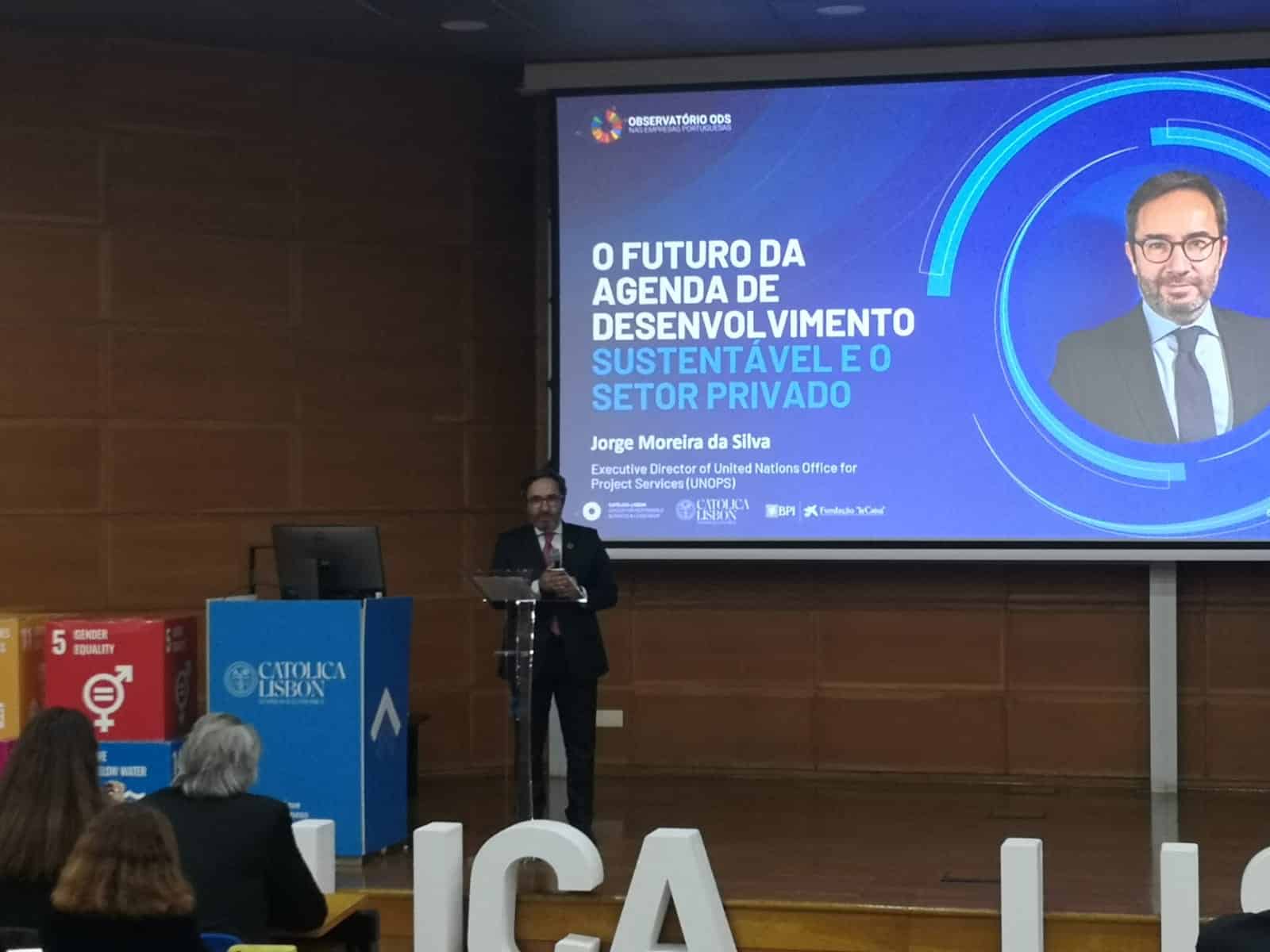
With about four years left for the United Nations’ 2030 Agenda for Sustainable Development to materialize, Jorge Moreira da Silva warns that “this is not the moment to hesitate,” reminding that the 17 goals can only be achieved if the international community accelerates in a way that has not been done so far.
“We did not get there with business as usual, and that has consequences,” said the executive director of the United Nations Office for Project Services (UNOPS) during an event last Friday at the Catholic University of Portugal in Lisbon.
The Portuguese diplomat assured that the sustainable development agenda is no longer viewed today solely as an environmental “green” agenda, and that it is recognized that its scope goes far beyond the environmental facet. Still, he lamented that much remains to be done, pointing out that of the 169 targets that constitute the 17 Sustainable Development Goals (SDGs), only one third are achieved or on track, while the remaining two thirds are behind or even regressing.
“We are better than a few decades ago, but far from what is needed,” said Jorge Moreira da Silva, noting that 24 of the 30 planetary vital signs have been surpassed or are threatened, that “we are not on track for 1.5 degrees” of global warming as was the aim of the Paris Agreement, and that there remains a development aid gap from the wealthier to the poorer countries on the order of four trillion dollars.
“In addition, he highlighted that, according to the climate commitments brought by countries to the climate summit held last November in the city of Belém, in the Brazilian state of Pará, the world will achieve a 10% reduction in greenhouse gas emissions by 2035, compared to pre-industrial levels. However, science says that, to be able to meet the Paris Agreement and avoid the worst climate scenarios, this reduction must be 55%.”
Thus, it is very likely that the 1.5 degrees Celsius target will be out of reach, which Jorge Moreira da Silva warned would be not only a breach of planetary boundaries but also “a rupture with the Paris Agreement.”
Conflicts and instability can derail sustainable development
The head of UNOPS considers that the conflicts and instability that multiply across the world risk derailing sustainable development.
“There is no development without peace, nor peace without development,” he noted, recalling that today we live in the greatest crisis of insecurity and conflict since the United Nations was created, and that 25% of the global population currently lives in conflict, the highest figure since World War II.
“Impunity runs rampant, there are systematic violations of international humanitarian law, UN Security Council resolutions are ignored,” stresses Jorge Moreira da Silva, to describe the level of instability that today characterizes the world. For him, this raises a host of difficulties for the realization of the 2030 Agenda, since “sustainable development begins with peace.”
Regarding the Sustainable Development Goals, of the 17, Portugal has achieved one, the one concerning renewable energy. However, the diplomat, while recognizing the achievement of this objective, stated that “it is of little use for Portugal to be 100% renewable energy if it does not help Mozambique reach the same level.”
He added that Portugal is among the OECD countries that contribute the least to official development assistance.
Jorge Moreira da Silva reminded that Mozambique is frequently affected by climate extremes, despite contributing less than 1% of global greenhouse gas emissions. In this context, he argued that when global crises occur “the most vulnerable are always left behind,” and he noted that for every euro invested in climate adaptation, ten euros are saved in costs resulting from inaction.
“Prevention pays off,” he asserted, lamenting that only 3% of sustainable financing is in developing countries where it is really needed. Therefore, he called for total alignment of financing, both public and private, with the sustainable development agenda.
Jorge Moreira da Silva also highlighted the fundamental role of companies in filling the financing gap for the poorest countries, saying that less than 1% of the global private sector’s assets would be enough to bridge this gap.
Finally, in a message to companies, he stated that “chasing the legislation is not enough” and that they should aim to go beyond what is required of them. For the UNOPS executive director, “no one wins at sustainable development by only complying with the law.”
Europe must ignore the “noise” and persist on the path of sustainability
The event in Lisbon also featured Wim Vermeulen, a prize-winning author and speaker internationally recognized as an authority on the meaningful integration of sustainability into corporate business strategies.
The expert opened his remarks with criticisms of the United States government, especially for the relentless push that the administration led by Donald Trump has waged against global sustainability efforts and in the field of sustainable development.
Trump is “the elephant in the room,” he pointed out, showing an image of an elephant wearing a red hat bearing the administration’s slogan: “Make America Great Again.”
Vermeulen spoke of a “noise” that leads us to believe that the world’s population, including states and companies, is fed up with hearing about, supporting, and spending money on sustainability and the energy transition beyond fossil fuels. And he warned that this noise makes us lose our way and lose sight of what is really important: protecting the planet and people.
The specialist assured that there is no retreat in Europe regarding the role of companies in environmental protection and climate efforts, reinforcing that these contributions are no longer seen as a “moral imperative” but as a matter of “risk management, pure and simple.”
Vermeulen said there is a growing level of “greenhushing,” a phenomenon that leads organizations not to publicize their actions and investments in environmental and sustainable development matters. For him, this is due to companies’ fear of publicizing what they do in these areas and being accused of “greenwashing,” or because they fear being barred from accessing certain external markets, such as the United States.
The speaker pointed out that there is pressure from the United States for European companies, should they want to do business across the Atlantic, to remove from their websites information and pages related to climate change, sustainability, and Diversity, Equity and Inclusion (DEI) topics. Vermeulen stressed that, despite these pressures, Europe should continue moving forward on sustainability and ignore the “noise.”
Regarding the European Commission’s actions, which in recent times have been strongly criticized by non-governmental organizations, especially environmentalists, for backtracking on regulations that protect natural resources and ecosystems, Vermeulen said the European executive “has lost its way a little.”
For the expert, the European Green Deal was crafted “without knowledge of the business reality,” which generated resistance from some companies and sectors, and what is now being done is to ease bureaucracy and design incentives to promote a greater alignment between business and sustainability.
Vermeulen also argued that there is no population fatigue with efforts toward greater sustainability, considering such a notion “strange.” What exists, he explained, is a distrust among people about the capacity or willingness of governments to take the lead on climate action and sustainability.
“People do not trust politicians to solve the problem,” he said, so leadership must be taken by businesses.
Sustainability increasingly at the center of decisions of large companies and SMEs
The interventions by Jorge Moreira da Silva and Wim Vermeulen occurred within the scope of presenting the results of the fourth report of the Observatory of the SDGs in Portuguese Companies, which reveals that the 2030 Agenda has reached “an unprecedented level of maturity in national corporate governance,” becoming a tool to support corporate management.
According to the Observatory study – an initiative of the Center for Responsible Business & Leadership of the Católica-Lisbon School of Business & Economics – about 96.4% of large companies and 82.6% of SMEs agree that sustainability substantially improves competitiveness.
In the study’s universe, 80% of larger companies and 62% of SMEs also admit that sustainability has already changed, or is changing, the way they produce and create value.
At the same time, 69% of Portuguese companies say they already have the SDGs “totally or largely” incorporated into their strategy, while in large companies this figure rises to 98% of the total.
However, the Observatory warns of the need to accelerate the pace, since globally only 17% of the SDG targets are currently on a favorable trajectory, and none of the 17 goals is on track to be fully achieved by 2030.