The natural world is full of impostors, animals that masquerade as others. This tactic allows them to elude the eyes of predators, imitate prey to make capturing them easier, and infiltrate and conquer the territories of other species, even rivals.
Among humans as well these stratagems are nothing new – think of espionage novels and films, for example. But now, a new scientific investigation reveals that blowfly larvae, large flies of the family Calliphoridae, are capable of dressing themselves to the nines to fool termites and live, undetectable, in their termite nests.
In the Anti-Atlas Mountains, in southern Morocco, an international team of scientists discovered how blowfly larvae manage to fool the termites, posing as a member of the colony.
The researchers traveled to that part of the world to study butterflies, but rainy weather kept many from taking flight. So they decided to search for ants. They lifted a rock, and there they encountered a colony of termites that included three fly larvae, of a species they had never seen before.
Subsequent genetic analyses revealed that it is a species of the genus Rhyncomya, which includes other species that have already been found in termite nests. However, this unknown species developed a particularly curious tactic to infiltrate termite colonies.
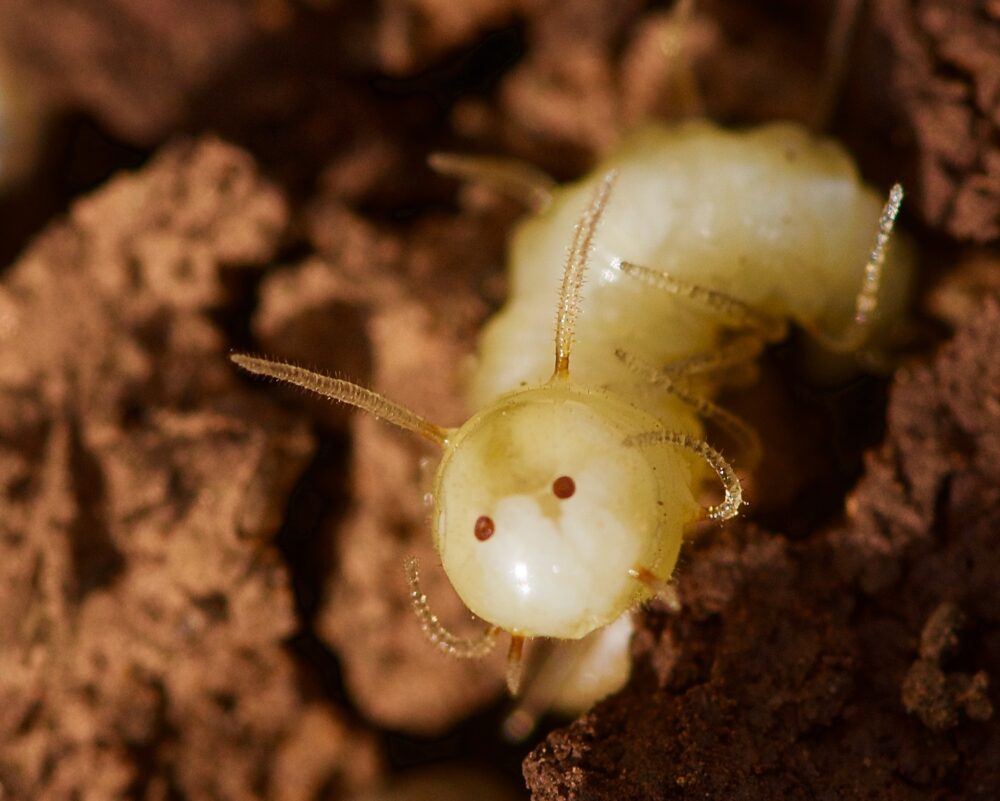
Upon studying the larvae more closely, they identified on the rear end of the animal a kind of “termite mask,” consisting of “a non-functional head with antennae and palps” that nearly perfectly imitates a termite’s head. And it also includes two small dark spots, resembling eyes, which are, in reality, the holes through which the larva breathes.
In addition to the visual disguise, the larva of this blowfly species also employs odor camouflage. Termite colonies, like those of ants, are fiercely protected against intruders, using chemical signals to identify who does not belong. When they detect an intruder, the soldiers attack and dismantle it into pieces.
But these larvae manage to imitate the odors of their hosts, thereby remaining safe from fatal assaults.
In the laboratory, the researchers found that the odor emitted by the larva is indistinguishable from the odor of the termites in whose nests they live. “This odor is essential for interacting with the termites and benefiting from their communal lifestyle,” explains, in a press release, Roger Vila, one of the principal authors of the article published in the journal Current Biology. “It is a chemical disguise.”
And it is quite effective, for, according to the investigation, the termites seem to feed the blowfly larva as if it were their own larva.
Photo: Vlad Dinca, co-author of the article
“As the larvae are not only tolerated, but are constantly communicating with the termites through contact with their antennae-like appendages,” Vila notes, adding that “it even seems that the termites feed them, but this has not yet been unequivocally demonstrated.”
Scientists believe that the relationship between the blowfly larva and the termites could be a form of “social parasitism” or of symbiosis.
“This discovery invites us to rethink the boundaries and potential of symbiotic relationships and social parasitism in nature,” Vila emphasizes. “But above all, we must realize how much we still do not know about the vast diversity and specialization of insects, which are essential organisms in ecosystems,” he highlights.