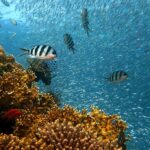
Various species of animals tend to live and operate in groups. With the help of conspecifics, they can more easily defend themselves against predators, explore new environments, and even find mates.
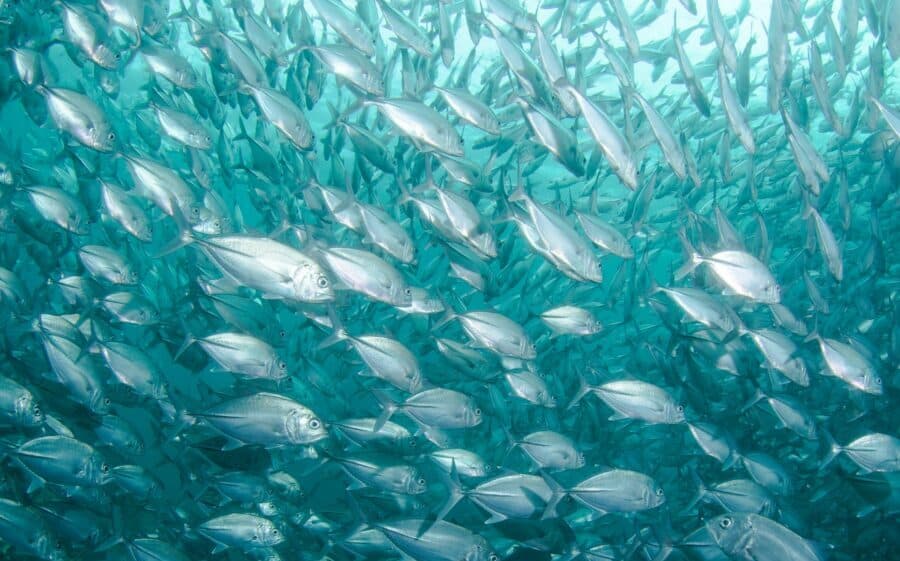
Now, a new investigation reveals that fish that swim in schools are capable of conserving more energy than those swimming alone.
Because water offers resistance to movement 50 times greater than air, aquatic animals must spend more energy to move from one side to the other. In addition, it is estimated that, on average, there is five times less oxygen in a kilogram of water than in the same amount of air, so fish have evolved to optimize how they produce and spend energy in the environments where they live.
Two scientists from Harvard University, in the United States of America, through laboratory experiments with groups of fish of the species Devario aequipinnatus, and the application of principles of biomechanics, realized that there was a much lower energy expenditure per tailbeat, about 56% less compared with solitary fish.
Photo: Yangfan Zhang
“What we found is that the total cost for the group to move as a whole is much lower per biomass than that of the individual,” explains, in a statement, Yangfan Zhang, the first author of the article published in the journal ‘eLife’.
Additionally, they also observed that the lower energy expenditure of the group occurred when the speed did not exceed nor fall below one body length per second. In other words, if the school travelled in one second more or less than the body length of the individuals, it would spend more energy.
“When we look at studies that monitor wild animals, we see that many animals migrate at a speed close to one body length per second,” notes Zhang.
Swimming faster than this costs more energy, and slower as well due to the resistance caused by the water.
The researchers suggest that, by saving energy, schooling fish may have more chances to escape predators, and argue that these energy savings and their benefits “may lie at the base of the prevalence among fish of coordinated group locomotion.”