Deep beneath our feet, scientists report evidence for a vast reservoir of water locked within Earth’s interior. Rather than a surface-like sea, this hidden store lies hundreds of kilometers down, reshaping our models of planetary evolution. The claim does not conjure waves and shores, but an intricate chemistry that holds water in solid rock.
A hidden reservoir, not a sea
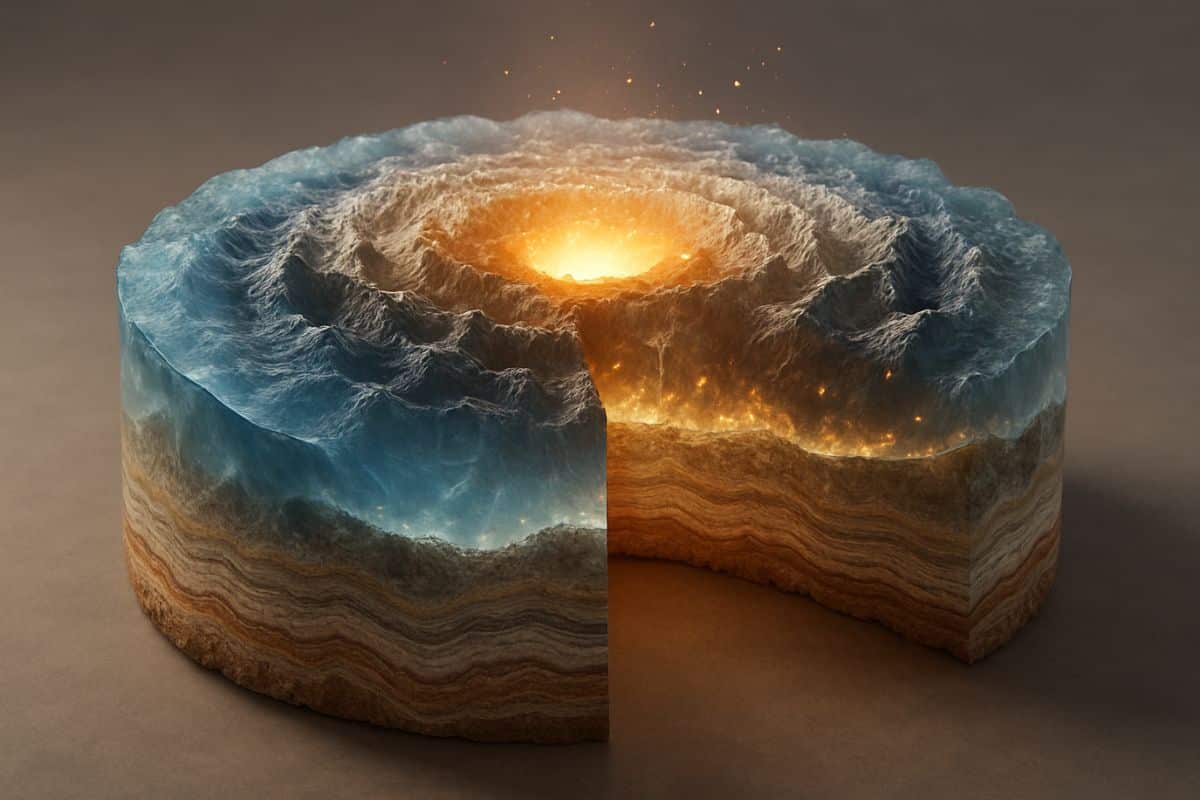
The key lies in the mantle’s transition zone, a layer between roughly 410 and 660 kilometers deep. Here, minerals trap water as hydroxyl groups rather than as liquid H2O. Under extreme pressure, crystal lattices act like sponges for hydrogen.
Two discoveries, a decade apart
In 2009, researchers analyzing a diamond from Brazil identified ringwoodite, a high-pressure form of olivine. The crystal held unmistakable signs of water, proving that the mantle can store volatiles. More than a decade later, a diamond from Botswana revealed similar inclusions, rekindling interest in this subterranean ocean. The newer work, led by mineral physicist Tingting Gu and published in Nature, strengthened the case that the transition zone is richly hydrated.
How water hides inside rock
Ringwoodite can incorporate OH− into its structure, binding water-like species at high pressures. The cumulative effect across a massive volume could equal one or more surface oceans, without forming liquid pools. Seismic data and laboratory experiments converge on this picture, tying mineral physics to global geophysics. Inclusions in diamonds act as tiny time capsules, preserving minerals forged in the mantle’s crucible.
Why this changes the big picture
This discovery recasts Earth’s deep water cycle, linking interior reservoirs to surface processes. Water strongly affects mantle viscosity, melting behavior, and plate tectonics. It may regulate volcanic degassing and long-term ocean volume. Subducted slabs carry water down, and mantle upwelling may carry some back.
- Influence on plate motion through reduced mantle **viscosity** and altered **rheology**
- Control of magma **generation** and volatile **fluxes** in volcanic arcs
- Buffering of long-term sea-level via deep **storage** and gradual **release**
- Improved models of mantle **convection** and thermal **evolution**
- Clues to how Earth retains **habitability** over geologic **time**
“I think that this underground ocean could be the source of a deep water cycle, which is in fact **crucial** to the functioning of our **planet**,” said Tingting Gu, emphasizing the scale of the mantle’s hidden **reservoir**.
Not at the core—and why that matters
Despite sensational headlines, this reservoir is not at the core, nor is it a swimmable ocean. It resides in the mantle’s transition zone, where minerals stabilize under fierce pressure. The nuance matters because mineral physics—not empty caverns—explains the observations and their planetary implications. Understanding the exact distribution of water shapes our models of interior dynamics.
Clues from diamonds and seismic waves
Diamonds rising in kimberlite eruptions sometimes trap tiny fragments of deep minerals. These inclusions, analyzed by spectroscopic and microscopic techniques, reveal hydration states at extreme conditions. Meanwhile, seismic waves map changes in mantle structure that match hydrated mineral boundaries. The convergence of multiple methods bolsters confidence in the overall story.
A window into other worlds
Earth’s interior hydration reframes how we think about rocky planets beyond our solar system. If deep reservoirs are common, surface water may be only the visible fraction of a planet’s total inventory. The balance between interior storage and surface release could decide long-term climate and habitability. That perspective subtly expands our view of the universe, from stars and galaxies to the hidden water within worlds.
What comes next
Future work will refine how much water the transition zone holds and how it cycles over time. Researchers will combine high-pressure experiments, seismic imaging, and analyses of deep diamonds to trace pathways from subduction to eruption. Each new sample and seismic map will narrow uncertainties, turning a tantalizing hypothesis into a quantified budget.
In the end, the planet beneath us is more hydrated and more dynamic than we once imagined. The discovery invites a fresh synthesis of geology, geochemistry, and planetary science. From the smallest inclusions to global circulation, water quietly threads through Earth’s interior, transforming how we read our planet’s deep and enduring story.