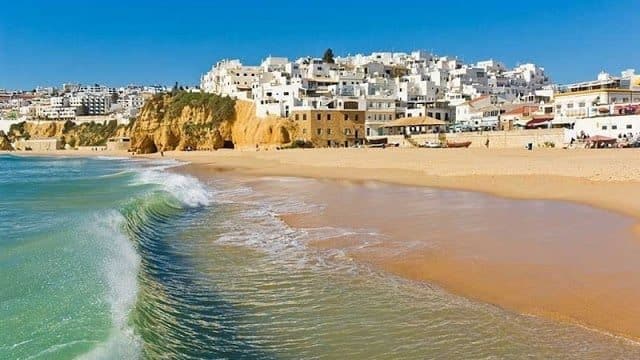
The storms of the winter last year caused “significant impacts on the morphology of the beaches”, but 41% of the monitored beaches recovered or exceeded the average values of width and sediment volume, while 59% remained below those values, revealed the Portuguese Environment Agency.
“Overall, the results show that the storms of the maritime winter of 2025/2026 caused significant impacts on the morphology of the beaches,” states a new report by the Portuguese Environment Agency (APA), released yesterday.
The APA evaluated the impacts of extreme events on the morphology of the beaches of continental Portugal, as well as “the evolution of the respective natural recovery process in the following months, continuing the technical report of the “Summary of Occurrences in the Coastal Strip of Continental Portugal (March 2026)”.
In the final considerations, the APA notes that the comparison with historical average conditions “shows that about 41% of the monitored beaches recovered or exceeded the average values of width and sedimentary volume, while 59% remain below these reference values, evidencing the persistence of sediment deficits in a significant part of the sites analyzed”.
On the beaches where it was possible to directly assess recovery relative to the losses caused by the storms, “it was found that between 35% and 41% recovered completely or surpassed the losses recorded in terms of width and volume, respectively”.
On the other hand, it adds, “about 45% show partial recovery, demonstrating a positive morphological response, but still insufficient to fully restore the conditions prior to the events”.
“Only a small fraction of the monitored beaches continues to show signs of persistent erosion or absence of effective recovery. Additionally, on the evaluated beaches, only by comparing the pre-storm situation with the current situation, mostly located on the southern coast of the Algarve, the morphological recovery still appears limited,” the document notes.
This situation, however, for the specialists, “is to be expected, given the short time window between the end of the storms and the surveys, with the expectation that, in the meantime, considerable recovery of width and sediment volume has occurred.”
The analysis, the agency explained, was based on data from the topographic surveys carried out under the Continental Portugal Coastal Zone Monitoring Program (Cosmo), complemented by additional campaigns developed by APA technical teams.
“The results allowed quantifying the evolution of the width of the beaches and the sedimentary volumes, as well as characterizing the current morphological state of the monitored beaches, contributing to a better understanding of coastal dynamics and to the strengthening of management strategies and adaptation to climate change,” it referred.
Twenty-seven beaches along the continental coast were analyzed (19 on the western coast, eight on the southern Algarve coast), in the municipalities of Caminha, Esposende, Vila do Conde, Matosinhos (North Region Hydrographic Administration), Ovar, Vagos, Figueira da Foz, Leiria, Marinha Grande (Center), Almada, Sesimbra (Tejo e Oeste), Odemira (Alentejo), Lagoa, Albufeira and Olhão (Algarve).
For the APA’s Coastal and Shoreline Protection Department team, with the collaboration of the Coastal Water Resources Division, ARH do Algarve, despite the significant impacts on beach morphology, “a substantial portion of the monitored beaches already shows natural recovery processes, with cases of full or partial recovery of the width of the shores and the sediment volumes.”
“However, the data show that a relevant portion of the beaches has not yet fully recovered the conditions prior to the storms, so the evolution of their morphological response should continue to be monitored,” they argued.
Experts noted that, in this context, “coastal monitoring is established as a strategic instrument of knowledge and decision support, indispensable for integrated and adaptive management of the coastal strip.”
“The continuity of these programs allows monitoring the evolution of the beaches, identifying more vulnerable situations, assessing the effectiveness of interventions carried out and underpinning priorities of action,” they concluded.