Shells of snails can function as small “time capsules” of meteorology, allowing reconstruction of extreme phenomena that occurred before the existence of modern meteorological records. The conclusion results from a study by the University of Queensland, published in a peer-reviewed scientific journal.
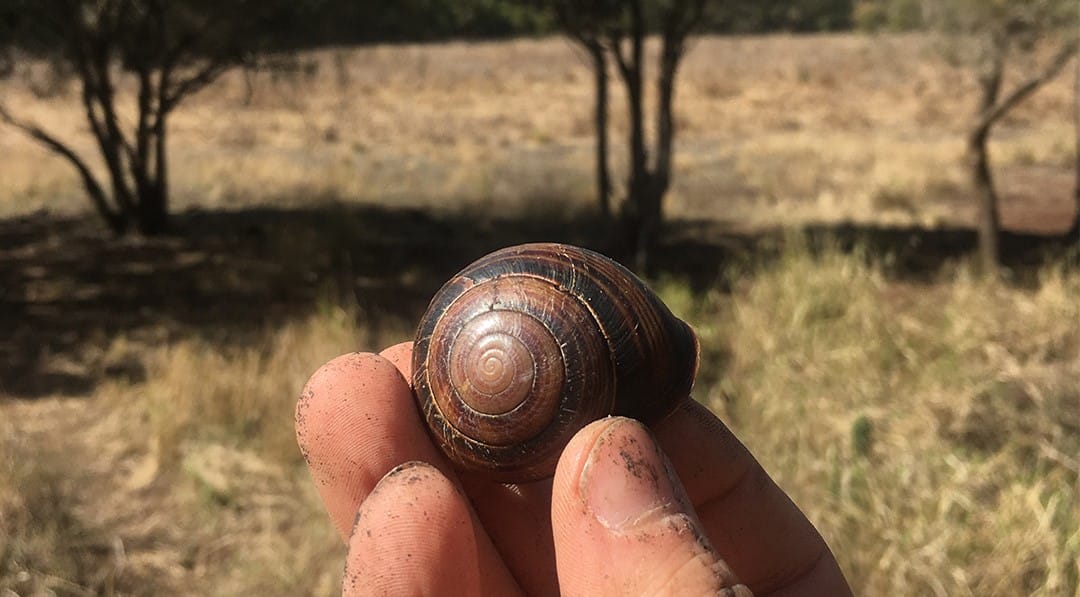
The team, led by researchers from the School of the Environment, analyzed the growth rings of the shell of a snail of the species Figuladra bayensis, known as the Biggenden Banded Snail, collected in Coalstoun Lakes National Park, in southeastern Queensland, Australia.
Small samples of the shell, collected at intervals of only a few millimeters, allowed determining the age of the animal, the period it lived, and the meteorological conditions to which it was exposed. For this, the researchers turned to high-resolution radiocarbon dating and to the analysis of stable oxygen and carbon isotopes present in the different layers of the shell.
“We used high-resolution radiocarbon dating to determine the age of the growth rings in the shell,” explains Nicholas Patton, a researcher at the University of Queensland.
“The shell contained elevated levels of radiocarbon from nuclear tests conducted in Australia in the 1960s, which allowed us to date the growth rings and reveal that the snail had lived for about 4.5 years,” he adds.
The isotope analysis also provided information about the rainfall logged during the animal’s life. The investigators found, however, that the shell did not grow continuously: rapid growth periods were interspersed with phases of little or no growth.
Initially, the team expected that the periods of faster growth would coincide with years of higher rainfall, which would provide more food to the snail. The results pointed, however, to another phenomenon.
“The results showed that the snail was responding to episodes of extreme rainfall, not to annual humidity,” says Jamie Shulmeister, honorary professor at the University of Queensland.
As the investigators were able to determine when the snail lived, it was possible to relate the bursts of growth to specific meteorological events. In this case, they coincided with periods immediately after the passage of cyclones in 2015 and 2017.
“Because we knew when the snail lived, the bursts of growth could be associated with periods immediately after the 2015 and 2017 cyclones,” explains Jamie Shulmeister.
The severe tropical cyclones Marcia and Debbie each triggered episodes of extreme rainfall in Coalstoun Lakes National Park. For the investigators, the result demonstrates that snail shells can constitute a tool to identify extreme meteorological phenomena that occurred before the existence of current meteorological records.
“It is surprising and quite exciting that the humble snail can be a tool for reconstructing the trajectories of past cyclones, even in prehistoric times,” says Jamie Shulmeister.
The team now intends to test the method on different shells and sedimentary deposits. If shells are found in different layers of sediment, the investigators could combine the individual records and move further back in time.
“If we can find shells within different layers of sedimentary deposits, we can combine the individual records from each shell to extend this information even further back in time,” concludes Nicholas Patton.