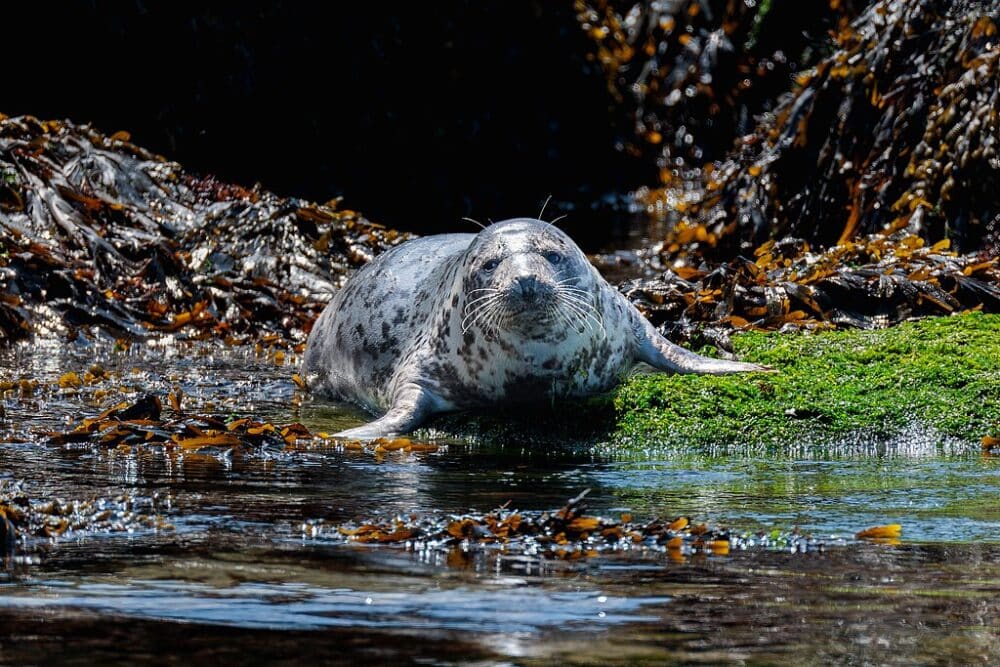
Some marine mammals, such as whales and seals, are capable of making dives to great depths, holding their breath for several minutes.
But how they do it without risking drowning had been a mystery until a team of scientists, led by the University of Saint Andrews in Scotland (United Kingdom), discovered what is considered to be a fundamental evolutionary adaptation.
In a study published in the journal Science, the researchers say that seals are capable of consciously knowing the oxygen levels in their blood. This allows them to decide whether they dive deeper or, instead, whether it would be better to surface to breathe.
The scientists consider that seals have a particularly developed ability to assess the levels of oxygen in their bloodstream in such a way that when the amount of oxygen is lower they make shallower dives. On the other hand, when they have higher levels of oxygen in the blood, they undertake dives to greater depths.
Another singular finding made in this work was that, unlike most other mammals, seals do not seem to be very sensitive to the levels of carbon dioxide in their blood, and the amount of this gas circulating in the animals’ bloodstream does not seem to affect the duration of the dives.
The researchers say that this ability of seals to know the oxygen levels in their blood is a fundamental adaptation in the evolutionary history of these marine mammals, allowing them to dive to greater depths without risking losing consciousness and drowning.
And they believe that this adaptation may also be present in other species and groups of animals that have learned to dive, such as some birds and marine reptiles.
“Discovering such a fundamental aspect of the evolution of marine mammals, which is so central to a large part of what they do—diving—is incredibly exciting,” says Chris McKnight, the study’s first author, in a press release.
“It seems that this has been right in front of our eyes all this time. No matter how simple and logical it may seem at first glance that seals can sense oxygen and that this helps them make decisions to avoid running out of oxygen and drowning, evolutionarily, this makes them and their physiology among the most uniquely adapted animals in the world,” he adds.