A team of four researchers from the Center for Marine and Environmental Sciences (MARE) discovered that heat waves negatively affect the cognitive performance of cleaner wrasses (Labroides dimidiatus).
Heat waves, intensified by rising global temperatures, have profoundly affected marine ecosystems. Among the most affected are coral reefs, essential to marine biodiversity and to the interactions among species. An example of these complex interactions is the relationship established between cleaner wrasses and their client fish.
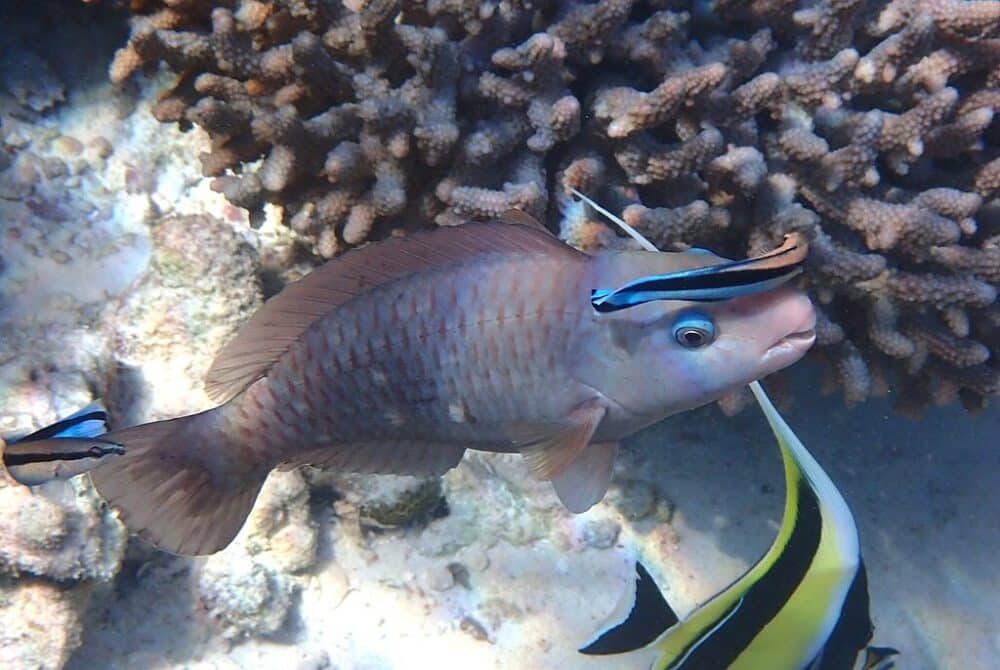
These small fish play an essential role by removing parasites from client fish, thereby maintaining the health and diversity of marine populations. However, warming waters have shown significant negative impacts on their behavior and physiology, as revealed by an article published in the journal an article published in the journal ‘Functional Ecology’.
Through laboratory experiments, the researchers found that after facing a heat wave, the cleaner wrasses showed a recovery in their cognitive performance. However, they temporarily maintained some deficits.
But the most alarming, according to the Portuguese team in a press release, were the morphological changes in the fish’s brain. Although the overall brain size of exposed fish was significantly larger, the telencephalon (the region associated with higher cognitive functions and social behaviors) was notably reduced, while the brainstem showed a considerable increase.
This imbalance in brain structure suggests that, although cognitive effects may be reversible in the short term, the changes in brain regions associated with higher cognitive functions (such as social interactions) could have lasting impacts.
“This means that the structural changes caused by heat waves may interfere with ecological interactions and with the vital role of cleaner wrasses on coral reefs,” warn the scientists.
For them, this study highlights the importance of conservation strategies that go beyond the physical protection of reefs and fish populations.
“The preservation of the ecological function of cleaner wrasses, which are fundamental to the health of coral reefs, also depends on actions that minimize the impacts of global warming and marine heatwaves, ensuring the recovery not only of populations but also of the cognitive and social abilities of these species,” they argue.