
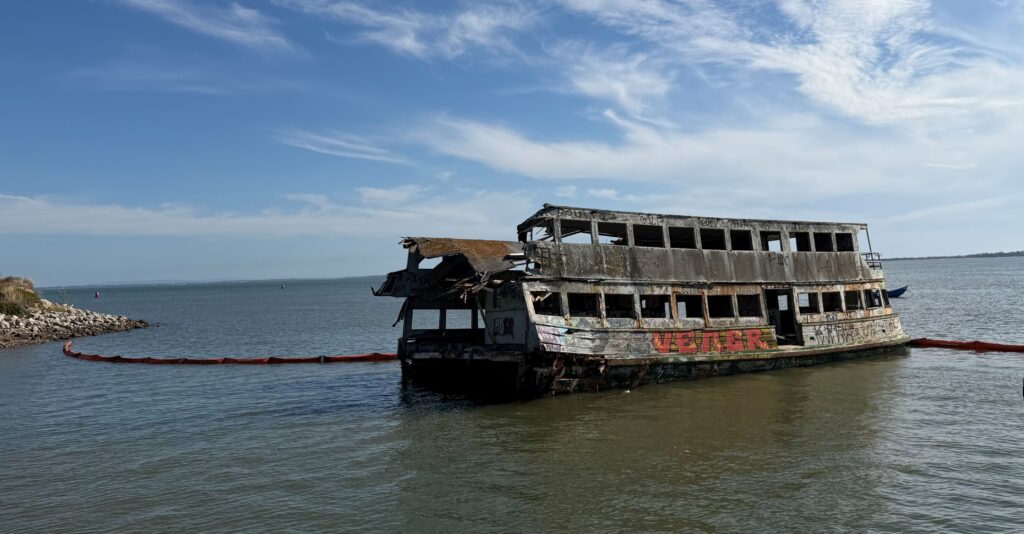
Almost 20 years after ceasing to sail and having been beached and abandoned on the Mitrena Peninsula, the historic vessel is finally being dismantled, “thus representing another step in the valorisation and upgrading of spaces under port jurisdiction, contributing to the reinforcement of safety conditions, the operability of the infrastructures and the environmental sustainability of the Port of Setúbal,” the statement said.
According to the same source, there are vessels that end up forming part of the memory of the estuary and the city. The vessel “Recordação” is one of them. Built of wood, in 1961, at the Arrentela shipyards, the old conventional passenger transport vessel began by crossing the Tagus, linking Terreiro do Paço to Cacilhas and transporting thousands of passengers daily. Later, it reached Setúbal, where for years it provided the river link to Tróia, becoming a familiar presence in the waters of the Sado and in the memories of several generations.
With the modernization of river connections and the introduction into operation of the new catamarans, in 2008, the “Recordação” ceased sailing. Since then, it remained beached in the Mitrena area, exposed for almost two decades to the action of the elements and to the natural wear of its wooden structure.
The Port of Setúbal has now begun the removal of the vessel, a necessary intervention given its advanced state of degradation. The condition of the structure does not allow its relocation as a vessel, so the “Recordação” is being worked on in situ, in a phased and controlled manner. The works are being carried out by a properly licensed and qualified entity for the purpose, ensuring the correct treatment, routing and valorisation of the resulting materials.
Before the operation, the vessel was subjected to environmental removal by a specialized company of all potentially contaminating materials, in accordance with the best international practices and with national and European legislation. It was also the subject of collection of elements for historical memory.
Throughout the operation, the Port of Setúbal monitored and supervised the works, ensuring compliance with safety requirements and applicable environmental protection measures. The entire operation was subject to prior approval by the various entities and competent authorities that oversee this process.
The intervention will contribute to the cleaning and upgrading of the shoreline and to the improvement of safety conditions in that space under port jurisdiction, long occupied by the remains of the vessel.
The Port of Setúbal will continue to develop initiatives that promote efficient, responsible and sustainable management of the public port domain, in close coordination with the competent authorities and for the benefit of the port community and the region.
In a subsequent phase, already in preparation, it will also be necessary to carry out the environmental removal, by certified companies, of the remaining old Transado ferries – Transportes Fluviais do Sado, S.A., still deposited in Mitrena, which likewise do not have conditions to sail to a shipyard due to the advanced state of degradation of their hulls and which have already been cleaned of all potentially contaminating materials.





