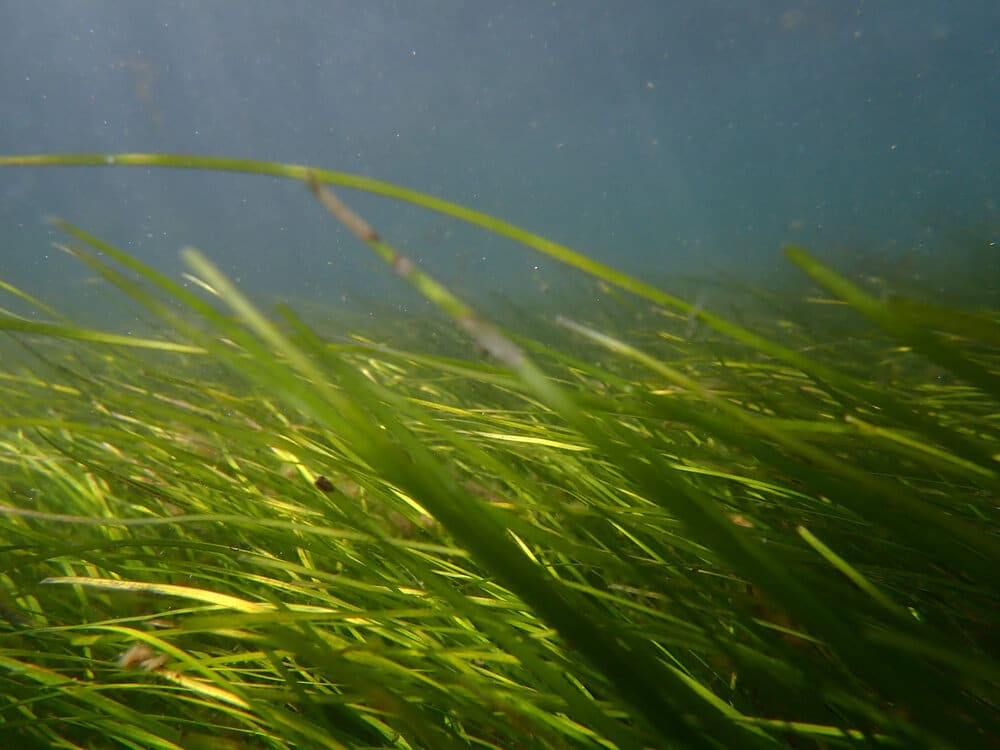
The non-governmental organization Ocean Alive has advocated the need for an “integrated approach” in the restoration of marine and estuarine habitats and called for the valuing of seagrass meadows.
In connection with World Seagrass Day, which was observed on Sunday, the organization focused on the Sado River estuary states that only an ecological and economic balance of territories “will sustain biodiversity, fishing, and the protection of coastal areas.”
In a statement, it also calls for the adoption of “transformative measures” that reconcile nature conservation with human activities, climate action, and the future of coastal communities.
Ocean Alive, which has been working for more than a decade in the Sado estuary with fishing communities, schools, researchers and decision-makers, says that an “integrated vision” has contributed to greater recognition of the importance of marine forests in public policies.
The organization highlights the inclusion of seagrass meadows and salt marshes in the Climate Law as natural carbon sinks, and adds that the recent Blue Forest program, created by the Ministries of the Environment and Agriculture, “has reinforced the relevance of mapping, restoration and conservation of these coastal systems, opening new funding and action prospects at the national scale.”
“We have worked for more than a decade to bring visibility to seagrass meadows. We have learned from communities that we cannot look at just one habitat. We must view the estuary as a whole,” says Raquel Gaspar, co-founder of Ocean Alive, as quoted in the release.
The organization emphasizes that, to maintain and restore seagrass meadows, their benefits must be valued in the decision-making processes that affect the territory.
And it adds that an act of environmental justice will be the valuation of the ecosystem services associated with seagrass meadows in environmental impact assessment processes.
World Seagrass Day was proclaimed by the United Nations General Assembly in 2022, on the proposal of Sri Lanka, to raise awareness of the need to protect and conserve these ecosystems.
Seagrasses are flowering plants in shallow coastal waters on all continents, except Antarctica, says the UN, explaining that the vegetation forms meadows that provide food and sustain some of the world’s largest fisheries, including Atlantic cod.
They are ecosystems, the UN adds, that form complex, highly productive and biologically rich habitats, and provide food and shelter for thousands of marine species such as turtles, fish, and seahorses.
They also protect coastal populations from flooding, dampening wave energy, improve water quality, and store up to 8% of the world’s oceanic carbon.
The United Nations urges countries to promote actions to conserve the vegetation that goes from the tropics to the Arctic Circle, covering 0.1% of the ocean floor.
Ocean Alive is a non-governmental organization dedicated to the conservation and restoration of marine forests, involving local communities, scientists and policymakers.