The majority of humans have a preference for one hand to perform a variety of tasks, such as writing or holding a glass, and also for feet, for example, to kick a football.
This is called lateralization, the preference for one side over the other, and it has also been found in other animals, including non-human primates and birds such as gannets.
Lateralization is normally associated with the existence of more than one appendage, such as arms, legs or antennae, but could it also occur when there is only a single appendage, such as the tongue or a proboscis (like the elephant’s trunk or the elongated mouthpart of a butterfly)? A scientific investigation reveals that yes, as even moths can have a preference for the left or right side.
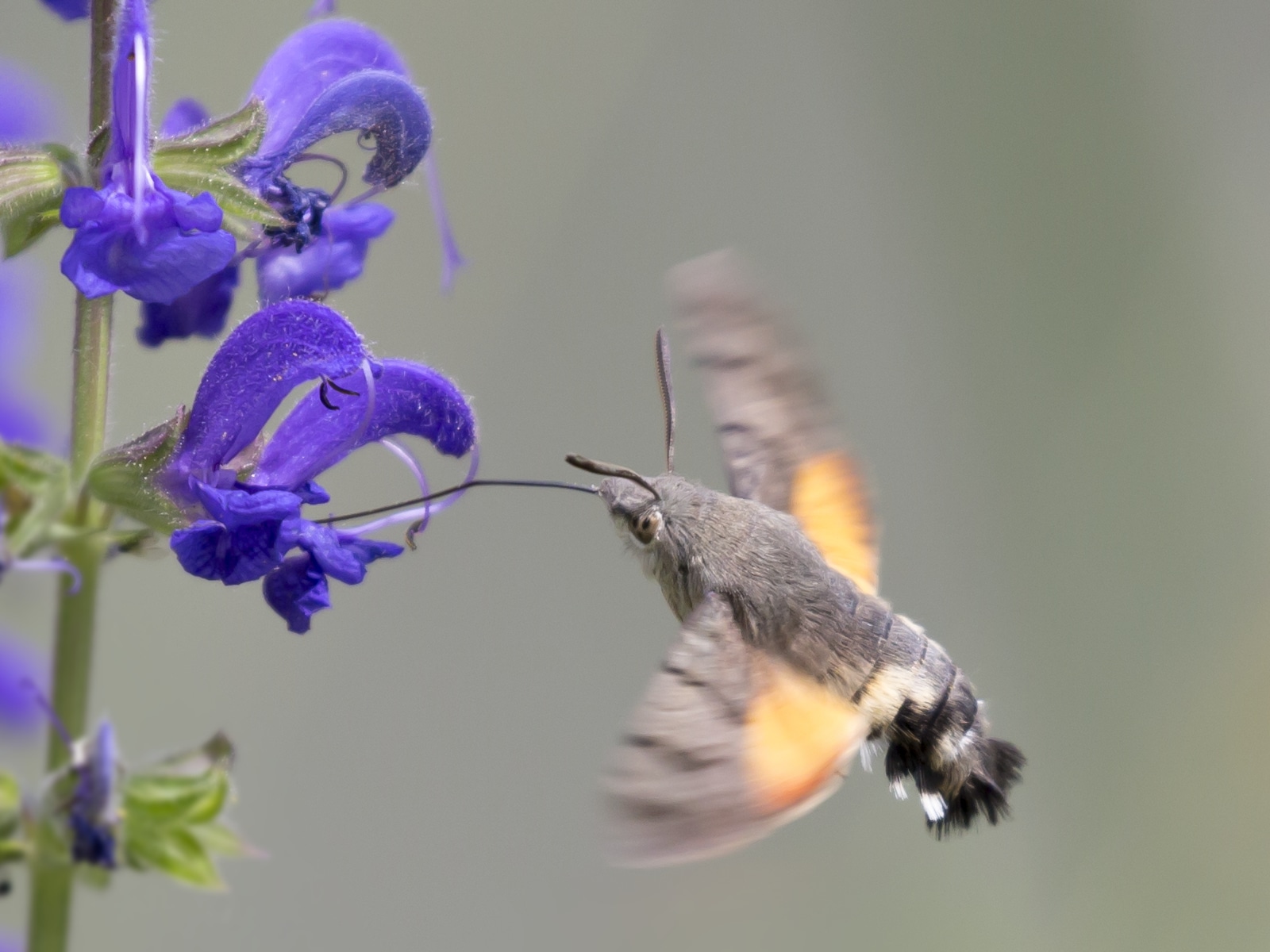
Led by scientists from the University of Konstanz (Germany), the study featured the hawkmoth species Macroglossum stellatarum, which, although belonging to the group of nocturnal moths, is mainly active during the day. The body shape and the way it beats its wings resemble a hummingbird or a bumblebee.
It feeds on nectar, extending its long proboscis and inserting it into the flower, from which it sucks the sugary liquid. And it is here that lateralization emerges, for the researchers say that these moths, and possibly other butterflies, seem to uncoil and extend their proboscises predominantly to the right or to the left to inspect flowers in search of nectar.
To discern lateralization in these butterflies, scientists, in the laboratory, presented the insects with artificial flowers, to which high-speed cameras were pointed. With these images, they were able to perceive the movements of the proboscises in relation to the rest of the animal’s body.
Thus, it was found that some tended to position the tip of the proboscis predominantly to the left side of the midline of their bodies when inspecting the flowers, while others showed a preference for the right side. Anna Lisa Stöckl, co-author of the article, considers that this preference is an “innate” trait and that “it plays an important role in the orientation of the moth’s behavior when inspecting flowers.”
Furthermore, the team also noticed that the Macroglossum stellatarum have a dominant eye to see the part of the flower they are touching. The experiments revealed that the side of the dominant eye corresponded “consistently” to the side toward which the proboscis was preferentially oriented. Thus, the dominant eye and the proboscis function as a coordinated unit.
“Insects have very small brains. Aligning the proboscis with the visual field of the dominant eye can save valuable processing capacity in controlling the behavior,” explains Lochlan Walsh, the study’s first author.
“Rather than constantly recalculating a movement for all possible angles, the animal can rely on a familiar side of its body to guide its actions,” he adds.
The team believes that the results of this work show that one does not need a large brain to perform precise behaviors, such as aligning sight with a long proboscis that one intends to insert into the center of a flower. “Animals can use efficient shortcuts created by the relationships between body, senses and movement,” points out Stöckl.
“Each hawkmoth solves the challenge of inspecting flowers through the lateral preferences of its own body. Therefore, our study suggests that lateralization can be one of nature’s ways of simplifying difficult tasks, whether that task is reaching a cup of coffee or using a proboscis to search for nectar while hovering in front of a flower.”