A fossil discovered in China, dating to roughly 168 to 163 million years ago, preserves a rare throat structure and provides new clues about the evolution of milk suction and swallowing in the earliest relatives of mammals.
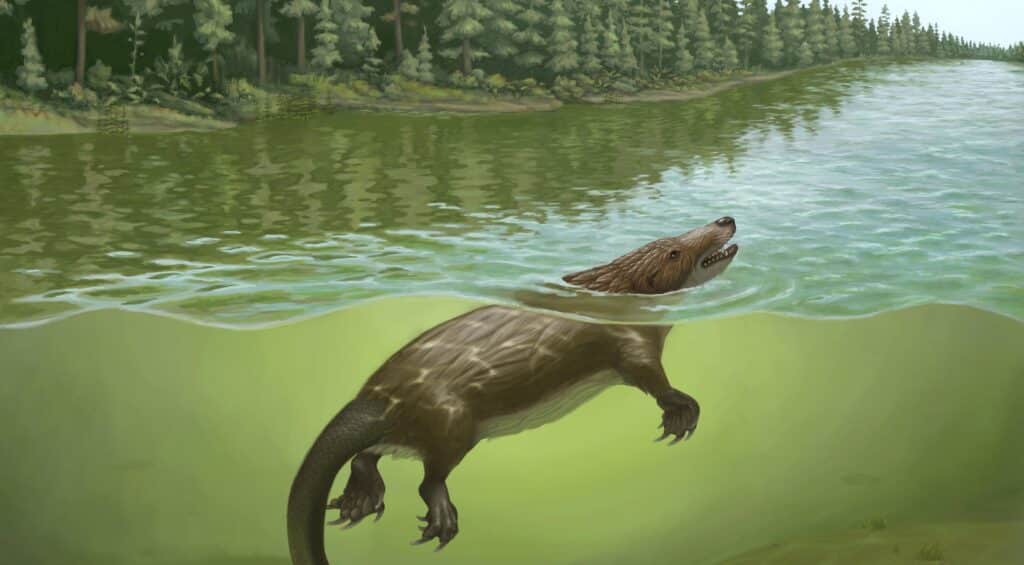
The species, named Megacauda, belongs to the docodonts, a group of mammaliaforms that includes extinct relatives of modern mammals. The animal had a broad, flattened tail, short hind limbs with relatively long feet, and teeth adapted for cutting. These features suggest a semi-aquatic lifestyle and a predatory diet.
Researchers believe that Megacauda could shelter in burrows on land and forage in the water, including fish, salamanders and invertebrates. Weighing about one to two kilograms and roughly the size of a modern platypus, it is the largest Jurassic mammaliaform known.
The most notable element of the fossil is, however, the exceptional preservation of the throat region. Soft tissues are rarely preserved in the fossil record, so this discovery allows analysis of a feeding-related structure in an unusually detailed way.
In mammals, the pharynx plays a specialized role in milk suction during lactation and in the swallowing of foods and liquids in adulthood. Analysis of the throat of Megacauda indicates that the set of structures necessary for these functions was already present in the earliest relatives of modern mammals during the Middle Jurassic.
Thus, the discovery helps to time the evolution of these features and reinforces the idea that the earliest mammaliaforms, which lived alongside the dinosaurs, occupied a diversity of ecological niches.
The study was published in the journal Nature.