Many of the mammals that live in the ocean and, during winter, have to face frigid waters rely on body fat to keep their internal temperature constant, as is the case with whales, walruses, dolphins, sea lions and many others.
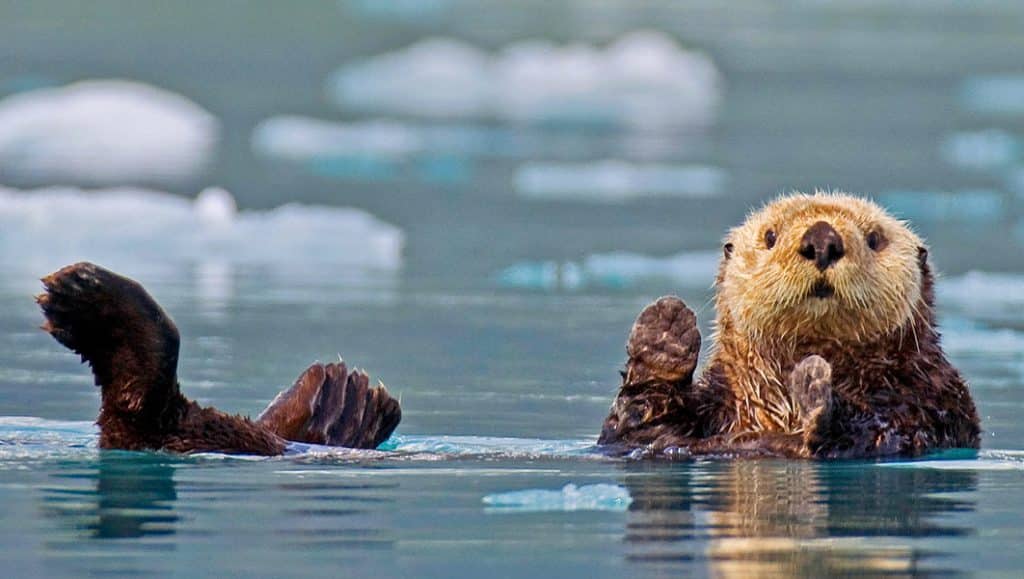
The sea otter is also one of the mammals that swims in cold waters in winter, and to avoid dying of cold it must maintain an internal temperature of about 37.7 degrees Celsius, almost double the temperature of the water in which it swims. But how does this animal manage to keep its body temperature constant and prevent hypothermia?
Unlike the large oceanic mammals, the otter is small, which means it is always losing heat. Evolutionarily, the otter is relatively recent, having emerged only about 1.6 million years ago. Whales appeared 50 million years ago and sea lions between 23 and 29 million years ago, which is enough time to adapt to life in the ocean.
The secret of otters in facing low temperatures lies in their fur, which is the thickest of all animals on the planet, about one million hairs per 2.5 square centimeters. The fur, which is waterproof, also allows air to be trapped near the surface of the skin, which helps to maintain the temperature and gives the shiny appearance characteristic of otters when they are in the water.
It was also this fur that almost caused the extinction of the species. During the 19th century sea otters were intensively hunted, almost to extinction, for the manufacture of hats and coats.
Although the population of sea otters has gradually recovered over the years, the International Union for Conservation of Nature continues to classify these animals as threatened. Currently, the greatest danger to sea otters is not hunting for clothing production, since the species is internationally protected, but oil spills.
Oil spills interfere with the waterproofing of the fur, in addition to making the otters sick due to the toxins they ingest. Sea otters play an important role in terrestrial ecosystems and mitigate some of the environmental impacts of human activity. Sea otters help to protect kelp — Laminariales, a type of algae belonging to the class Phaeophyceae — from sea urchins, which in turn slow global warming.
Thus, it is important to protect this animal, not only so that it does not go extinct but also to mitigate global warming.