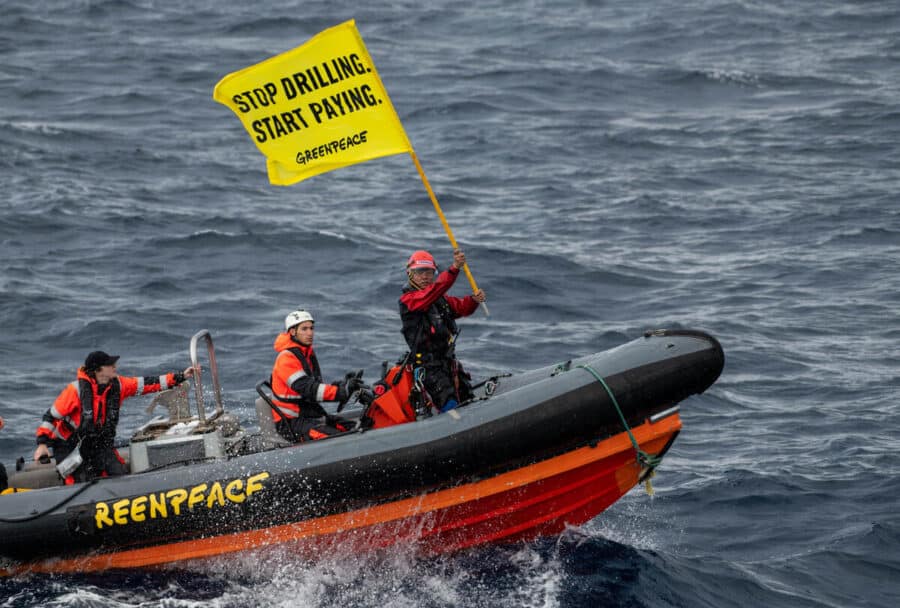
A judge in the North Dakota state of the United States on Friday upheld the verdict ordering the NGO Greenpeace to pay 345 million dollars (€293 million) in damages to the operator of a pipeline it opposed.
The decision, unprecedented in the history of environmental NGOs, threatens the very existence of the iconic environmental protection organization, which accuses an American oil company of trying to silence it by bankruptcy, AFP reported after reviewing the ruling.
“This is a devastating ruling,” Michael Gerrard, a law professor at Columbia University and a climate-litigation expert, told AFP, “not only for Greenpeace, but also for the global environmental movement.”
Today’s decision confirms a jury verdict from March 2025 that held three Greenpeace entities responsible for the majority of the charges brought by Energy Transfer and ordered them to pay more than $665 million (€563 million).
That record amount was later reduced by the judge, who found that some damages had been counted twice.
Energy Transfer, the oil and gas infrastructure company, accused Greenpeace of playing a central role in large-scale protests in 2016 and 2017 against the construction of a pipeline, a claim rejected by the NGO and by Indigenous representatives involved in the protest movement.
The company sued three Greenpeace entities, including its international and American branches, for various offenses, including defamation, disruption of the peace, and trespass, seeking a record-breaking damages award.
The NGO, which has repeatedly stated that it cannot pay such an amount, said it intends to appeal.
“This legal battle is far from over. We will seek a new trial and, if that is not possible, we will appeal the ruling to the North Dakota Supreme Court,” Kristin Casper of Greenpeace International announced this week.
The Standing Rock Sioux Tribe and environmental groups, including Greenpeace, accompanied at times by thousands of protesters, tried unsuccessfully to block the construction of a stretch of the pipeline which, according to the Sioux, would cross sacred sites and threaten their drinking-water sources.
Energy Transfer sought $300 million in damages from Greenpeace to compensate for the harm it claimed to have suffered during this protest movement.
But, during the trial, the damages requested more than doubled, in order to “deter Greenpeace and other organizations from acting in the same way in the future,” according to one of Energy Transfer’s lawyers, Trey Cox, cited by the North Dakota Monitor.
This was the second lawsuit filed by the group against Greenpeace, after the failure of an initial action in 2019 in a federal court.
Determined to retaliate, Greenpeace announced in 2025 that it would sue the company in the Netherlands, where its international headquarters are located, invoking European legislation against abusive litigation and would seek compensation for the costs incurred in these legal battles.