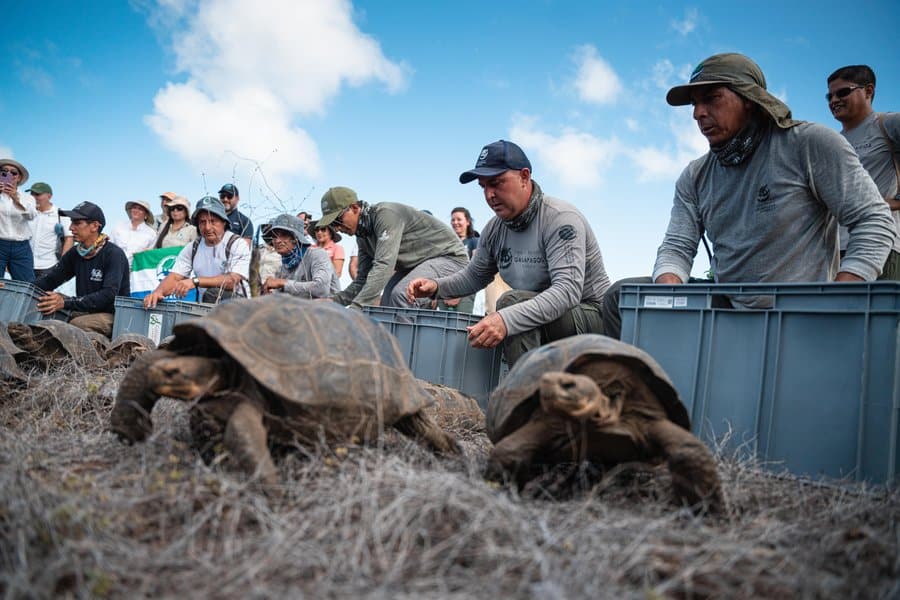
Giant tortoises are, once again, walking on Floreana Island, also known as Santa Maria, in the Galápagos archipelago, after having been driven to extinction in the 1840s by whaling crews who fed on this large land reptile.
Last week, 158 juveniles of Chelonoidis niger niger, the Galápagos giant tortoise subspecies native to Floreana Island, were reintroduced into the ancestral habitat of their ancestors. The action is part of an ecological restoration project for the island which, in addition to the giant tortoise, aims to reintroduce 12 native species, described as one of the most ambitious ecological restoration initiatives ever implemented in the Ecuadorian archipelago.
According to information released by the Charles Darwin Foundation, a partner in the project, the giant tortoises released last week are the result of decades of scientific work.
In the 2000s, scientists conducted genetic tests on some giant tortoises living on Wolf Volcano on Isabela Island, also in the Galápagos, and realized that they carried genes from Floreana tortoises, a lineage that at that time was believed to be irretrievably lost.
Through a captive breeding program, specialists attempted to create a tortoise population that was genetically as close as possible to the original Floreana giant tortoises.
Hugo Mogollón, director of the Galápagos Conservancy, the organization that led the tortoise release, says, in a statement, that identifying the tortoises on Isabela with the genes of the Floreana subspecies and breeding their descendants allowed bringing the tortoises back to the island in a form that faithfully reflects the original lineage.
For him, this action has “created a critical scientific foundation for the restoration of Floreana ecosystems and the future reintroduction of additional native species.”
Experts explain that the giant tortoises will be essential to Floreana’s ecological restoration efforts, as they help keep open habitats, promote the growth of native plants, and create conditions for the proper functioning of the entire ecosystem. In addition, it is hoped that the return of the tortoises will also benefit several other animal species, such as seabirds, coral reefs, and fish populations.
The Chelonoidis niger niger giant tortoises were the first native species from the Floreana restoration project to be released on the island. With that phase completed, NGOs and Ecuadorian public institutions are already preparing the next steps, which include releases of other indigenous species, such as mimids, snakes, finches and Galápagos flycatchers.