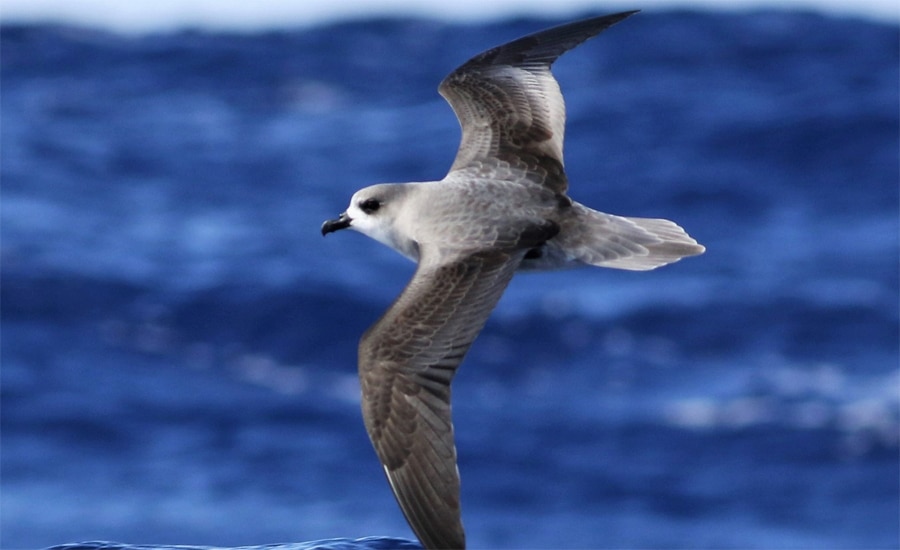
The Madeiran petrel population, an endangered seabird endemic to the Madeira archipelago, remains stable despite the 2024 fire threatening its nesting area, according to the Institute for Forests and Nature Conservation (IFNC).
“With the possibility that the fire could reach the main known nesting area, on 21 August 2024 five juvenile birds were removed from their nests and translocated to the Wild Birds Recovery Center (CRAS) in order to be cared for until a possible return to the nests,” the institute said in a note sent to Lusa.
The Madeiran petrel (Pterodroma madeira) nests in the mountains between Pico do Areeiro and Pico Ruivo, in the Eastern Mountain Massif of Madeira Island, and, that year, 112 nests were recorded, of which 72 were active, with a record of 30 hatchings.
By 2025, around 73 active nests were counted, with around 41 juveniles recorded.
“Although the August 2024 fires threatened the Madeiran petrel, the known population has remained stable, with reproductive success around 40-50%,” the Institute for Forests and Nature Conservation (IFNC) said.
The fire raged for 13 consecutive days, from 14 to 26 August, and covered an area of 5,116 hectares, across the municipalities of Ribeira Brava, Ponta do Sol, Câmara de Lobos (in the western area) and Santana (on the northern coast), where it reached the central mountain range.
The flames also consumed 139 hectares of laurisilva forest, which covers a total of 15,000 hectares and is UNESCO World Heritage, and, as they reached the island’s highest peaks, they threatened the nests of the Madeiran petrel, considered one of the world’s rarest seabirds.
The rescue of the five juveniles was coordinated by the Directorate of Nature Conservation Services, with the Nature Wardens Corps, teams of veterinarians in training at CRAS, and technicians from the LIFE Freiras project, which has been running since 2022 and aims to protect the species.
“Two days later [on 23 August], the birds were returned to their nests, with the fire extinguished in the area,” IFNC said, stressing that “the nests continued to be monitored and the juveniles followed until the season ended.”
The LIFE Freiras project also focuses on combating invasive plants around the Madeiran petrel nesting areas, namely gorse.
According to the IFNC, the body under the Regional Secretariat for Tourism, Environment and Culture, in 2023 and 2025 manual control was carried out on about 10 hectares, ensuring a 60% reduction of gorse and promoting the recovery of native vegetation in 57% of the area intervened.
“It was found that the soil seed bank is rich and durable, as after the removal of the gorse there was an increase from 15 to 88 in the rate of indigenous plants,” the institute explains, adding that the ground-level cutting strategy allows areas with no shade, with vegetation recovering from the soil’s natural seed bank.