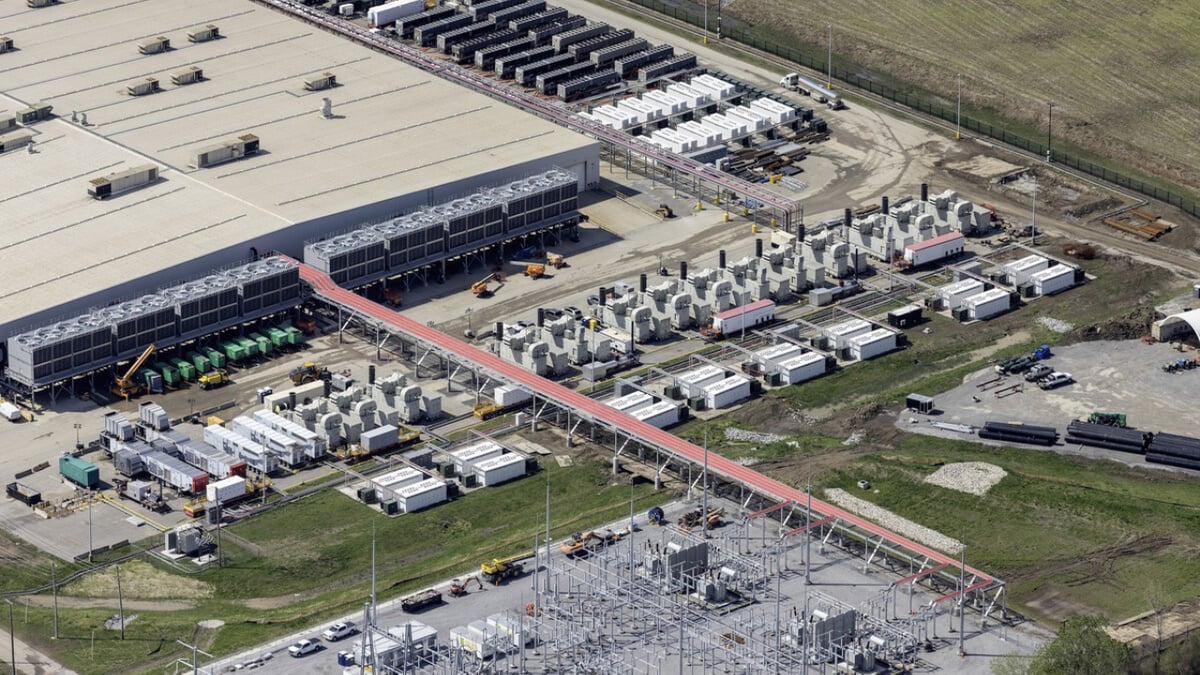
The race to build ever more powerful AI systems is forcing a reckoning with old-school infrastructure. In Memphis, a Musk-linked data operation has become a lightning rod for environmental and legal scrutiny. At the center is a sprawling array of gas-fired turbines feeding compute-hungry models, and a flurry of questions about missing permits.
A power build-out hidden in plain sight
According to the Southern Environmental Law Center (SELC), xAI assembled and commissioned at least 35 combustion turbines over the past year. Today, 26 are still running, joined by three larger units for a combined capacity around 407 MW. That’s utility-scale generation, parked beside racks of servers training next-wave models.
Aerial and thermal imagery commissioned by SELC reportedly show continued activity at the site, despite assurances the engines were strictly temporary. These findings align with on‑the‑ground accounts of steady industrial noise and visible logistics at the fenced compound.
[Image: Aerial photograph of the Memphis Colossus site, credit SELC]
[Image: Thermal image showing heat plumes above turbines, credit SELC]
When invisible pollution isn’t harmless
Memphis is already labeled the “asthma capital” of the United States, and every additional ton of pollution lands on vulnerable lungs. A 400 MW gas plant can emit more than 2,000 tons of NOx per year, a key precursor to smog and respiratory disease. Those emissions, while often invisible, exacerbate ER visits, missed school days, and long‑term morbidity.
This matters in a city where environmental burdens are not evenly distributed. Communities near industrial corridors tend to carry higher chronic risk, making incremental pollution far from an abstract statistic. In that context, a stealth energy build-out raises stark equity questions.
Reassurances that don’t quite land
Facing a surge of public concern, the Greater Memphis Chamber of Commerce offered a calming narrative. “The turbines are temporary and will be phased out within two months,” the Chamber stated in early May. The pledge hinged on swiftly connecting the data center to the local grid, with only a subset left for a Phase II expansion.
For nearby residents and environmental advocates, the assurances felt thin and conditional. They point to the months of operations without clear permits, the opacity around emissions, and the pattern of “build now, formalize later.” Trust, once strained, is hard to rebuild.
The AI arms race meets the grid’s hard limits
Training frontier models demands colossal electricity, squeezing grids already coping with extreme weather and aging assets. Some firms are rushing to self-supply with gas-fired peakers, renting time on the climate tab. The Colossus project exposes the blunt trade-offs between innovation velocity and public-interest guardrails.
When speed trumps process, costs shift to communities that don’t share the upside of speculative technology. That’s the heart of environmental justice: who benefits, who bears the burden, and who gets a say when lines are crossed.
What happens next
Federal and state authorities are reportedly reviewing the project’s regulatory status. SELC is weighing a formal complaint under federal clean air laws, which could bring substantial fines or mandated shutdowns. In parallel, grid interconnection and procurement timelines loom over any quick exit from on‑site generation.
The outcome will signal how regulators balance novel workloads against established law. It will also guide how data centers source power amid rising demand, tighter interconnection queues, and public pressure to decarbonize at pace.
Why this case matters
- It spotlights the true energy appetite of cutting‑edge AI, moving beyond vague sustainability pledges.
- It tests whether “temporary” fossil solutions gain de facto acceptance when projects outpace permitting.
- It underscores the health stakes in already burdened neighborhoods, where cumulative impacts are felt first.
- It previews the regulatory playbook for fast-scaling compute, from penalties to forced retrofits.
- It challenges tech leaders to align speed with transparent, lawful operations and local consent.
A turning point for energy-hungry intelligence
If the facts bear out, this saga may become a case study in how not to power next-generation AI. The lesson isn’t to halt innovation, but to align ambition with community health and legal compliance. Skipping permits might shave weeks off a build, but it can add years of reputational and legal drag.
The Memphis controversy is an early test of the industry’s social license in the age of autonomous systems. The market wants bigger models, but the public wants breathable air. If both are non‑negotiable, the path forward must be cleaner, clearer, and fully permitted.