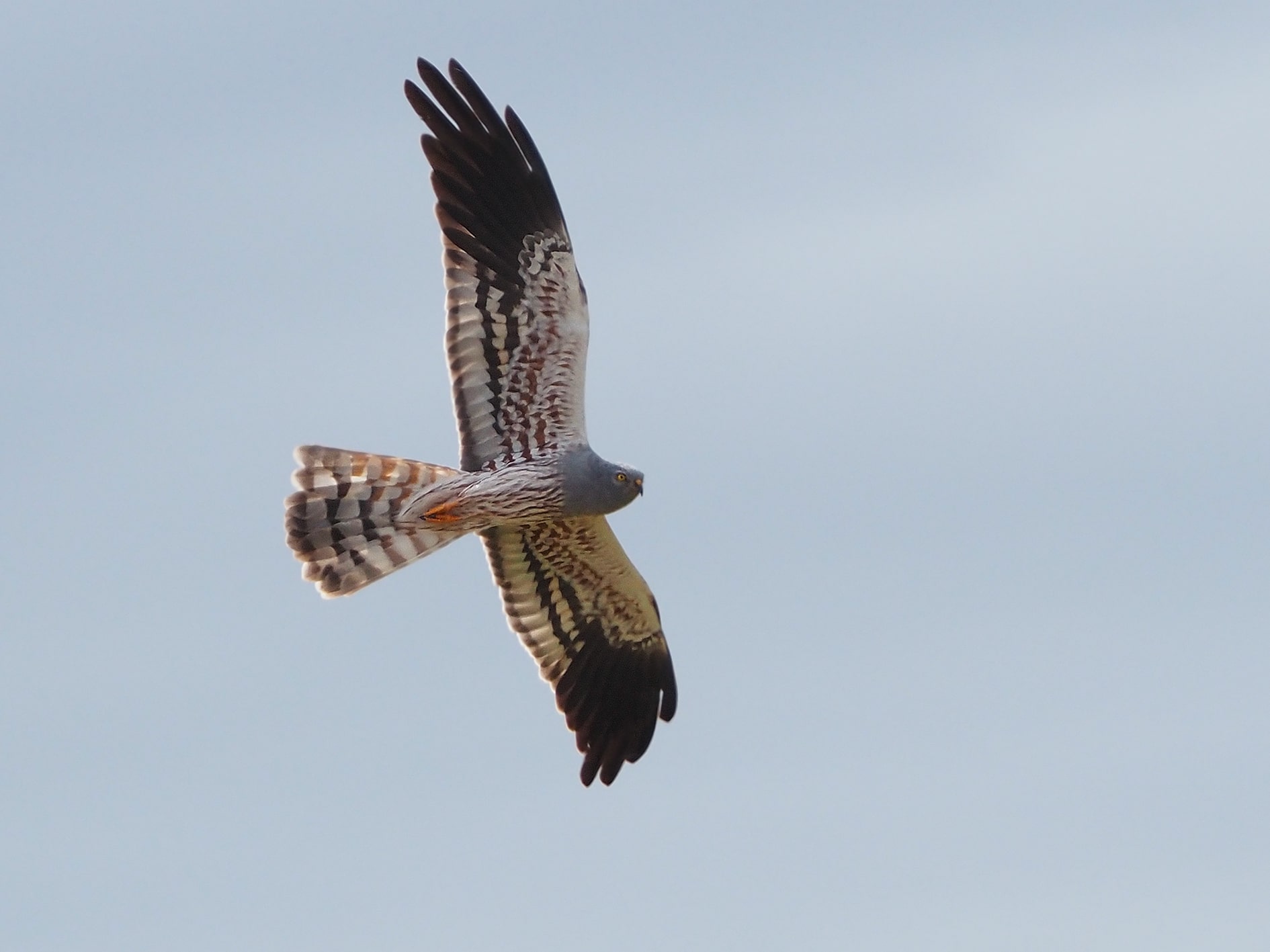
Users of the mobile application (app) for smartphones eBird, the world’s largest global platform for citizen science to record bird observations, can actively contribute to saving the Montagu’s harrier from extinction, according to a press release.
According to the same source, the LIFE SOS Pygargus project considers citizen involvement essential to protect this migratory species with an “Endangered” status in Portugal and calls on users of the app to register and share data about the Montagu’s harrier. These records are very important and directly contribute to the actions of the project’s annual campaign “Save the Montagu’s Harrier”, implemented by the project, and to conservation science and long-term better management of the species.
The Montagu’s harrier (Circus pygargus) is at the brink of extinction. Its population has declined by about 80% in Portugal, during the period 2012-2022, and 30% in Spain, between 2006 and 2017, with a downward trend. It therefore becomes highly a priority to collect updated information on its distribution, characterize its breeding and feeding habitats, and identify threats that compromise its reproductive success and productivity.
The Montagu’s harrier is a migratory bird, which winters in sub-Saharan Africa and spends spring and summer on the Iberian Peninsula, where it nests and remains from March to September. The first birds of this species have already begun to arrive in Portugal and Spain, and everyone can contribute observation data of individuals, pairs and/or nests.
How to help?
During the breeding period, from March to August, if you go into the field and observe an individual of this species, a pair or a nest (constructed on the ground in fields with cereals/fodder or scrubland areas in mountainous regions), it is essential that: log the observation in eBird (don’t have the app yet? Download from the App Store or Google Play); send the project team information about nests and nesting sites (the GPS coordinates indication is essential), as well as additional relevant information, such as photographs, videos or detailed field notes, through the “Record Observation” form available here; and log the checks of color-banded birds.
There is a nationwide campaign underway in the national territory to monitor the Montagu’s harrier using PVC color-banding reads. Juveniles and adults of this species are marked with a metal ring and a dark-green PVC ring with a three-character white alphanumeric code (letters and/or numbers). In males, the colored ring is placed on the right leg, and in females on the left leg. Data relating to Montagu’s harrier ring checks should be reported here.
Nests and injured or dead birds: how to proceed?
In the case of nests, whenever detected, as well as if threats to the species/nest are identified, such as agricultural activities, fires, predation risk, among others, you should immediately report to the project team (see the map with mobile phone numbers and e-mail contacts by area of operation here).
If you find a wounded or dead bird, do not touch, remove or alter the position of the individual or carcass, unless instructed by authorities. Contact immediately the SOS Environment and Territory Hotline (+351 808 200 520) of the Nature and Environment Protection Service of the National Republican Guard (SEPNA/GNR). If you are in Spain, contact the Servicio de Protección de la Naturaleza – SEPRONA (062) of the Guardia Civil.
How to best register Montagu’s harrier data in eBird?
Whether complete checklists or casual observations, the recording of individuals of this species in the app eBird should be done as follows:
1. Use the Age and Sex Table to characterize all individuals present;
2. Use the “Details” field to describe the morphotype (physical characteristics, such as color, size, etc.) of the bird;
3. Enter the highest nesting code observed on each visit;
4. Describe in detail relevant behaviors that do not have a specific code (kleptoparasitism, interactions with habitat, with other individuals of the same species or with other bird species, etc.);
5. Add photos that help characterize the observed individuals and the habitat;
6. Log the presence of predator-prone species, including domestic or wild mammals and other birds (raptors, corvids and storks);
7. Log and document other species of the genus Circus, namely blue‑harrier (Circus cyaneus) and marsh harrier (Circus aeruginosus). If it is not possible to identify the species, the record should be made as Circus sp, describing in the “Details” field the observed characteristics that may contribute to its identification;
8. In this species, there are observed pairs with behaviors compatible with polygyny (where one male mates with several females) and polyandry (where one female mates with several males), so any behavior that suggests this possibility should be described in the “Details” section;
9. In the case of birds during migration or long-distance movement, follow them as long as possible and indicate the direction of flight (cardinal point);
10. Link your records to “Personal Observation Points,” which should be omitted if they contain sensitive information about the occurrence of the species.
More detailed information about the species, such as identification, specific behaviors, plumage variations and morphology, among others, is available in an expanded article published on the eBird platform, as well as on the project’s website and the project’s Facebook and Instagram pages.
More than a record: become a “Friend of the Montagu’s Harrier”
Saving the Montagu’s harrier from extinction on the Iberian Peninsula “is a Herculean task that requires great efforts and, above all, citizen and multi-stakeholder collaboration.” Therefore, the LIFE SOS Pygargus project created the “Friends of the Montagu’s Harrier” Network, to which everyone can join.