A thermal giant built from salt
Denmark’s latest energy feat is a record-shattering milestone built around a molten-salt “monster.” This grid-scale system is engineered to deliver steady power equivalent to 100,000 homes for 10 hours. The result is a bold template for how nations can bank variable renewables at industrial scale. Backed by rigorous engineering, the platform transforms affordable materials into reliable energy security.
How the molten‑salt battery works
The core is a high‑temperature thermal battery that stores electricity as heat rather than in electrochemical cells. Surplus wind and solar are converted to thermal energy at roughly 600°C and held in insulated tanks. The medium is a hydroxide salt, a chlorine‑industry byproduct that is abundant and low‑cost. When demand climbs, hot salt feeds a steam generator that can drive turbines or supply process heat. This dual‑use design maximizes round‑trip value by serving both electricity and industry.
- Up to 90% efficiency for direct industrial heat
- Roughly 80–90% efficiency in combined heat and power
- About 40% efficiency for electricity‑only mode
- Storage durations reaching two weeks in appropriately sized systems
- No critical metals, no toxic chemistry
- Non‑flammable, recyclable salt compatible with a circular economy
From pilot to scale in Danish industry
Real‑world validation arrived with the MOSS demonstrator in Esbjerg, which began operations in April 2024. Hyme Energy, working with Sulzer, is now scaling to a 200 MWh site in Holstebro. That facility is poised to become the world’s largest industrial thermal storage system dedicated to green heat. Early customers include Arla Foods, which expects about €3 million in annual savings from heat delivered on demand.
“This is not just a battery; it’s a bridge between electricity and heat that industry can actually use.”
Engineering that tames extreme heat
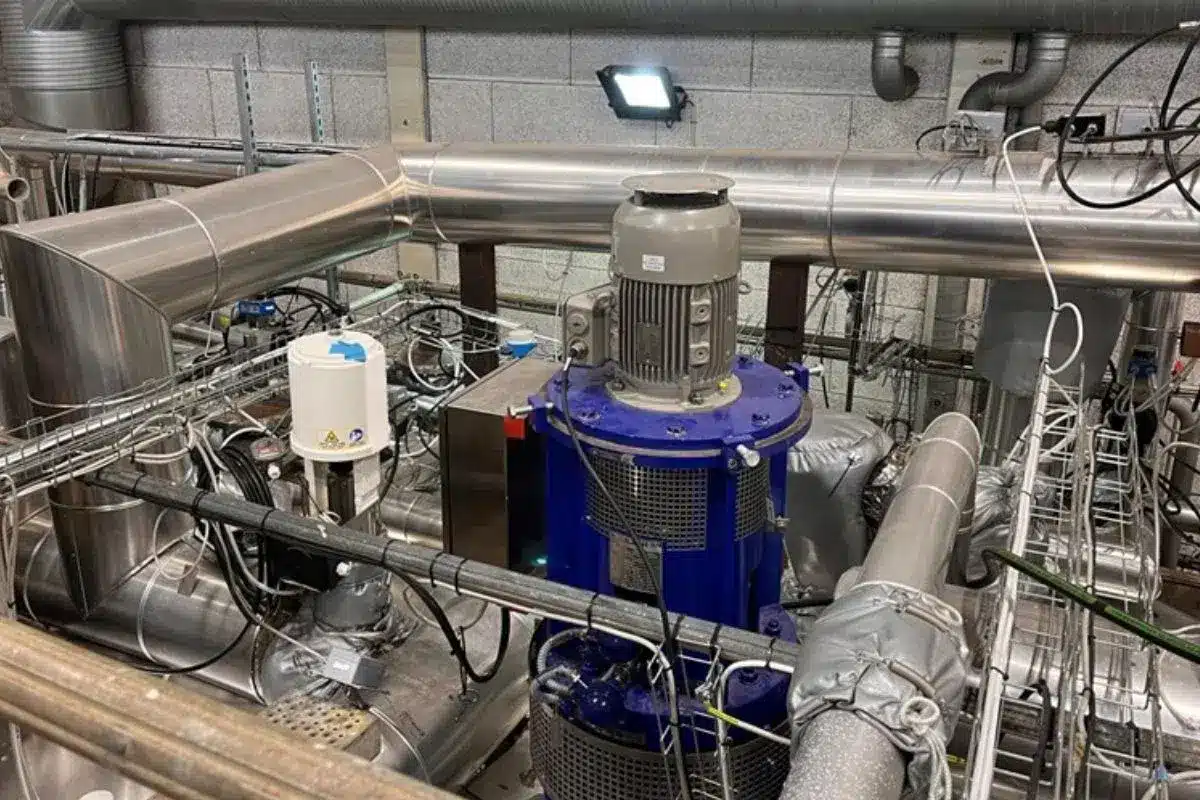
The project’s backbone is Sulzer’s expertise with super‑hot fluids, honed in large solar‑thermal projects. Specialized pumps maintain reliable salt circulation under intense heat and corrosive conditions. Materials science mitigates corrosion, while precision insulation slashes thermal losses. Robust containment keeps the salt stable over long durations without safety compromise.
Why this solves a stubborn climate problem
Industrial heat is one of the hardest sectors to decarbonize because it demands constant, high‑grade energy. By storing renewable output as heat, this system bypasses the inefficiency of converting back and forth to electricity. It also avoids scarce metals, hazardous chemistry, and fire risk common to certain battery types. The result is a safer, scalable platform for factories, district heating, and combined heat‑and‑power hubs. It complements wind and solar by turning surplus into firm capacity without fossil backup.
Economics, safety, and grid flexibility
The salt is inexpensive and recyclable, shrinking lifecycle costs while supporting a European supply chain. Long lifetimes and minimal performance fade can lower total cost of ownership in heat‑intensive industries. Non‑flammable media improves safety and siting flexibility near urban loads. Operators can monetize flexibility services, from peak shaving to reserve markets and district‑heat arbitrage that upgrades system‑wide efficiency.
A blueprint Denmark can export
Denmark’s model reframes storage as an energy‑services stack rather than a one‑size battery for electrons alone. It addresses real‑world needs: industrial steam, process heat, and flexible power during peaks. With a robust European supply chain, the approach can be replicated at thousands of sites. Each deployment displaces fossil boilers, stabilizes renewable grids, and unlocks new revenue for clean‑energy assets. By pairing pragmatic engineering with abundant materials, Denmark is charting a credible pathway to deep decarbonization at industrial scale.
What comes next
Integration with heat pumps and electric boilers can lift round‑trip efficiency and widen use‑cases. Smarter controls will optimize dispatch across electricity, steam, and district‑heat loops. As modules scale, durations and outputs can be tailored to diverse industrial profiles. The lesson is clear: when storage speaks the language of heat, renewable energy finally meets heavy industry on its own terms.