Marine life in the depths of the ocean may take decades to recover from the impact of deep-sea mining for rare metals, according to an investigation.
A study published in the journal ‘Nature’ concluded that the site of a deep-sea mining test conducted in 1979 in the North Pacific still showed lower biodiversity — the variety of species — than neighboring undisturbed sites, 44 years later.
The investigation was conducted in 2023 and 2024, 5,000 metres below the surface of the Pacific Ocean, in the Clarion-Clipperton Zone. This zone lies roughly halfway between Mexico and Hawaii and is a vast, flat and deep region of the seafloor, known as the “abyssal plain”.
The scientists from the National Oceanography Centre in Southampton conducted the investigation as part of a consortium that includes the Natural History Museum in London, the British Geological Survey and Heriot-Watt University in Edinburgh, the Joint Nature Conservation Committee, the Scottish Association for Marine Science in Oban, Argyll, the University of Liverpool, the University of Plymouth and the University of Southampton.
The partners are part of Seabed Mining and Resilience to Experimental Impact (SMARTEX), a UK Natural Environment Research Council-funded research project. SMARTEX was created to determine the ecological impact, in the central Pacific Ocean, of deep-sea mining of deposits known as nodules, which contain rare metals such as cobalt, manganese and nickel, essential elements for the batteries of electric vehicles and other electronic devices.
Mark Hartl, a marine biologist at Heriot-Watt University, specializing in ecotoxicology — the way organisms are exposed to pollutants and suffer their impact — is part of the SMARTEX consortium and is a co-author of the research.
The researcher explains that “these nodules are potato-sized mineral deposits that have accumulated in layers over thousands of years. Mining companies want to extract them to obtain essential metals such as cobalt and nickel. But there are many unanswered questions. For example, we know that nodules produce oxygen. If removed, will this reduce the amount of oxygen in the deep sea and affect the organisms that live there? What is the effect of exposing animals to sediment plumes containing metals stirred up during the mining process? These are some of the questions we are trying to answer.”
Hartl’s role involved investigating how depth-dwelling organisms are affected by exposure to sediments and the stress associated with them, to help quantify the less obvious impacts of deep-sea mining. In this context, he developed a procedure to measure how mining activity can damage the DNA — the genes — of deep-sea fish. This work was published in Deep Sea Research.
“This has never been done before,” explains Hartl, “so we didn’t have baseline data to compare the effects of mining. We are currently optimizing the tests for other stress signals applicable to the deep sea,” he adds.
It is estimated that more than 21 billion tonnes of nodules lie on the seabed of the Clarion-Clipperton Zone, which extends over more than 6 million square kilometres — about 25 times the size of the United Kingdom.
These nodules fields sustain “highly specialized animal and microbial communities,” say the researchers. These include giant single-celled organisms with calcareous shells (foraminiferans); sea cucumbers and highly specialized fish — and many species that depend on nodules as the only hard surface on which they settle.
The researchers studied an area on the ocean floor where an experimental mining machine 14 metres long was placed in March 1979. It mined an unknown amount of nodules for four days, using a rotating mechanical rake on the seafloor that picked up nodules and transferred them along a conveyor to a crusher.
The scientists conclude that, four decades after this mining test, “the biological impacts on many groups of organisms are persistent,” although some species have begun to recover.
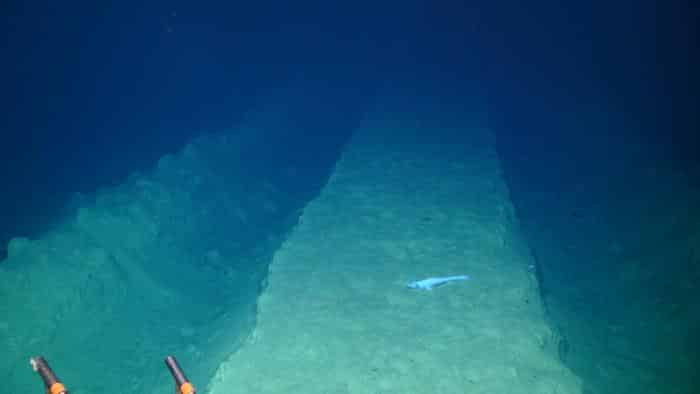
The physical traces of the test are also still visible, including areas of the seafloor stripped of nodules and visible marks of the mining vehicle’s trail.
The lead author of the study and head of the expedition, Professor Daniel Jones of the National Oceanography Centre, explains that “to address the crucial question of recovery from deep-sea mining, we first have to look to the past and use old mining tests to help understand long-term impacts. Forty-four years later, the trails of mining look very similar to what they were when they were first made, with an eight-metre-wide strip of seabed devoid of nodules and two large grooves on the seabed where the machine passed. The abundance of many animals was reduced within the trails, but we saw some of the first signs of biological recovery.”
Co-author Adrian Glover, of the Natural History Museum, reveals that the “general ecological theory predicts that, after a disturbance, any ecosystem will go through a series of successive recolonization and growth phases. However, up to this study, we had no idea of the time scales of this critical process in deep-sea mining regions, nor how different parts of the community respond in different ways.”
“Our results do not answer whether deep-sea mining is socially acceptable, but they provide the data needed to make more informed policy decisions, such as the creation and improvement of protected areas and how to monitor future impacts,” he adds.
Deep-sea mining is currently prohibited under an international moratorium — a suspension — while the International Seabed Authority (ISA) — which regulates and manages all mineral-related activities on international seabed areas — develops the legal, financial and environmental framework to support any potential commercial exploitation when it occurs. A key question for this decision is whether deep-sea ecosystems can recover from disturbances caused by mining activity, says the National Oceanography Centre.
The National Oceanography Centre adds that deep-sea mining is increasingly being considered as a potential solution to supply the crucial metals needed to advance global technology and to drive the transition to a zero-emission future.
In the Nature article, the researchers explain that nodules extraction would cause “immediate impacts” on the seabed surface and habitat in the path of the collecting vehicles. This impact includes mechanical disturbances, namely the removal of hard surface spaces that species live under the seabed and the compaction of sediments. Another impact is the creation of sediment plumes that can have “significant impacts on ecosystems” beyond the mined areas, they state.