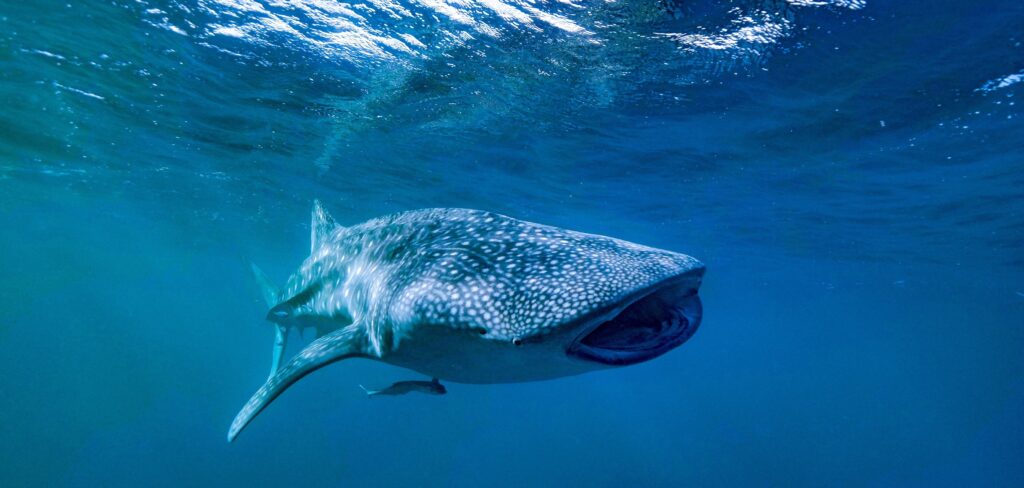
The whale sharks, the largest fish on the planet, rely on a surprising variety of strategies to find food, feeding on small prey at different depths of the ocean. The finding comes from a study led by the Australian Institute of Marine Science (AIMS) and Murdoch University in Australia, which identified 36 distinct behaviors of the species, the most comprehensive catalog ever compiled.
The investigation combined imagery collected via cameras installed on the dorsal fins of five whale sharks observed at Ningaloo Reef, along the western coast of Australia, with an analysis of around one hundred scientific articles published about the species.
Despite their impressive size, the whale sharks (Rhincodon typus) feed mainly on plankton and small marine organisms, such as copepods, capturing them through a filtration feeding system.
Of the 36 behaviors described by the researchers, 12 are related to foraging. Six of these behaviors are new to science. Among them is the so-called “slow-sliding feeding,” in which the animal descends slowly in the water column with its mouth open, capturing prey as it sinks, and the “diving feeding,” which consists of an active descent toward the seabed, collecting food along the way.
According to Christine Barry, the study’s lead author and a PhD student at AIMS and the Harry Butler Institute of Murdoch University, the results show that whale sharks exhibit a diversity of feeding behaviors greater than that observed in other large marine filter feeders, such as baleen whales or basking sharks.
“It is not surprising that the largest fish in the oceans is so focused on feeding, given that it eats some of the smallest prey in existence. What we did not know was the number of different strategies it uses to do so,” says the researcher.
The scientist adds that this flexibility allows whale sharks to take advantage of feeding opportunities in different environments and conditions, an important advantage in tropical waters, where food resources tend to be more dispersed and unpredictable.
Images captured by the cameras revealed that slow-sliding feeding behaviors are the most frequent, having been recorded at all observed depths.
For Luciana Ferreira, a researcher at AIMS and co-author of the study, the results also reinforce the ecological importance of Ningaloo Reef, one of the world’s main whale shark aggregation areas.
“These findings show that Ningaloo functions as a safe pantry for whale sharks and reinforce the importance of maintaining protection of this ecosystem,” she notes.
The study was published in the scientific journal Marine Biology and also involved researchers from the University of Western Australia, California State University and Macquarie University.