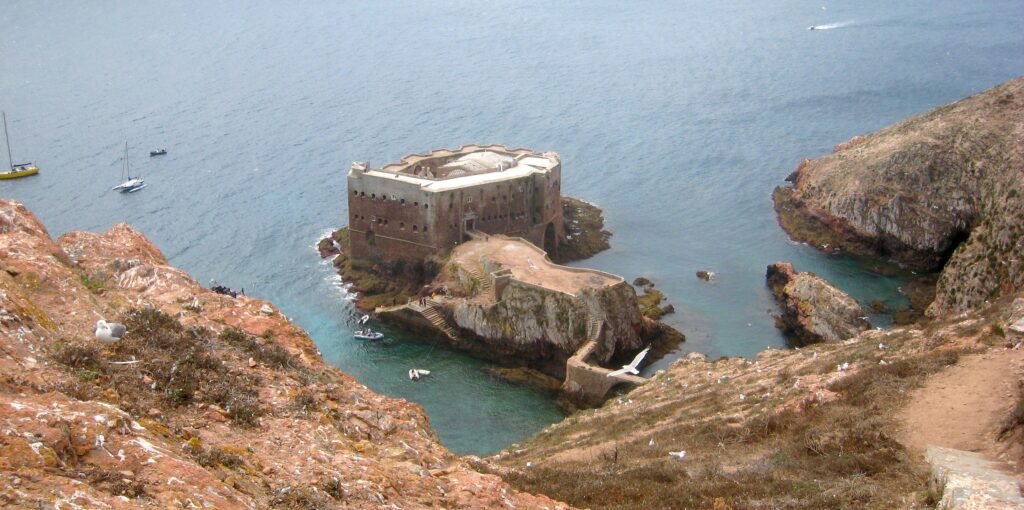
The Government has assigned Special Area of Conservation status to the Berlengas archipelago, off Peniche, establishing conservation measures and prohibiting activities, in accordance with the decree-law published today in the Official Journal.
The legal regime for habitat conservation provides “a special protection, specifically directed at maintaining or restoring the favorable conservation status of natural or semi-natural habitat types and of wild species populations with significant presence in that zone,” in accordance with the decree-law.
The objective is “to contribute to the maintenance or restoration of the favorable conservation status, in the Mediterranean biogeographic region, of the habitat types and species defined in the management plan,” including the cliffs with vegetation along the Atlantic and Baltic coasts and the species ‘Armeria berlengensis’ and ‘Herniaria lusitanica subsp. Berlengiana’.
The introduction into nature and the restocking of any non-native terrestrial flora and fauna species are prohibited, as is trampling vegetation and movement off designated trails, paths or other spaces intended for this purpose, access to the islets, collection, disturbance, deterioration, destruction or detention of individuals or specimens of species of fauna and flora subject to legal protection measures and deterioration or destruction of habitats of fauna and flora species or habitat types, still in accordance with the decree.
The Natura 2000 Network is an European ecological network, consisting of Special Protection Areas (SPA), to guarantee the conservation of bird species, and Special Areas of Conservation (SAC), to ensure the conservation of flora and fauna species.
To comply with the directive, member states are obliged to designate sites according to these two designations.
The Berlengas archipelago was classified in 2011 as a UNESCO World Biosphere Reserve (United Nations Educational, Scientific and Cultural Organization), has held natural reserve status since 1981, has been a Natura 2000 site since 1997 and was designated as a Special Protection Area for Birds in 1999.
The archipelago stands out for its biodiversity, with coastal and underwater habitats, rare endemic species (such as Armeria berlengensis) and protected seabird populations such as the airo, the cagarra and the crested cormorant.