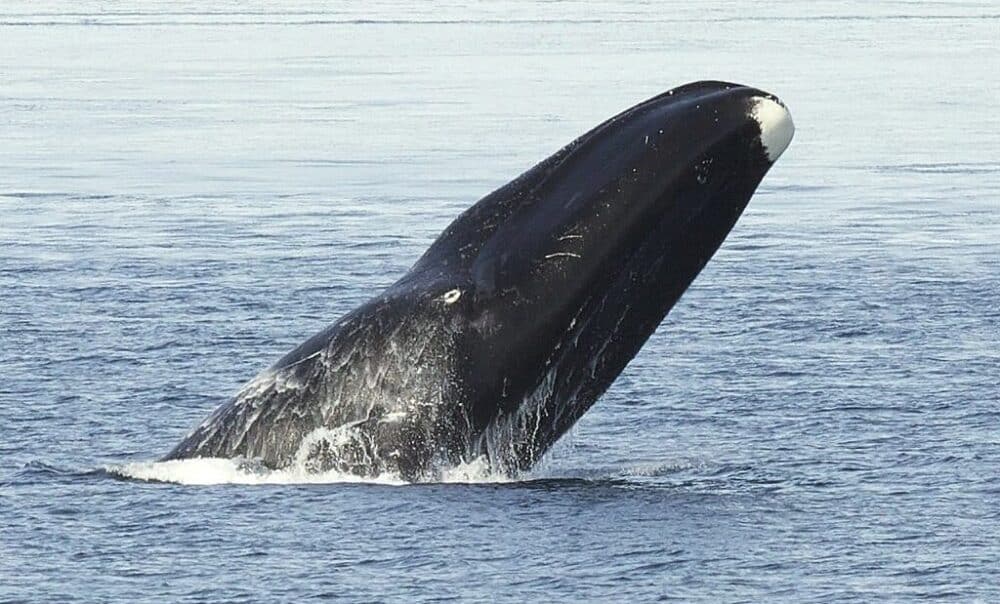
The rise in water temperature in the Arctic seas is altering the behaviors of Greenland right whales (Balaena mysticetus) and causing them to spend more time in ship transit areas, increasing the risk of collisions.
A study led by Oregon State University, in the United States of America, in collaboration with the U.S. National Oceanic and Atmospheric Administration (NOAA), reveals that the population of this whale species that inhabits the Arctic region linking to the Pacific and migrates through the Bering Strait is departing for wintering grounds later and later.
These whales migrate annually between the Bering and Beaufort seas, and their population has been increasing, even to levels higher than those before commercial whaling. However, due to climate change, in 2022 the whales left their summering areas in the cold Arctic waters six weeks later than in 2008.
Based on acoustic records to monitor the movement of these marine mammals, scientists have found that some whales are moving further north, to the Chukchi Sea, where they say human maritime traffic is increasing. Others no longer even cross the Bering Strait, choosing to spend the winter in the increasingly warm Arctic waters.
Thus, in an article published in Geophysical Research Letters, they say that the risk of collisions between whales and ships is increasing, which could be exacerbated as the ice recedes and allows ships to sail farther and for longer periods throughout the year.
“A change like this may not necessarily be bad for the whales,” says Angela Szesciorka, the study’s first author, since it means the animals do not have to undertake long migrations that consume a lot of energy and expose them to other dangers. However, “whenever we see an overlap between whales and maritime traffic we should be concerned,” she adds.
The team also supported their work with the traditional knowledge of Arctic Indigenous communities, who say that the Greenlandic right whales’ migration patterns have changed in recent years.
“As sea ice continues to shrink, ship traffic, especially large commercial vessels that can go much farther than smaller fishing boats, will only increase,” warns Szesciorka, who argues that “it’s better to start thinking about these things sooner rather than later so that we can avoid problems,” favoring a preventive rather than reactive approach.
“We have seen these changes in migration patterns in just nine years. For a species that can live up to 200, this is very notable. It shows that they can adapt, for now, to changes in their environments. But there will come a point where they won’t be able to adapt anymore? We have to wait and see,” argues the researcher.